 Bug FAQ
Yellow-faced Blowfly
Cynomya mortuorum · Order: Diptera · Family: Calliphoridae
Also called: bluebottle blow fly
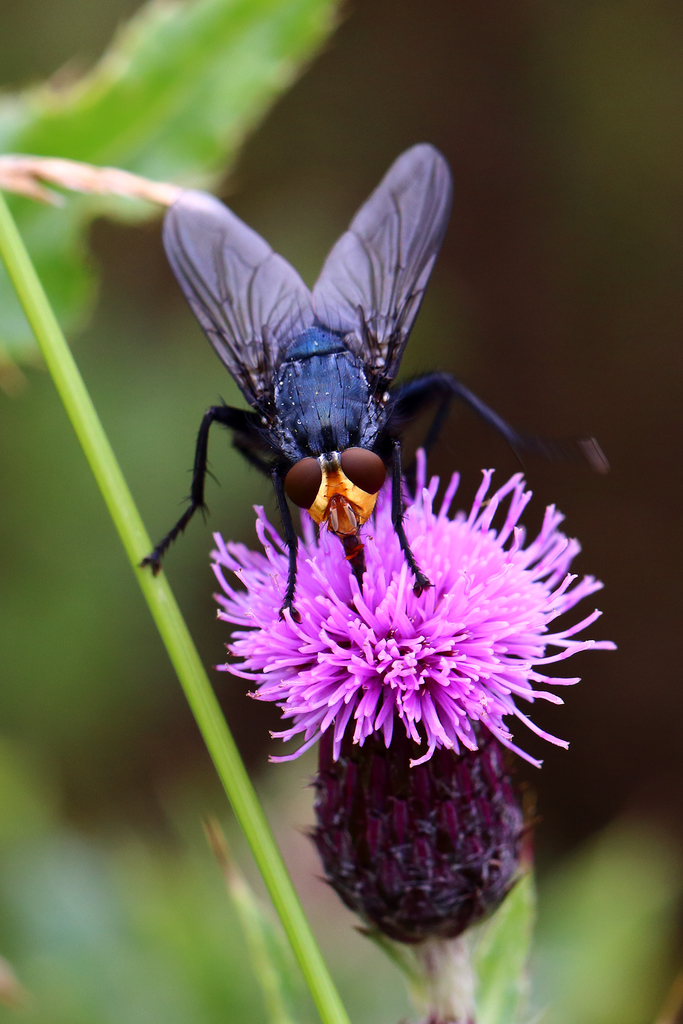
The yellow-faced blowfly has a bluish-green body with bright yellow to orange cheeks and parafacial areas, and only one postacrostichal seta distinguishes it from its close relative C. cadaverina. It lives on woodland edges and meadows with flowers across northern Europe, northern North America and east to Turkestan, especially in Norway and Finland. Adults feed on pollen while females lay eggs on carrion; the life cycle takes about 38 days and includes egg, three larval stages, pupa and adult.
Source: Wikipedia
How to recognize it
The fly is bluish-green like other Calliphoridae but has bright yellow to orange cheeks and parafacial setae, unlike C. cadaverina which has dark cheeks. It has only one postacrostichal seta, while C. cadaverina has two.
Source: Wikipedia
Where it lives
Found on woodland edges, meadows and other flower-rich places in Europe and Asia.
Source: Wikipedia
What it eats
Adults feed on pollen. Females lay eggs on carrion, providing food for the developing larvae.
Source: Wikipedia
Life cycle
The development from egg to adult takes about 38 days. The life cycle includes egg, three larval instars, a pupal stage and the adult (imago).
Source: Wikipedia
When you see it
As a cold-weather species, it is most commonly seen in the fall months.
Source: Wikipedia
Where it comes from
Occurs in northern parts of Europe and North America and extends east to Turkestan. Populations are strongest in Norway and Finland and less common in the United States and the Iberian Peninsula.
Source: Wikipedia
Lookalikes
The two commonly confused species are C. mortuorum and C. cadaverina; they differ in cheek colour and the number of postacrostichal setae.
Source: Wikipedia
Where it is found in the US
Recorded in 1 of 51 states and DC. Most records: Alaska.
Darker = more records. Counts are museum and citizen-science records, not population size.
Source: GBIF
Months it is reported in the US
Source: GBIF
More photos
Questions people ask
How can I tell this blowfly apart from similar species?
Look for bright yellow to orange cheeks and only one postacrostichal seta; C. cadaverina has dark cheeks and two setae.
Source: Wikipedia
When are yellow-faced blowflies active?
They are a cold-weather fly and are most often seen in the fall months.
Source: Wikipedia
Where might I find this species?
They live on woodland edges, meadows and other flower-rich habitats in northern Europe, northern North America and east to Turkestan, especially in Norway and Finland.
Source: Wikipedia
Same family (Calliphoridae)
 Common European Greenbottle FlyLucilia sericataNuisance, not dangerous
 Blue BlowflyCalliphora vicinaCan spread germs or disease
 Black Blow FlyPhormia reginaNuisance, not dangerous
 Oriental Latrine FlyChrysomya megacephalaCan spread germs or disease
 Australian Sheep Blow FlyLucilia cuprinaNuisance, not dangerous
 Locust BlowflyStomorhina lunata
Sources
- Wikipedia: https://en.wikipedia.org/wiki/Cynomya_mortuorum
Look it up elsewhere: GBIF · iNaturalist · BugGuide · ITIS · Wikipedia
Text written 2026-10-23 from the sources above and checked sentence by sentence against them. Data fetched 2026-10-22.