 Bug FAQ
Black Blow Fly
Phormia regina · Order: Diptera · Family: Calliphoridae
Also called: Black Blowfly
Source: UC IPM
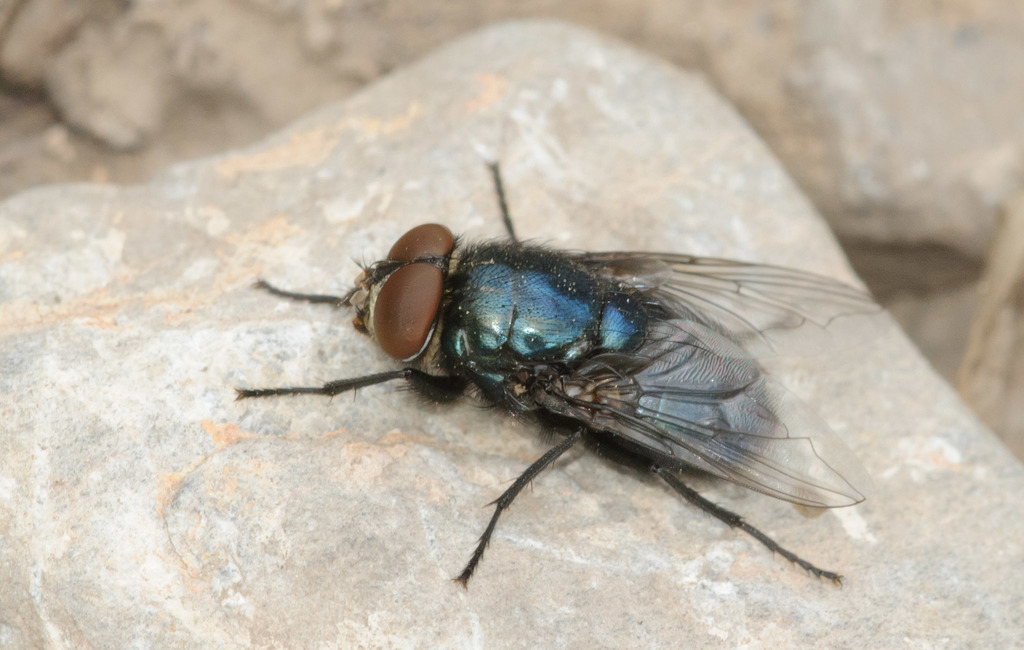
Adult black blow flies are metallic blue or green with orange hairs near the front thorax and a black face area (gena). Females lay eggs on carrion or animal waste, and the larvae feed on the decaying material through three growth stages before pupating. They are common across the United States, especially in rural areas near water, and are most active in spring and summer in the north.
Source: Wikipedia
How to recognize it
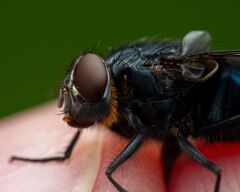
Adults have a shiny metallic blue or green body with orange setae around the front thoracic spiracle and a black gena.
Is it a pest in the house?
They breed in animal waste, decaying organic matter, and are strongly attracted to human food and garbage.
Source: UC IPM
How to get rid of it
Removing breeding sites such as decaying waste is the most effective control method. If sanitation fails, targeted insecticide use can be considered.
Source: UC IPM
Where it lives
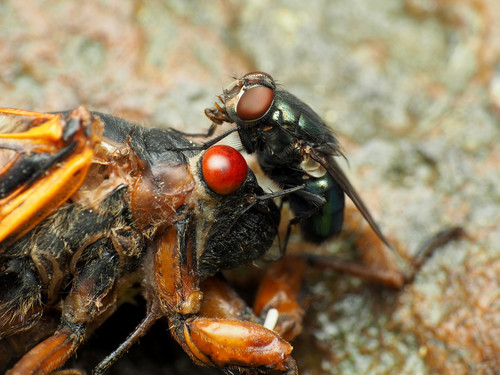
They are found on human corpses, animal carcasses, feces, and other decaying organic material. In the San Francisco Bay Area they prefer rural sites near water rather than urban settings.
Source: Wikipedia
What it eats
Females deposit eggs on carrion where the larvae hatch and feed on the tissue.
Source: Wikipedia
Life cycle
Eggs are laid on a nutrient source, and larvae pass through three instars, each separated by a molt.
Source: Wikipedia
When you see it
They are most common in the northern U.S. during spring and summer, moving southward in winter.
Source: Wikipedia
Where it comes from
The species occurs throughout the United States and other parts of North America.
Source: Wikipedia
Lookalikes
Their larvae look and behave like house-fly larvae, making identification difficult for the untrained.
Source: UC IPM
Where it is found in the US
Recorded in 49 of 51 states and DC. Most records: California, Virginia, Arizona, Pennsylvania, Maryland, Missouri, Massachusetts, Texas.
Darker = more records. Counts are museum and citizen-science records, not population size.
Source: GBIF
Status: native in North America; native in Canada. Source: iNaturalist
Months it is reported in the US
Source: GBIF
More photos

Questions people ask
Why are they attracted to my kitchen?
They are drawn to food scraps and garbage, which provide breeding sites.
Source: UC IPM
How can I get rid of them?
Clean up animal waste and decaying food, and consider insecticides if sanitation alone does not work.
Source: UC IPM
Same family (Calliphoridae)
 Common European Greenbottle FlyLucilia sericataNuisance, not dangerous
 Blue BlowflyCalliphora vicinaCan spread germs or disease
 Oriental Latrine FlyChrysomya megacephalaCan spread germs or disease
 Australian Sheep Blow FlyLucilia cuprinaNuisance, not dangerous
 Locust BlowflyStomorhina lunata
 Orange-bearded Bluebottle FlyCalliphora vomitoria
Sources
- UC IPM: https://ipm.ucanr.edu/PMG/PESTNOTES/pn7457.html
- Wikipedia: https://en.wikipedia.org/wiki/Phormia
Look it up elsewhere: GBIF · iNaturalist · BugGuide · ITIS · Wikipedia
Text written 2026-10-22 from the sources above and checked sentence by sentence against them. Data fetched 2026-10-22.