 Bug FAQ
Oriental Latrine Fly
Chrysomya megacephala · Order: Diptera · Family: Calliphoridae
Also called: Blow fly, Oriental Blue Fly
Source: Wikipedia

The Oriental latrine fly is a metallic blue-green fly with large red eyes; females lay many eggs on feces, meat or fish. It thrives in warm climates, develops from egg to adult in about 10 days, and lives roughly a week as an adult.
Source: Wikipedia
How to recognize it
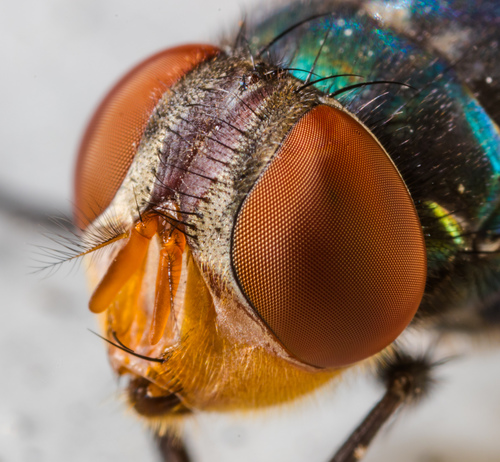
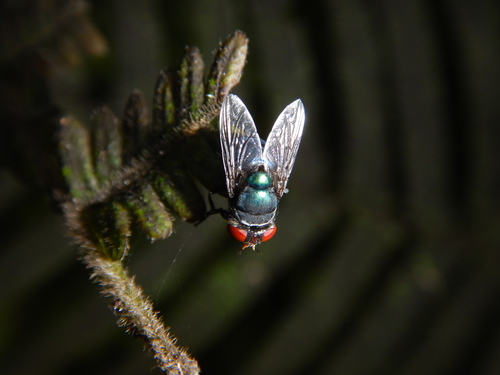
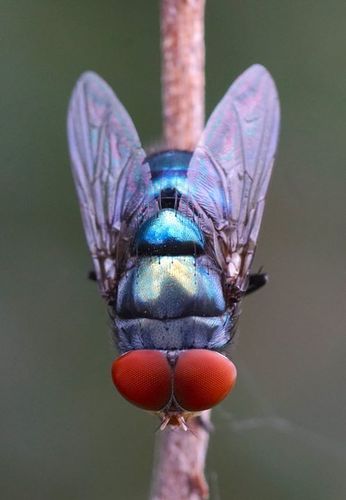
It has a greenish-blue metallic, box-like body and large red eyes that are close together in males and farther apart in females.
Source: Wikipedia
Size
Adults show a metallic blue-green thorax and abdomen with yellow cheeks. Larvae become thicker toward the rear and change size with each instar.
Source: Wikipedia
Is it a pest in the house?
It can cause accidental secondary myiasis by entering open wounds. It creates large economic problems in Asia, Africa and the Pacific.
Source: Wikipedia
Does it bite or sting?
It is linked to myiasis and can infect fish and livestock.
Source: Wikipedia
How to get rid of it
Traps using odors that attract the flies can reduce their numbers. Insecticides are used but can lead to resistance.
Source: Wikipedia
Where it lives
It has been recorded in California, Texas, Louisiana and Hawaii. The species is synanthropic, living closely with humans, and likely originated from Papua New Guinea.
Source: Wikipedia
What it eats
Females can lay 200-300 eggs, often depositing them in human feces, meat or fish.
Source: Wikipedia
Life cycle
The life cycle includes egg, larva and pupa stages. Adults live about seven days.
Source: Wikipedia
When you see it
Warmer temperatures increase its reproductive output. At 27 °C, eggs hatch in 18 h, the first molt occurs at 30 h, the second at 72 h, pupation at 144 h, and adults emerge around 234 h.
Source: Wikipedia
Where it comes from
Its native range is the Oriental and Australasian realms, also extending into Japan and the Palearctic region.
Source: Wikipedia
Lookalikes
Second and third instar larvae of Chrysomya rufifacies prey on C. megacephala larvae when food is scarce or density is high. Research is ongoing to assess its role as a vector for diarrhoea-causing bacteria like E. coli.
Source: Wikipedia
Where it is found in the US
Recorded in 17 of 51 states and DC. Most records: Texas, Florida, California, Hawaii, Louisiana, Georgia, South Carolina, Mississippi.
Darker = more records. Counts are museum and citizen-science records, not population size.
Source: GBIF
Status: introduced in North America; introduced in United States. Source: iNaturalist
Months it is reported in the US
Source: GBIF
More photos

Questions people ask
How can I get rid of them?
Use odor-baited traps and, if needed, insecticides, though resistance may develop.
Source: Wikipedia
Where are these flies found?
They are common in warm regions, especially the Oriental and Australasian realms, and have been reported in several US states and Hawaii.
Source: Wikipedia
Same family (Calliphoridae)
 Common European Greenbottle FlyLucilia sericataNuisance, not dangerous
 Blue BlowflyCalliphora vicinaCan spread germs or disease
 Black Blow FlyPhormia reginaNuisance, not dangerous
 Australian Sheep Blow FlyLucilia cuprinaNuisance, not dangerous
 Locust BlowflyStomorhina lunata
 Orange-bearded Bluebottle FlyCalliphora vomitoria
Sources
- Wikipedia: https://en.wikipedia.org/wiki/Chrysomya_megacephala
Look it up elsewhere: GBIF · iNaturalist · BugGuide · Wikipedia
Text written 2026-10-22 from the sources above and checked sentence by sentence against them. Data fetched 2026-10-22.