 Bug FAQ
Blue Blowfly
Calliphora vicina · Order: Diptera · Family: Calliphoridae
Also called: Blow Fly, Common Blow Fly, Common Bluebottle
Source: UC IPM

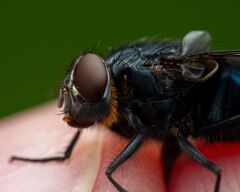
The blue blowfly (Calliphora vicina) is a 10 to 11 mm metallic blue-gray fly with bright orange cheeks that lives in urban areas across the U.S. and Europe. Females lay up to 300 eggs on carrion or wounds; larvae develop through three instars, hatching in about a day, and the species can produce five generations per year at warm temperatures. It is most common in cooler weather, especially winter, and can spread disease agents from garbage or animal feces onto human food.
How to recognize it
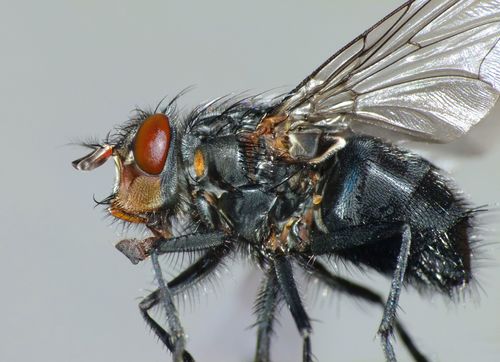
It has a shiny metallic blue-gray body with bright orange cheeks that set it apart from similar species.
Size
Adults measure about 10 to 11 mm long.
Source: Wikipedia
Does it bite or sting?
They can carry disease agents from garbage or animal waste and deposit them on human food.
Source: UC IPM
How to get rid of it
Removing breeding sites is the best way to control them, and insecticides can be used if sanitation alone fails.
Source: UC IPM
Where it lives
You’ll find it in urban environments throughout the United States.
Source: Wikipedia
Life cycle
At 27 °C (81 °F) it can complete five generations a year, and the first larval stage hatches roughly 24 hours after the eggs are laid.
Source: Wikipedia
When you see it
It prefers cooler temperatures, showing up most often in winter and less in summer.
Source: Wikipedia
Where it comes from
The species is native to Europe and the New World, with occasional records in South Africa since 1965.
Source: Wikipedia
Lookalikes
Immature stages look identical to those of C. vomitoria, making early identification difficult. Blow fly larvae resemble house fly larvae, which can confuse untrained observers.
Where it is found in the US
Recorded in 43 of 51 states and DC. Most records: California, South Carolina, New York, Texas, Pennsylvania, Alaska, Massachusetts, Washington.
Darker = more records. Counts are museum and citizen-science records, not population size.
Source: GBIF
Months it is reported in the US
Source: GBIF
More photos
Questions people ask
Can they spread disease?
Yes, they can transfer germs from garbage or animal feces onto human food.
Source: UC IPM
When are they most active?
They are most common in cooler weather, especially during winter months.
Source: Wikipedia
How can I get rid of them?
Eliminate places where they can breed, and use insecticides only if cleaning doesn’t work.
Source: UC IPM
Same family (Calliphoridae)
 Common European Greenbottle FlyLucilia sericataNuisance, not dangerous
 Black Blow FlyPhormia reginaNuisance, not dangerous
 Oriental Latrine FlyChrysomya megacephalaCan spread germs or disease
 Australian Sheep Blow FlyLucilia cuprinaNuisance, not dangerous
 Locust BlowflyStomorhina lunata
 Orange-bearded Bluebottle FlyCalliphora vomitoria
Sources
- UC IPM: https://ipm.ucanr.edu/PMG/PESTNOTES/pn7457.html
- Wikipedia: https://en.wikipedia.org/wiki/Calliphora_vicina
Look it up elsewhere: GBIF · iNaturalist · BugGuide · ITIS · Wikipedia
Text written 2026-10-22 from the sources above and checked sentence by sentence against them. Data fetched 2026-10-22.