 Bug FAQ
Locust Blowfly
Stomorhina lunata · Order: Diptera · Family: Calliphoridae
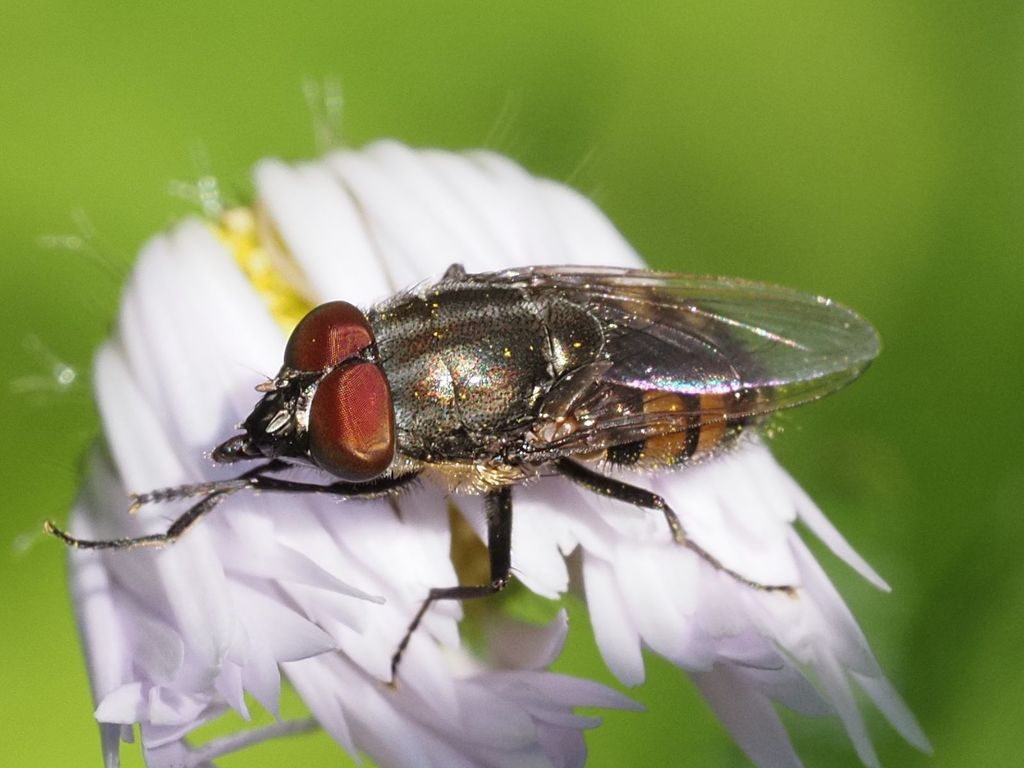
The locust blowfly is a small fly about 5 to 9 mm long with a wingspan of 13 to 16 mm and a striped thorax and banded abdomen. Adults are seen from July to October, feeding on nectar and pollen of umbellifer and aster family flowers, while the larvae prey on locust eggs.
Source: Wikipedia
How to recognize it
It looks like a house fly but has a long proboscis, a thorax with longitudinal stripes, and an abdomen with yellow-black bands; males show orange patches on the sides of the third and fourth abdominal segments, females have grey dust patches.
Source: Wikipedia
Size
Length ranges from 5 to 9 mm and wingspan from 13 to 16 mm.
Source: Wikipedia
Where it lives
They are usually found in meadow habitats.
Source: Wikipedia
What it eats
Larvae are important predators of eggs of several locust species, including the South African brown locust, desert locust, and migratory locust. Adults feed on nectar and pollen from umbellifer (Apiaceae) and aster (Asteraceae) flowers such as autumn hawkbit, tansy, wild chervil, wallflower, and meadowsweet.
Source: Wikipedia
When you see it
They are active in the late summer and early autumn months (July-October).
Source: Wikipedia
Where it comes from
The species occurs across most of Europe, the Afrotropical, eastern Palearctic, Near East, North Africa, Indomalayan, and Nearctic regions.
Source: Wikipedia
Lookalikes
Because of its unusual abdominal band pattern, it is often mistaken for hoverflies.
Source: Wikipedia
More photos


Questions people ask
How can I tell a locust blowfly apart from a house fly?
Look for the long proboscis, striped thorax, and the yellow-black banded abdomen; males have orange patches on abdominal segments 3 and 4, females have grey dust patches.
Source: Wikipedia
When are locust blowflies active?
Adults appear from July to October and are migratory during that period.
Source: Wikipedia
What do locust blowfly larvae eat?
The larvae prey on eggs of locust species such as the South African brown locust, desert locust, and migratory locust.
Source: Wikipedia
Same family (Calliphoridae)
 Common European Greenbottle FlyLucilia sericataNuisance, not dangerous
 Blue BlowflyCalliphora vicinaCan spread germs or disease
 Black Blow FlyPhormia reginaNuisance, not dangerous
 Oriental Latrine FlyChrysomya megacephalaCan spread germs or disease
 Australian Sheep Blow FlyLucilia cuprinaNuisance, not dangerous
 Shiny Blue Bottle FlyCynomya cadaverinaCan spread germs or disease
Sources
- Wikipedia: https://en.wikipedia.org/wiki/Stomorhina_lunata
Look it up elsewhere: GBIF · iNaturalist · BugGuide · ITIS · Wikipedia
Text written 2026-10-22 from the sources above and checked sentence by sentence against them. Data fetched 2026-10-22.