 Bug FAQ
Common European Greenbottle Fly
Lucilia sericata · Order: Diptera · Family: Calliphoridae
Also called: Blow Fly, Common Green Bottle Fly, European Green Blow Fly, Sheep Blow Fly
Source: Wikipedia

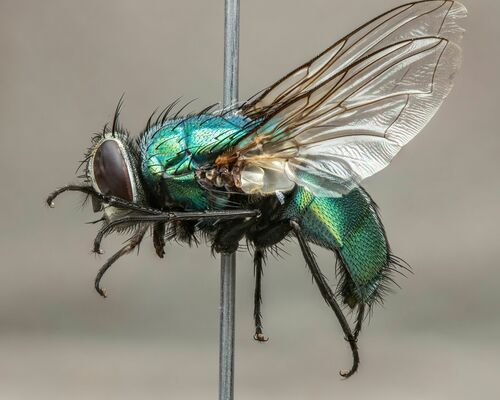
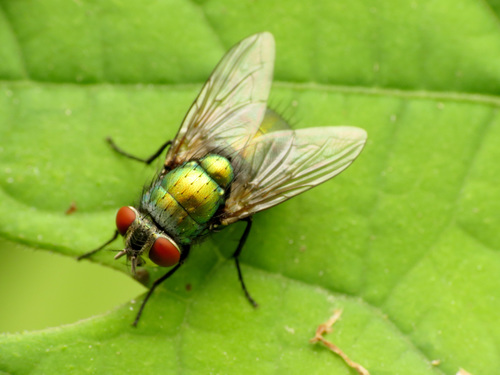
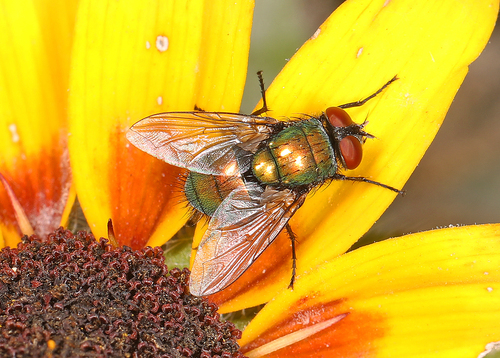
The common green bottle fly is a metallic blue-green fly about 10 to 14 mm long and can be recognized by three bristles on its back and three cross-grooves on the thorax. Adults feed on carrion, feces, pollen and nectar, while the larvae eat only dead tissue; females lay eggs on carrion or sometimes on live animals, which can lead to myiasis. It is found worldwide in temperate and tropical regions, prefers lower elevations, and is most active in spring when it emerges to mate.
Source: Wikipedia
How to recognize it
Three bristles sit on the middle of the fly’s back and three cross-grooves run across the thorax.
Source: Wikipedia
Size
The body length is 10 to 14 mm, a bit larger than a house fly.
Source: Wikipedia
Is it a pest in the house?
Larvae feed on decaying organic matter and females may lay eggs in carrion or on live animals, causing myiasis.
Source: Wikipedia
How to get rid of it
Sulfur compounds and indole attract gravid flies and could be used in traps, and females choose oviposition sites that maximize offspring survival.
Source: Wikipedia
Where it lives
It often lays eggs in the wet wool of sheep and prefers lower elevations than other blow flies.
Source: Wikipedia
What it eats
Larvae feed exclusively on dead organic tissue, while adults eat carrion, feces, pollen and nectar.
Source: Wikipedia
Life cycle
Its life cycle follows the typical Calliphoridae pattern and usually takes 2 to 3 weeks, depending on conditions.
Source: Wikipedia
When you see it
Adults emerge in spring to mate.
Source: Wikipedia
Where it comes from
It is common across Europe, Africa, Australia and other temperate and tropical areas.
Source: Wikipedia
Lookalikes
It looks almost identical to L. cuprina; microscopic differences include the number of occipital bristles (1 to 9 per side in L. sericata versus ≤3 in L. cuprina).
Source: Wikipedia
Where it is found in the US
Recorded in 50 of 51 states and DC. Most records: California, New York, Massachusetts, Pennsylvania, Illinois, Maryland, Washington, Michigan.
Darker = more records. Counts are museum and citizen-science records, not population size.
Source: GBIF
Status: introduced in United States. Source: iNaturalist
Months it is reported in the US
Source: GBIF
More photos

Questions people ask
Can they harm pets?
Females can lay eggs on live animals, and the larvae may cause myiasis, so they can be a nuisance to pets.
Source: Wikipedia
How can I identify this fly?
Look for a metallic blue-green body about 1 cm long, three bristles on the middle of the back, and three cross-grooves on the thorax.
Source: Wikipedia
When are they most common?
They emerge in spring and are most active during that season.
Source: Wikipedia
Same family (Calliphoridae)
 Blue BlowflyCalliphora vicinaCan spread germs or disease
 Black Blow FlyPhormia reginaNuisance, not dangerous
 Oriental Latrine FlyChrysomya megacephalaCan spread germs or disease
 Australian Sheep Blow FlyLucilia cuprinaNuisance, not dangerous
 Locust BlowflyStomorhina lunata
 Orange-bearded Bluebottle FlyCalliphora vomitoria
Sources
- Wikipedia: https://en.wikipedia.org/wiki/Common_green_bottle_fly
Look it up elsewhere: GBIF · iNaturalist · BugGuide · Wikipedia
Text written 2026-10-22 from the sources above and checked sentence by sentence against them. Data fetched 2026-10-22.