 Bug FAQ
Yellow-collared Scape Moth
Cisseps fulvicollis · Order: Lepidoptera · Family: Erebidae

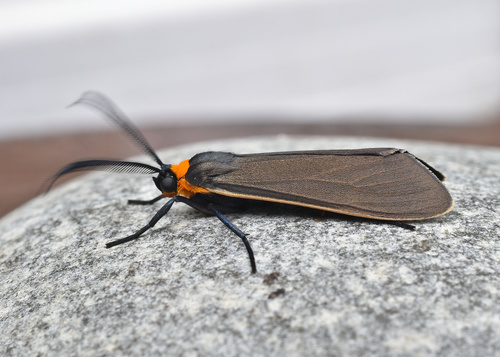
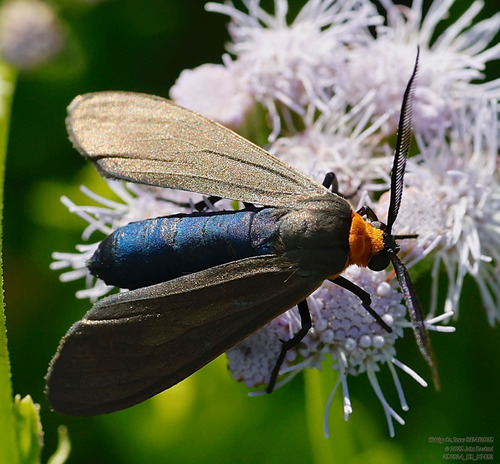
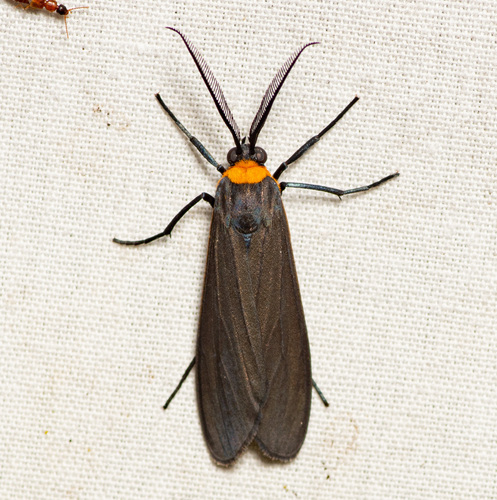
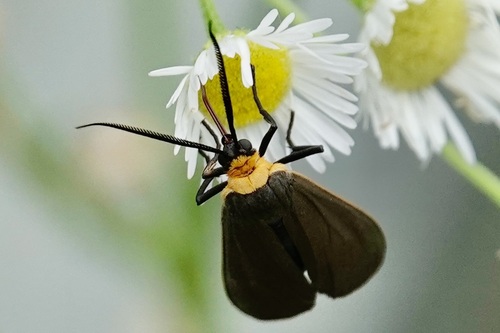
The yellow-collared scape moth has a wingspan of about 1 to 1½ inches (25-38 mm). Its caterpillars are yellow, brown or black with sparse soft hairs and have dark stripes bordered by yellow or orange bands.
Source: Wikipedia
Size
The adult’s wingspan ranges from 1 to 1½ inches (25-38 mm).
Source: Wikipedia
When you see it
Adults appear in late spring and summer.
Source: Wikipedia
Where it comes from
It is widespread throughout North America, including the southeastern United States.
Source: Wikipedia
Lookalikes
It can be confused with the Virginia ctenucha (Ctenucha virginica).
Source: Wikipedia
Where it is found in the US
Recorded in 49 of 51 states and DC. Most records: Texas, Ohio, Pennsylvania, New York, Michigan, Maryland, Virginia, Illinois.
Darker = more records. Counts are museum and citizen-science records, not population size.
Source: GBIF
Status: native in North America; native in Canada; native in United States. Source: iNaturalist
Months it is reported in the US
Source: GBIF
More photos
Questions people ask
Can I find this moth in my backyard?
Yes, it is active in fields and forest edges during late spring and summer across much of North America.
Source: Wikipedia
Same family (Erebidae)
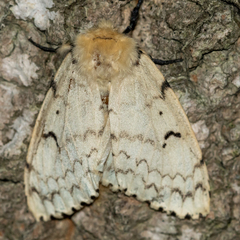 Spongy MothLymantria disparDamages trees, gardens or crops
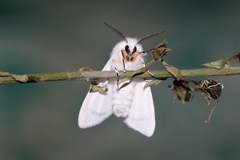 Fall Webworm MothHyphantria cuneaDamages trees, gardens or crops
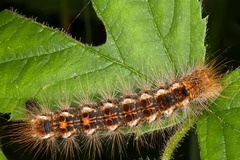 Brown-tail MothEuproctis chrysorrhoeaCan irritate skin
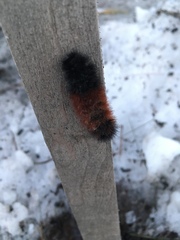 Isabella Tiger MothPyrrharctia isabella
 Virginian Tiger MothSpilosoma virginicaCan irritate skin
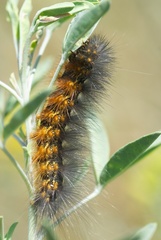 Salt Marsh MothEstigmene acrea
Sources
- Wikipedia: https://en.wikipedia.org/wiki/Cisseps_fulvicollis
Look it up elsewhere: GBIF · iNaturalist · BugGuide · ITIS · Wikipedia
Text written 2026-10-22 from the sources above and checked sentence by sentence against them. Data fetched 2026-10-22.