 Bug FAQ
Salt Marsh Moth
Estigmene acrea · Order: Lepidoptera · Family: Erebidae
Also called: Acrea Moth, Saltmarsh Caterpillar
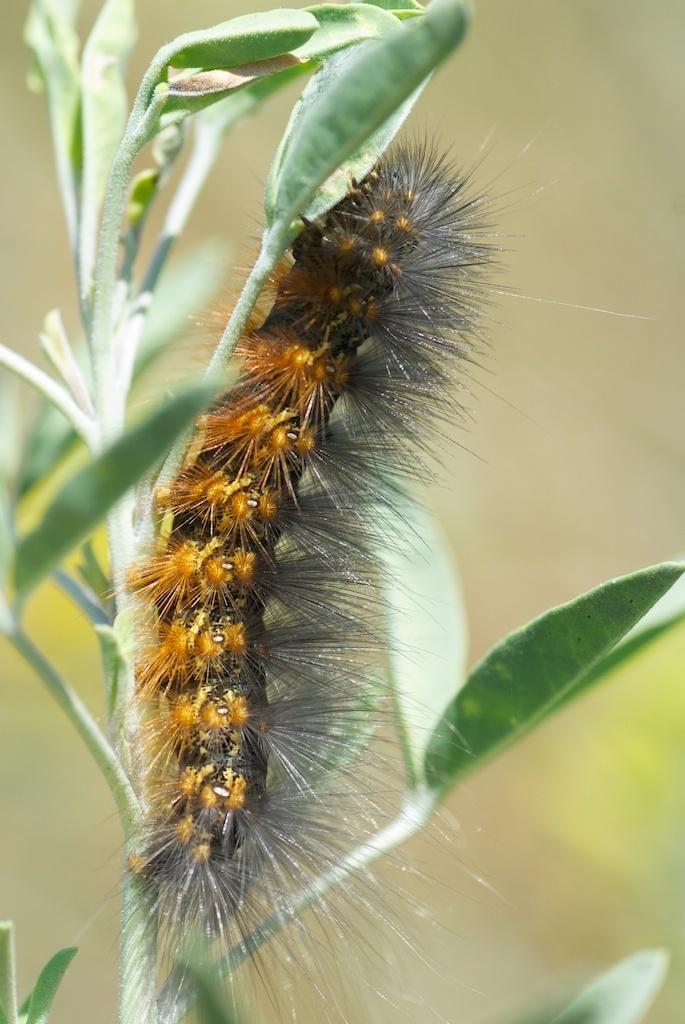
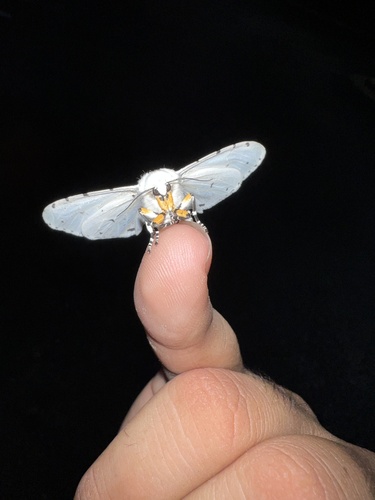
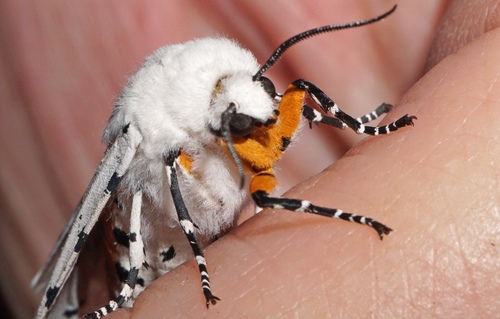
The Salt Marsh Moth has a wingspan of about 4.5 to 6.8 cm (1.8 to 2.7 in). It lives from Canada through the United States down to Colombia, and adults appear from May to August, year-round in southern Florida and Texas.
Source: Wikipedia
Where it lives
Found throughout North America and southward through Mexico to Colombia.
Source: Wikipedia
What it eats
Caterpillars feed on many plants including dandelion, cabbage, cotton, walnut, apple, tobacco, pea, potato, clover, and maize. The moth is not affected by pyrrolizidine alkaloids found in many plant families.
Source: Wikipedia
Life cycle
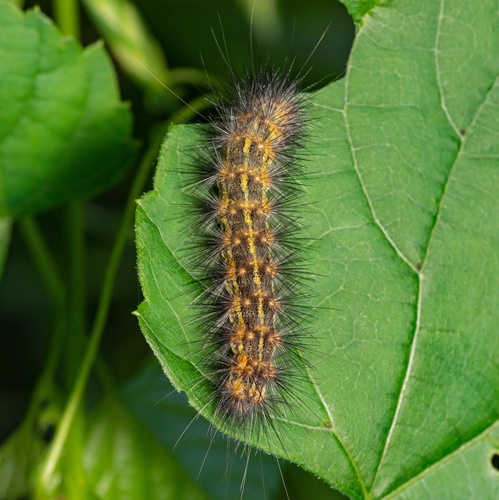
Females lay yellowish eggs in clusters on host plant leaves. The larva, called the salt marsh caterpillar, grows to about 5 cm (2 in) and varies widely in colour. It pupates in a cocoon made partly from its own hairs, usually wrapped in a leaf or debris. In the southern part of its range it can have several generations each year.
Source: Wikipedia
When you see it
Adults are typically seen from May through August, but are present year-round in southern Florida and Texas.
Source: Wikipedia
Where it comes from
Its native range extends from North America down to Colombia.
Source: Wikipedia
Where it is found in the US
Recorded in 50 of 51 states and DC. Most records: Texas, California, Florida, Louisiana, Illinois, Ohio, Virginia, Kansas.
Darker = more records. Counts are museum and citizen-science records, not population size.
Source: GBIF
Status: native in North America; native in Canada; native in United States. Source: iNaturalist
Months it is reported in the US
Source: GBIF
More photos

Questions people ask
Are they a crop pest?
Their caterpillars feed on many cultivated plants, so they can affect crops.
Source: Wikipedia
When can I expect to see them?
They are most common from May to August, but can be seen all year in southern Florida and Texas.
Source: Wikipedia
Same family (Erebidae)
 Spongy MothLymantria disparDamages trees, gardens or crops
 Fall Webworm MothHyphantria cuneaDamages trees, gardens or crops
 Brown-tail MothEuproctis chrysorrhoeaCan irritate skin
 Isabella Tiger MothPyrrharctia isabella
 Virginian Tiger MothSpilosoma virginicaCan irritate skin
 Banded Tussock MothHalysidota tessellaris
Sources
- Wikipedia: https://en.wikipedia.org/wiki/Estigmene_acrea
Look it up elsewhere: GBIF · iNaturalist · BugGuide · ITIS · Wikipedia
Text written 2026-10-22 from the sources above and checked sentence by sentence against them. Data fetched 2026-10-22.