 Bug FAQ
White-marked Tussock Moth
Orgyia leucostigma · Order: Lepidoptera · Family: Erebidae
Source: Wikipedia

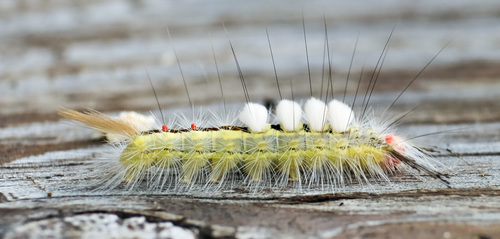
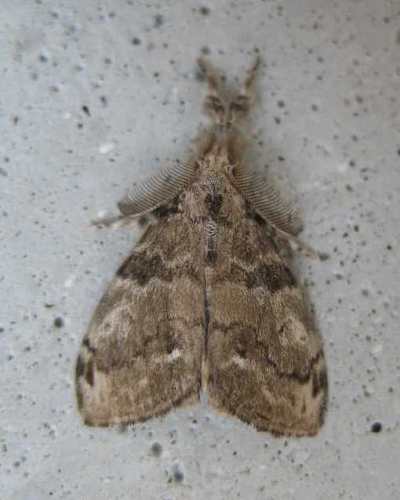
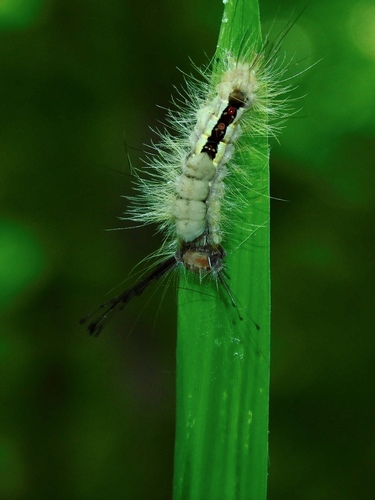
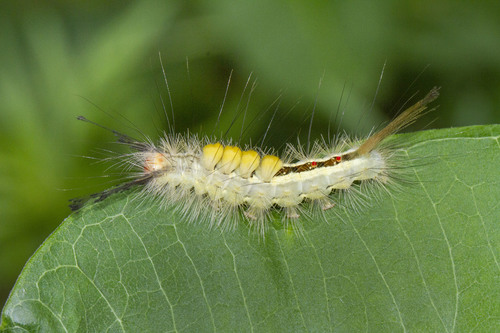
The white-marked tussock moth grows to about 35 mm and is recognizable by a bright red head, striped body and four white tufts on its back. Caterpillars feed on many deciduous and coniferous trees, skeletonizing leaves when young and eating most of the leaf tissue when older. They overwinter as eggs, have two or more generations per year, and adults appear from June to October.
Source: Wikipedia
Size
The moth reaches about 35 mm in length.
Source: Wikipedia
Does it bite or sting?
Contact with the caterpillar’s hairs can trigger allergic skin reactions in many people.
Source: Wikipedia
How to get rid of it
Viral diseases often end outbreaks, and the fungus Entomophaga maimaiga, introduced for spongy moth control, can also infect this species.
Source: Wikipedia
Where it lives
Caterpillars are found on a very wide range of both deciduous and coniferous trees.
Source: Wikipedia
What it eats
Young larvae skeletonize leaf surfaces, while older larvae consume all leaf tissue except the larger veins. They feed on many species of trees, both deciduous and coniferous.
Source: Wikipedia
Life cycle
Two or more generations occur each year in the east. The species overwinters in the egg stage.
Source: Wikipedia
When you see it
Adults are on the wing from June through October.
Source: Wikipedia
Where it comes from
They are common in late summer across eastern North America, extending west to Texas, California, and Alberta.
Source: Wikipedia
Where it is found in the US
Recorded in 42 of 51 states and DC. Most records: North Carolina, Ohio, Illinois, Georgia, Virginia, Alabama, Michigan, Maryland.
Darker = more records. Counts are museum and citizen-science records, not population size.
Source: GBIF
Status: native in North America; native in United States; native in Canada. Source: iNaturalist
Months it is reported in the US
Source: GBIF
More photos
Questions people ask
What trees do they damage?
They feed on many deciduous and coniferous trees, skeletonizing leaves when young and eating most of the leaf tissue when older.
Source: Wikipedia
How can they be controlled?
Outbreaks are usually ended by viral disease, and the fungus Entomophaga maimaiga can also infect them.
Source: Wikipedia
Same family (Erebidae)
 Spongy MothLymantria disparDamages trees, gardens or crops
 Fall Webworm MothHyphantria cuneaDamages trees, gardens or crops
 Brown-tail MothEuproctis chrysorrhoeaCan irritate skin
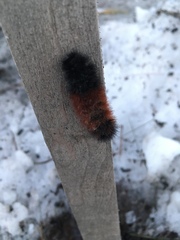 Isabella Tiger MothPyrrharctia isabella
 Virginian Tiger MothSpilosoma virginicaCan irritate skin
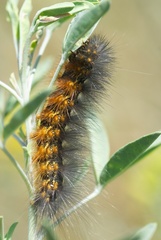 Salt Marsh MothEstigmene acrea
Sources
- Wikipedia: https://en.wikipedia.org/wiki/Orgyia_leucostigma
Look it up elsewhere: GBIF · iNaturalist · BugGuide · ITIS · Wikipedia
Text written 2026-10-22 from the sources above and checked sentence by sentence against them. Data fetched 2026-10-22.