 Bug FAQ
White-margined Ctenucha Moth
Ctenucha multifaria · Order: Lepidoptera · Family: Erebidae
Also called: White-margined Ctenucha
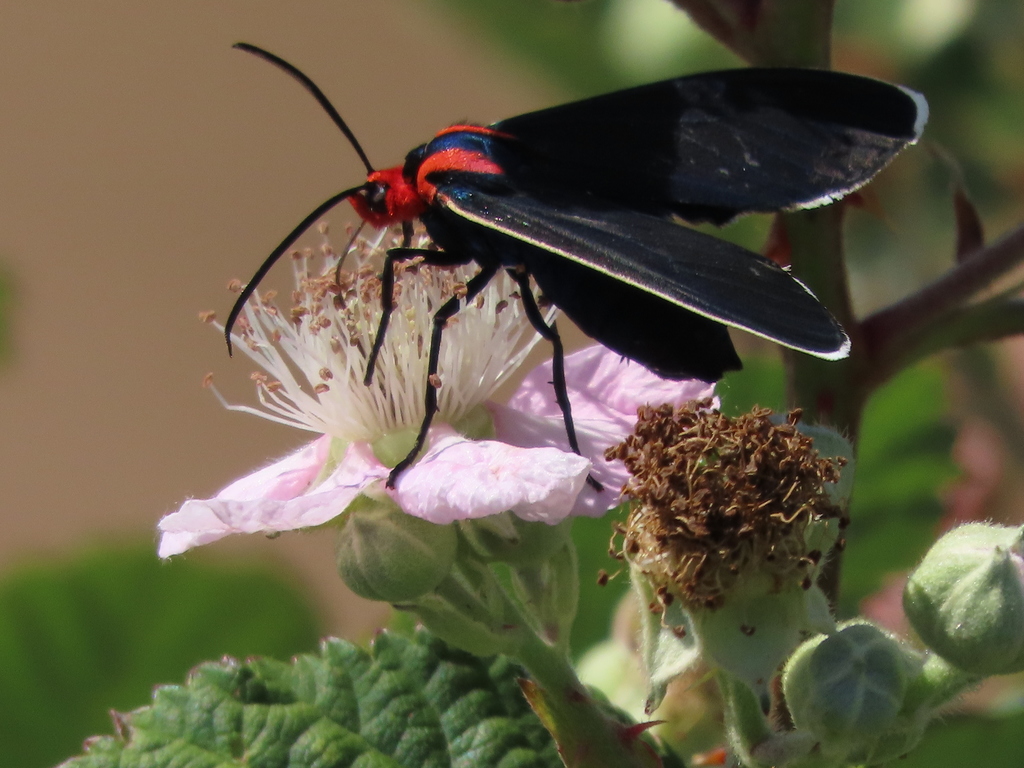
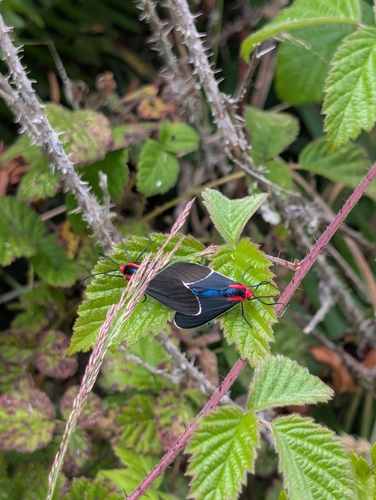
The adult has a blue body about 20 to 26 mm long and a wingspan of 46 to 50 mm. It lives along the Pacific coast of California north of Santa Maria and in Oregon, and it is active during the day. Its forewings are black with a white margin, the head and shoulders are red, and it can be confused with the brown-winged Ctenucha but has black instead of brown wings.
Source: Wikipedia
How to recognize it
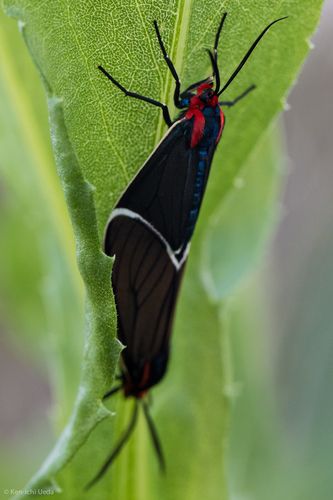
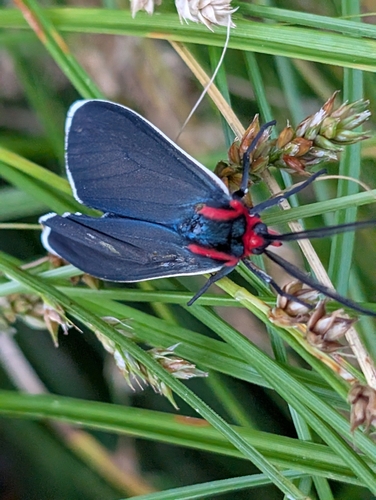
The head and shoulder area are red, and the forewings are black with a white edge.
Source: Wikipedia
Size
The body length ranges from 20 to 26 mm. The wingspan measures between 46 and 50 mm.
Source: Wikipedia
Where it lives
It is found along the coast in California north of Santa Maria and in Oregon.
Source: Wikipedia
What it eats
The larvae are covered in hairs that later form the cocoon.
Source: Wikipedia
Life cycle
Hairy larvae spin a cocoon from their own hairs before becoming adults.
Source: Wikipedia
When you see it
This moth is diurnal, meaning it is active during daylight hours.
Source: Wikipedia
Where it comes from
Its native range is the coastal United States, specifically California north of Santa Maria and Oregon.
Source: Wikipedia
Where it is found in the US
Recorded in 3 of 51 states and DC. Most records: California, Oregon, Arizona.
Darker = more records. Counts are museum and citizen-science records, not population size.
Source: GBIF
Months it is reported in the US
Source: GBIF
More photos
Questions people ask
When are White-margined Ctenucha moths active?
They are active during the day because they are a diurnal species.
Source: Wikipedia
How can I tell this moth apart from similar species?
Look for black forewings with a white margin and red markings on the head and shoulders; other similar moths have brown wings.
Source: Wikipedia
Same family (Erebidae)
 Spongy MothLymantria disparDamages trees, gardens or crops
 Fall Webworm MothHyphantria cuneaDamages trees, gardens or crops
 Brown-tail MothEuproctis chrysorrhoeaCan irritate skin
 Isabella Tiger MothPyrrharctia isabella
 Virginian Tiger MothSpilosoma virginicaCan irritate skin
 Salt Marsh MothEstigmene acreaDamages trees, gardens or crops
Sources
- Wikipedia: https://en.wikipedia.org/wiki/Ctenucha_multifaria
Look it up elsewhere: GBIF · iNaturalist · BugGuide · ITIS · Wikipedia
Text written 2026-10-26 from the sources above and checked sentence by sentence against them. Data fetched 2026-10-26.