 Bug FAQ
White Ermine
Spilosoma lubricipeda · Order: Lepidoptera · Family: Erebidae
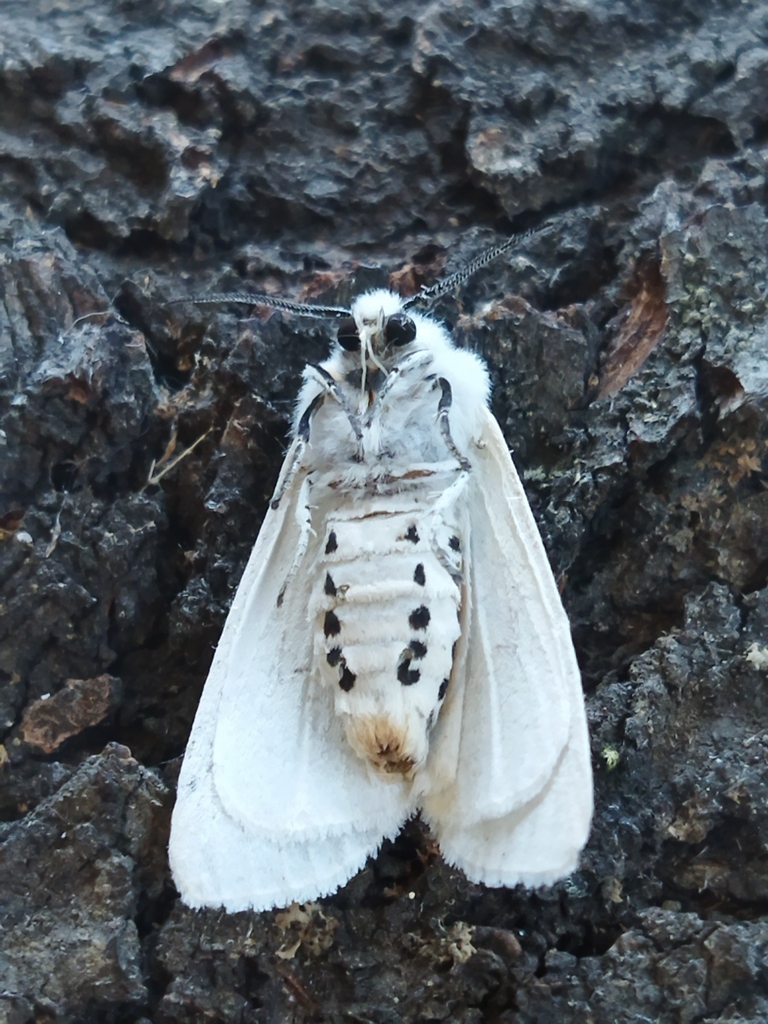
The white ermine moth has a wingspan of about 34 to 48 mm and its wing pattern ranges from almost completely white to heavily dotted with sharp black spots. It flies from May to September, depending on where it lives, and its caterpillars eat nettles, broom, alfalfa, viper’s-bugloss and dandelion.
Source: Wikipedia
How to recognize it
The forewings are sprinkled with clearly defined black dots, always some along the leading edge and in rows across the disc, but overall the pattern can be from almost all white to heavily dotted.
Source: Wikipedia
Size
Wingspan ranges from 34 to 48 mm.
Source: Wikipedia
What it eats
Caterpillars feed on stinging nettle, common broom, alfalfa, viper’s-bugloss and dandelion.
Source: Wikipedia
Life cycle
Adults are on the wing from May through September, varying with location.
Source: Wikipedia
When you see it
Flight period is May to September depending on where they are found.
Source: Wikipedia
Where it comes from
Its native range covers the same temperate Eurasian belt from Europe to East Asia.
Source: Wikipedia
Lookalikes
They are noticeably longer than the similar Spilosoma urticae, and some European forms resemble the Asian sangaica variants such as paucipuncta and krieghoffi.
Source: Wikipedia
More photos


Questions people ask
Are they harmful to gardens?
Their larvae feed on a few garden plants like nettles and dandelion, but they are not noted as serious pests.
Source: Wikipedia
Same family (Erebidae)
 Spongy MothLymantria disparDamages trees, gardens or crops
 Fall Webworm MothHyphantria cuneaDamages trees, gardens or crops
 Brown-tail MothEuproctis chrysorrhoeaCan irritate skin
 Isabella Tiger MothPyrrharctia isabella
 Virginian Tiger MothSpilosoma virginicaCan irritate skin
 Salt Marsh MothEstigmene acrea
Sources
- Wikipedia: https://en.wikipedia.org/wiki/Spilosoma_lubricipeda
Look it up elsewhere: GBIF · iNaturalist · BugGuide · Wikipedia
Text written 2026-10-22 from the sources above and checked sentence by sentence against them. Data fetched 2026-10-22.