 Bug FAQ
Tropical Tiger Moth
Asota caricae · Order: Lepidoptera · Family: Erebidae
Source: Wikipedia
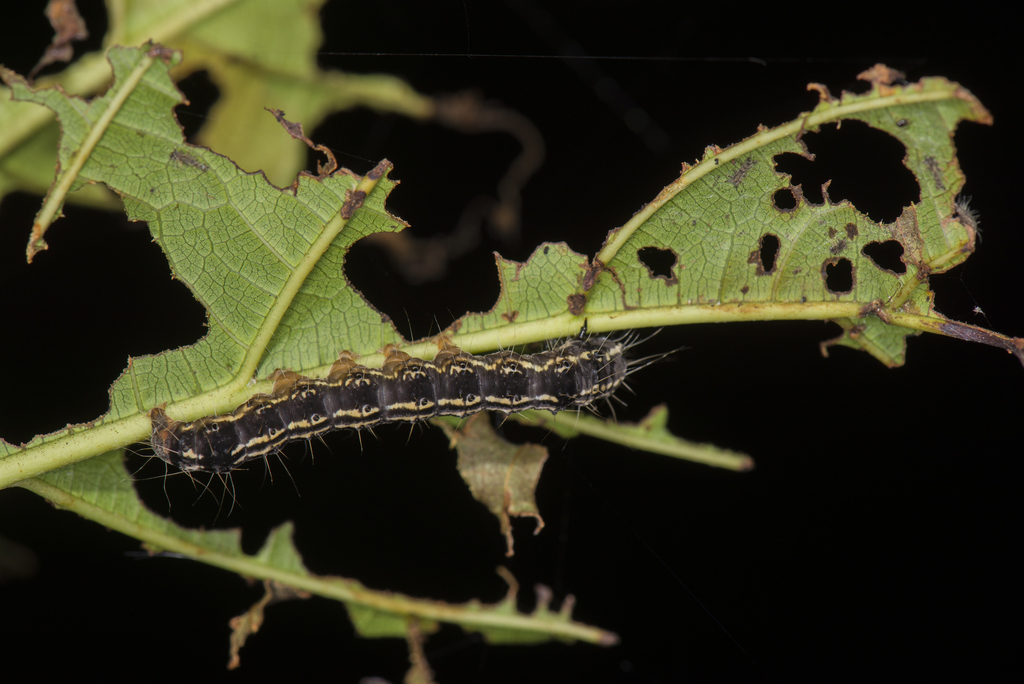
The tropical tiger moth has a wingspan of about 5 to 6 cm. Adults have brownish forewings with a basal orange patch, black spots, white-streaked veins and a white spot near the discal cell.
Source: Wikipedia
How to recognize it
The palpi show black spots on the first and second joints. Forewings are brownish-fuscous with a basal orange patch, two subbasal black spots, three spots along its outer edge, white-streaked veins and a white spot at the lower angle of the discal cell.
Source: Wikipedia
Size
Wingspan ranges from 51 to 58 mm.
Source: Wikipedia
Where it lives
Found in forest and agricultural areas.
Source: Wikipedia
What it eats
Larvae feed on leaves of Ficus, Broussonetia, Mesua, Tectona and Shorea species.
Source: Wikipedia
Life cycle
Pupation takes place in a thin cocoon attached to a leaf.
Source: Wikipedia
Questions people ask
What plants do the larvae eat?
The caterpillars feed on several tree species, including fig (Ficus), paper mulberry (Broussonetia), Mesua, teak (Tectona) and Shorea.
Source: Wikipedia
Same family (Erebidae)
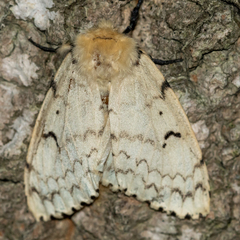 Spongy MothLymantria disparDamages trees, gardens or crops
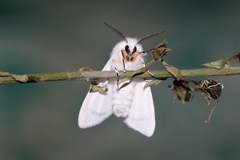 Fall Webworm MothHyphantria cuneaDamages trees, gardens or crops
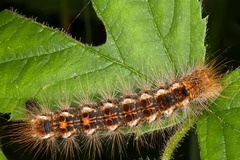 Brown-tail MothEuproctis chrysorrhoeaCan irritate skin
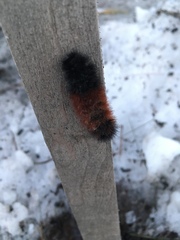 Isabella Tiger MothPyrrharctia isabella
 Virginian Tiger MothSpilosoma virginicaCan irritate skin
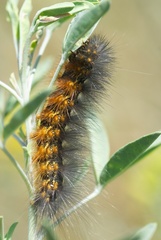 Salt Marsh MothEstigmene acrea
Sources
- Wikipedia: https://en.wikipedia.org/wiki/Asota_caricae
Look it up elsewhere: GBIF · iNaturalist · BugGuide · Wikipedia
Text written 2026-10-22 from the sources above and checked sentence by sentence against them. Data fetched 2026-10-22.