 Bug FAQ
Toothed Fan-foot
Zanclognatha dentata · Order: Lepidoptera · Family: Erebidae
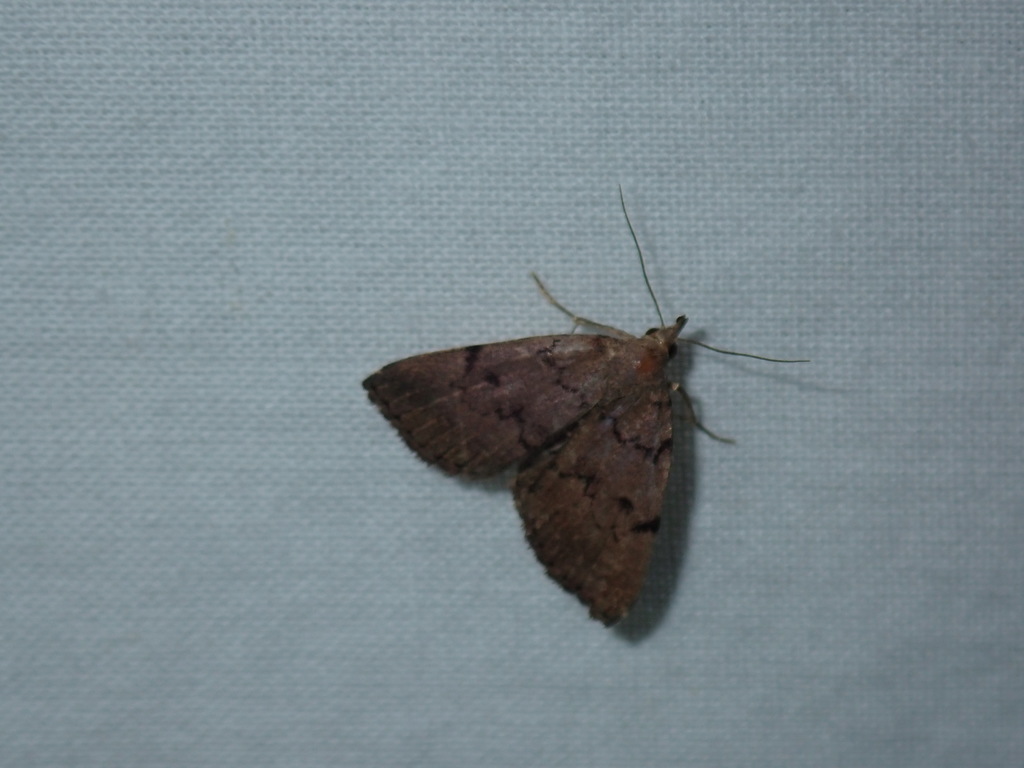
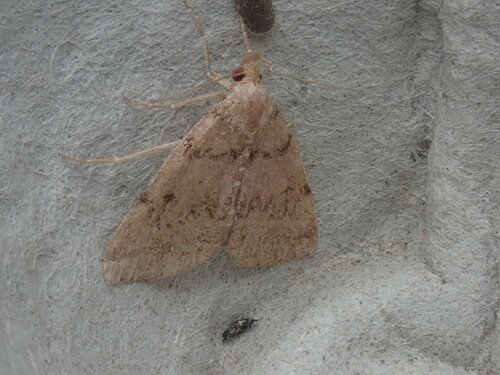
The toothed fan-foot moth has forewings about 10.5 to 13 mm long and shows a pale to chocolate-brown, subtriangular shape with a toothed antemedial line and a distinct discal spot. It lives across eastern North America, from Ontario and Nova Scotia down through the Great Lakes region into the Appalachians as far as northern Georgia. Adults are attracted to lights and sugar bait in a wide variety of wetland and forest habitats.
Source: Wikipedia
How to recognize it
The forewings are subtriangular, pale to chocolate brown, and usually have clear markings. A toothed or scalloped antemedial line and a well-developed discal spot are typical.
Source: Wikipedia
Size
Forewing length ranges from about 10.5 to 13 mm.
Source: Wikipedia
Where it lives
Adults have been collected at lights and on sugar bait in wetlands such as bogs, swamps, marshes, cedar swamps, as well as mesic hardwood forests, boreal conifer forests, and pine-oak barrens.
Source: Wikipedia
What it eats
Larvae feed on dead, browned, slightly moist leaves of balsam fir, eastern hemlock, Douglas fir, witch hazel, and Japanese honeysuckle.
Source: Wikipedia
Life cycle
There is one generation per year, with adults flying from late June through early August. In western North Carolina and northern Georgia, a small second brood can appear in early September.
Source: Wikipedia
When you see it
The species typically has a single mid-summer flight period from the end of June to early August.
Source: Wikipedia
Where it comes from
It occurs in North America from Ontario and Nova Scotia south through the Great Lakes states and the Appalachians to northern Georgia.
Source: Wikipedia
Where it is found in the US
Recorded in 20 of 51 states and DC. Most records: Massachusetts, Pennsylvania, Vermont, New York, Maine, Ohio, Wisconsin, Connecticut.
Darker = more records. Counts are museum and citizen-science records, not population size.
Source: GBIF
Status: native in North America; native in Canada. Source: iNaturalist
Months it is reported in the US
Source: GBIF
More photos
Questions people ask
What do the larvae eat?
Larvae feed on dead, browned, slightly moist leaves of several conifers and shrubs, including balsam fir, eastern hemlock, Douglas fir, witch hazel, and Japanese honeysuckle.
Source: Wikipedia
Where is the toothed fan-foot moth found?
It is native to eastern North America, ranging from Ontario and Nova Scotia down through the Great Lakes states and the Appalachians to northern Georgia.
Source: Wikipedia
What habitats do they prefer?
Adults are attracted to lights and sugar bait in a wide range of wetland and forest habitats, including bogs, swamps, marshes, cedar swamps, mesic hardwood forests, boreal conifer forests, and pine-oak barrens.
Source: Wikipedia
Same family (Erebidae)
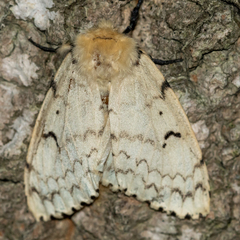 Spongy MothLymantria disparDamages trees, gardens or crops
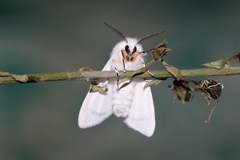 Fall Webworm MothHyphantria cuneaDamages trees, gardens or crops
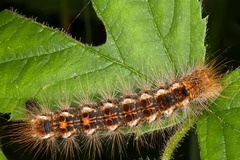 Brown-tail MothEuproctis chrysorrhoeaCan irritate skin
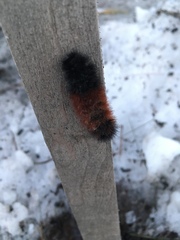 Isabella Tiger MothPyrrharctia isabella
 Virginian Tiger MothSpilosoma virginicaCan irritate skin
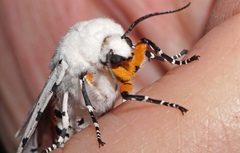 Salt Marsh MothEstigmene acreaDamages trees, gardens or crops
Sources
- Wikipedia: https://en.wikipedia.org/wiki/Zanclognatha_dentata
Look it up elsewhere: GBIF · iNaturalist · BugGuide · ITIS · Wikipedia
Text written 2026-10-26 from the sources above and checked sentence by sentence against them. Data fetched 2026-10-26.