 Bug FAQ
Swan Moth
Sphrageidus similis · Order: Lepidoptera · Family: Erebidae
Also called: Goldtail Moth
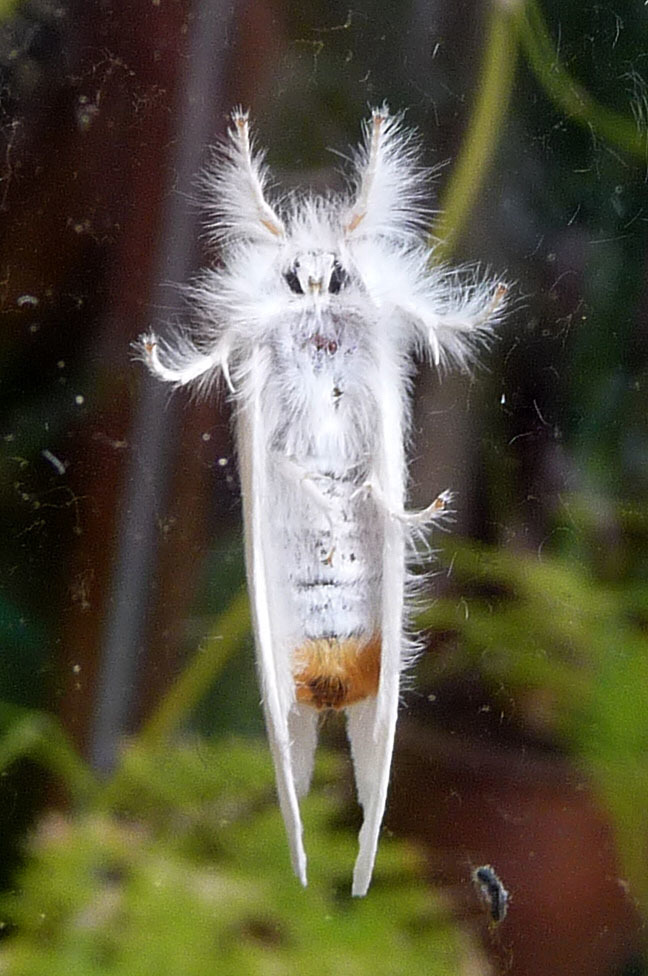
Adult Swan Moths are pure white with a bright yellow tip on the abdomen and a small dark mark on the male's forewing. They have a wingspan of 35 to 45 mm, with females generally larger than males. They fly at night in July and August, are attracted to light, and their larvae overwinter before pupating in early June.
Source: Wikipedia
How to recognize it
All body parts are pure white except for a bright yellow tip on the abdomen, larger in females, and males have a small black or brown spot on the forewing.
Source: Wikipedia
Size
Wingspan ranges from 35 to 45 mm; females are noticeably larger than males.
Source: Wikipedia
What it eats
Larvae feed on the same trees and shrubs listed for habitat and have also been recorded on monkshood.
Source: Wikipedia
Life cycle
Eggs are covered with the female’s anal wool; larvae hatch, disperse, hibernate singly, and pupate in early June inside a whitish cocoon.
Source: Wikipedia
When you see it
Adults are nocturnal flyers in July and August and are especially attracted to light, with males showing stronger attraction.
Source: Wikipedia
Lookalikes
They resemble the white Euproctis chrysorrhoea but are more purely silky white and have distinct yellow abdominal tips and anal wool.
Source: Wikipedia
Status: native in Canada. Source: iNaturalist
More photos


Questions people ask
When can I see Swan Moths?
Adults are active at night during July and August and are attracted to lights.
Source: Wikipedia
How can I tell a Swan Moth apart from similar moths?
Look for the pure white coloration, bright yellow tip on the abdomen, and the small dark spot on the male’s forewing.
Source: Wikipedia
Same family (Erebidae)
 Spongy MothLymantria disparDamages trees, gardens or crops
 Fall Webworm MothHyphantria cuneaDamages trees, gardens or crops
 Brown-tail MothEuproctis chrysorrhoeaCan irritate skin
 Isabella Tiger MothPyrrharctia isabella
 Virginian Tiger MothSpilosoma virginicaCan irritate skin
 Salt Marsh MothEstigmene acrea
Sources
- Wikipedia: https://en.wikipedia.org/wiki/Yellow-tail
Look it up elsewhere: GBIF · iNaturalist · BugGuide · ITIS · Wikipedia
Text written 2026-10-22 from the sources above and checked sentence by sentence against them. Data fetched 2026-10-22.