 Bug FAQ
Shiny Blue Bottle Fly
Cynomya cadaverina · Order: Diptera · Family: Calliphoridae
Source: Wikipedia

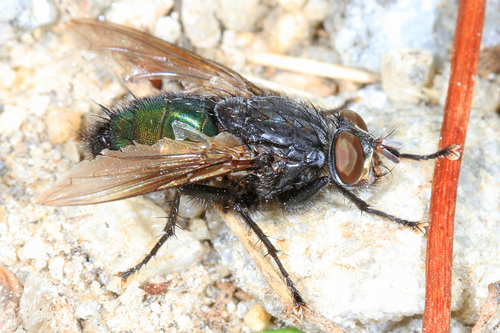
The shiny blue bottle fly is a large, dark-blue fly about 9 to 14 mm long with distinctive blue stripes on its back. It breeds in excrement and other filthy places, can enter homes in winter, and may transmit enteric pathogens that cause foodborne illness.
Source: Wikipedia
Size
Adults measure between 9 and 14 mm in length.
Source: Wikipedia
Is it a pest in the house?
Adults overwinter and may enter houses during that time. Because it breeds in excrement and filthy sites, it is considered a “filthy fly” by the FDA.
Source: Wikipedia
Does it bite or sting?
It can transmit enteric pathogens that cause foodborne disease in humans. These flies show clustering behavior, gathering together in groups.
Source: Wikipedia
How to get rid of it
Because they breed in filthy environments, keeping areas clean and free of excrement helps reduce their presence.
Source: Wikipedia
Where it lives
It breeds in excrement and other filthy habitats, posing a health hazard by spreading enteric pathogens.
Source: Wikipedia
What it eats
The species is occasionally associated with myiasis, though it is not a regular cause. Myiasis differs from therapeutic maggot use, which intentionally employs larvae to clean wounds.
Source: Wikipedia
Life cycle
Like all flies, it undergoes a complete metamorphosis: egg, larva, pupa, and adult. Under suitable conditions it can produce about 17 generations per year, laying 25 to 50 eggs each time.
Source: Wikipedia
When you see it
It prefers cool weather and is most abundant on carrion in spring and fall.
Source: Wikipedia
Where it comes from
It is found throughout the Nearctic region, especially in southern Canada and the northern United States.
Source: Wikipedia
Lookalikes
They are attracted to later stages of decomposition and are rarely found on fresh carrion. They appear in the second wave of insect succession, after blow flies (Lucilia) and bluebottle flies (Calliphora).
Source: Wikipedia
Where it is found in the US
Recorded in 45 of 51 states and DC. Most records: Alaska, Texas, New York, Illinois, Massachusetts, Pennsylvania, Virginia, Minnesota.
Darker = more records. Counts are museum and citizen-science records, not population size.
Source: GBIF
Status: native in North America; native in Canada; native in United States. Source: iNaturalist
Months it is reported in the US
Source: GBIF
More photos
Questions people ask
How can I prevent these flies from entering my home?
Seal entry points and maintain cleanliness to eliminate the excrement and filth they breed in.
Source: Wikipedia
Do they spread disease?
Yes, they can carry enteric pathogens that cause foodborne illnesses in people.
Source: Wikipedia
When are they most common?
They are most abundant in cool weather, especially during spring and fall.
Source: Wikipedia
Same family (Calliphoridae)
 Common European Greenbottle FlyLucilia sericataNuisance, not dangerous
 Blue BlowflyCalliphora vicinaCan spread germs or disease
 Black Blow FlyPhormia reginaNuisance, not dangerous
 Oriental Latrine FlyChrysomya megacephalaCan spread germs or disease
 Australian Sheep Blow FlyLucilia cuprinaNuisance, not dangerous
 Locust BlowflyStomorhina lunata
Sources
- Wikipedia: https://en.wikipedia.org/wiki/Cynomya_cadaverina
Look it up elsewhere: GBIF · iNaturalist · BugGuide · ITIS · Wikipedia
Text written 2026-10-24 from the sources above and checked sentence by sentence against them. Data fetched 2026-10-24.