 Bug FAQ
Secondary Screwworm Fly
Cochliomyia macellaria · Order: Diptera · Family: Calliphoridae
Also called: Secondary Screwworm
Source: Wikipedia
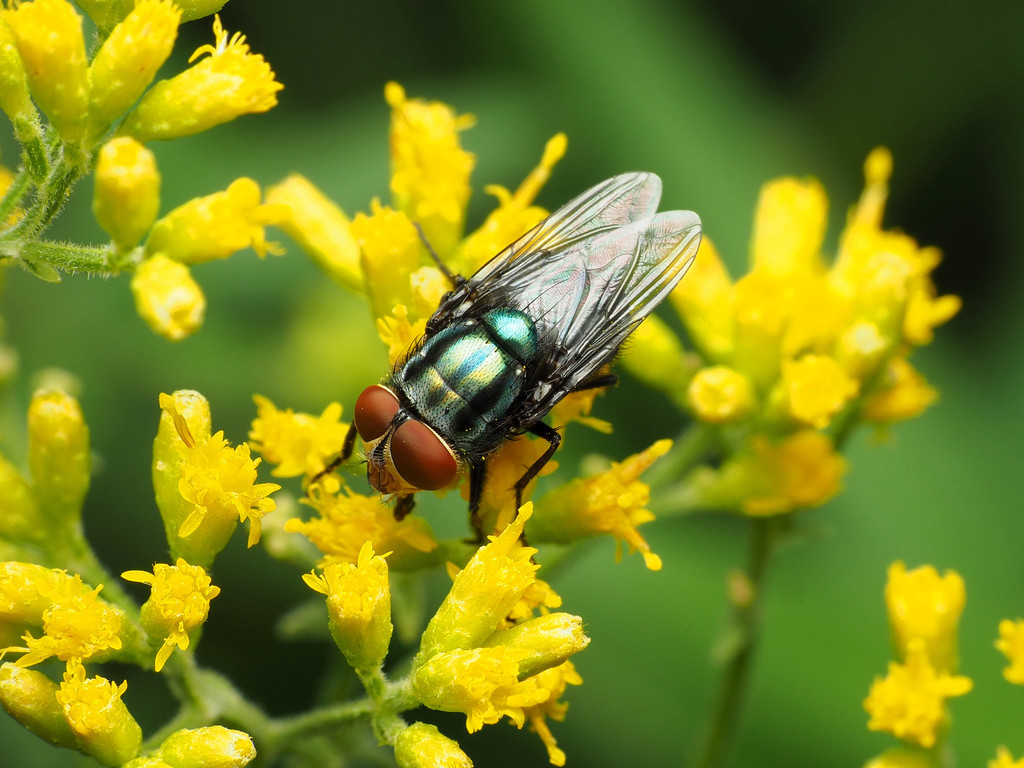
Adult secondary screwworm flies are 5 to 8 mm long with a metallic blue-green body, a red-orange head, and three black stripes on the thorax. They are common in the southeastern United States, especially Florida, Louisiana and Georgia, and are attracted to carrion, garbage, slaughterhouses and outdoor markets. A female can lay up to a thousand eggs and lives 2 to 6 weeks, with populations rising after extended rain.
Source: Wikipedia
How to recognize it
The fly has a metallic greenish-blue thorax, a red-orange head and eyes, and three black longitudinal stripes on the thorax.
Source: Wikipedia
Size
Adults measure between 5 and 8 mm in length.
Source: Wikipedia
Is it a pest in the house?
The livestock industry views the secondary screwworm as a major pest because of the large economic losses from myiasis and disease transmission.
Source: Wikipedia
Does it bite or sting?
The larvae can infect wounds, creating medical problems for humans and animals.
Source: Wikipedia
How to get rid of it
Pyrethrin aerosol and other pesticides have been developed to reduce their numbers. Treating infestations can be time-intensive and may lead to repeated problems.
Source: Wikipedia
Where it lives
They are attracted to carrion and garbage and often appear in slaughterhouses and outdoor markets in tropical areas.
Source: Wikipedia
Life cycle
Adults live for about 2 to 6 weeks. A female can lay a thousand or more eggs in her lifetime.
Source: Wikipedia
When you see it
Population numbers increase during periods of extended rainfall.
Source: Wikipedia
Where it comes from
The species is most frequent in the southeastern United States, such as Florida, Louisiana and Georgia.
Source: Wikipedia
Lookalikes
It is closely related to C. hominivorax but differs in adult appearance and the lack of an oral sclerite in larvae.
Source: Wikipedia
Where it is found in the US
Recorded in 39 of 51 states and DC. Most records: Texas, South Carolina, Maryland, Virginia, Florida, California, Illinois, New York.
Darker = more records. Counts are museum and citizen-science records, not population size.
Source: GBIF
Status: native in North America; native in Canada; native in United States. Source: iNaturalist
Months it is reported in the US
Source: GBIF
More photos
Questions people ask
How can I prevent secondary screwworm infestations?
Keep waste, carrion and garbage sealed, and maintain cleanliness in areas like slaughterhouses and outdoor markets.
Source: Wikipedia
What should I do if I suspect a wound infection by these flies?
Seek veterinary or medical attention promptly because the larvae can cause serious wound infestations and disease transmission.
Source: Wikipedia
Are there chemicals that work against them?
Yes, pyrethrin aerosol and other pesticides are used to control their populations.
Source: Wikipedia
Same family (Calliphoridae)
 Common European Greenbottle FlyLucilia sericataNuisance, not dangerous
 Blue BlowflyCalliphora vicinaCan spread germs or disease
 Black Blow FlyPhormia reginaNuisance, not dangerous
 Oriental Latrine FlyChrysomya megacephalaCan spread germs or disease
 Australian Sheep Blow FlyLucilia cuprinaNuisance, not dangerous
 Locust BlowflyStomorhina lunata
Sources
- Wikipedia: https://en.wikipedia.org/wiki/Cochliomyia_macellaria
Look it up elsewhere: GBIF · iNaturalist · BugGuide · ITIS · Wikipedia
Text written 2026-10-23 from the sources above and checked sentence by sentence against them. Data fetched 2026-10-22.