 Bug FAQ
Scarlet Tiger
Callimorpha dominula · Order: Lepidoptera · Family: Erebidae
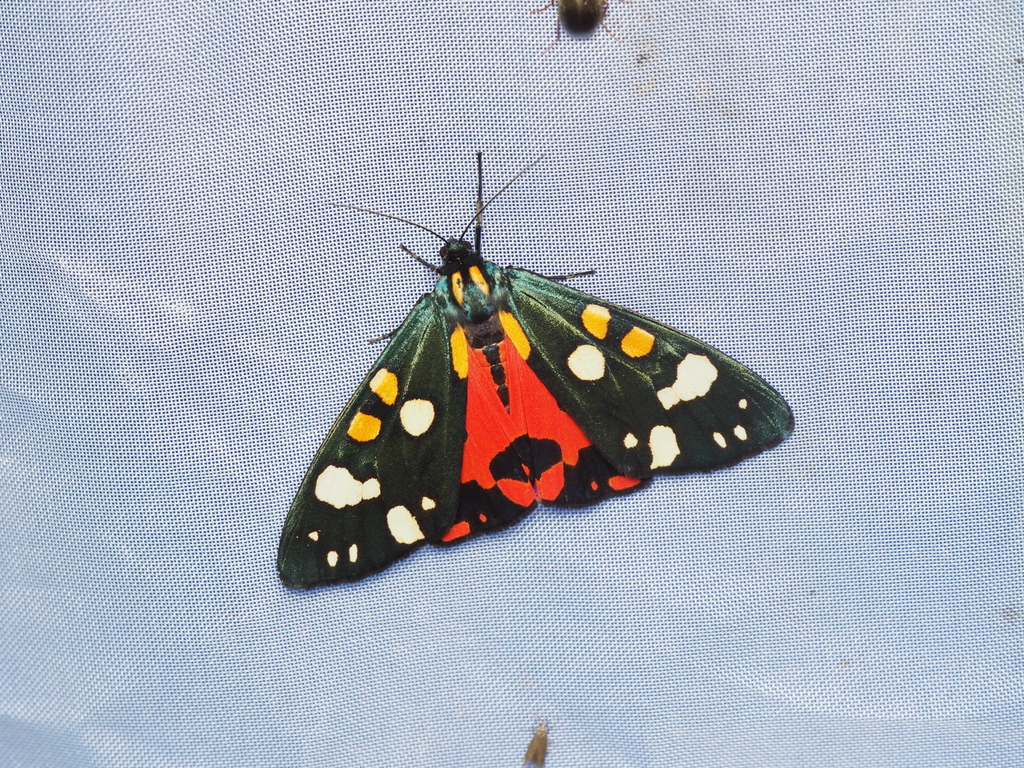
The scarlet tiger moth has a wingspan of about 45 to 55 mm and its caterpillars grow to roughly 40 mm long. Adults show variable colours, with metallic-green tinged forewings, red hindwings marked with three irregular black spots, a black thorax with green gloss and two short yellow stripes, and a black abdomen (-). They live in damp habitats such as wet meadows and river banks, are found across most of Europe and the Near East, and the caterpillars mainly eat comfrey but will feed on other plants (-).
Source: Wikipedia
How to recognize it
Adults vary in colour; forewings are blackish with a metallic-green sheen and white-yellow or orange markings. Hindwings are red with three large irregular black spots. The thorax is black with a green gloss and two short longitudinal yellow stripes. The abdomen is black.
Source: Wikipedia
Size
The moth’s wingspan ranges from 45 to 55 mm (1.8 to 2.2 in). Caterpillars can grow to about 40 mm (1.6 in) long.
Source: Wikipedia
What it eats
Caterpillars are polyphagous, mainly feeding on comfrey but also on a variety of other plants.
Source: Wikipedia
Life cycle
The scarlet tiger moth has one generation per year.
Source: Wikipedia
Where it comes from
The species occurs throughout most of Europe and parts of the Near East, including Turkey, the South Caucasus and northern Iran.
Source: Wikipedia
More photos

Same family (Erebidae)
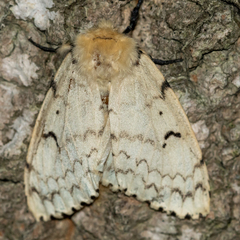 Spongy MothLymantria disparDamages trees, gardens or crops
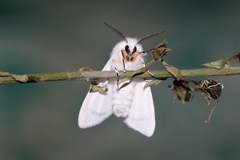 Fall Webworm MothHyphantria cuneaDamages trees, gardens or crops
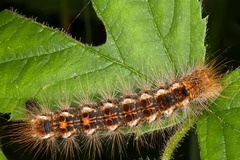 Brown-tail MothEuproctis chrysorrhoeaCan irritate skin
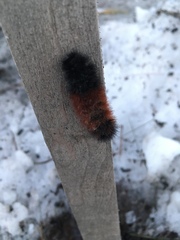 Isabella Tiger MothPyrrharctia isabella
 Virginian Tiger MothSpilosoma virginicaCan irritate skin
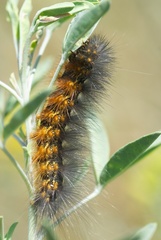 Salt Marsh MothEstigmene acrea
Sources
- Wikipedia: https://en.wikipedia.org/wiki/Scarlet_tiger_moth
Look it up elsewhere: GBIF · iNaturalist · BugGuide · Wikipedia
Text written 2026-10-22 from the sources above and checked sentence by sentence against them. Data fetched 2026-10-22.