 Bug FAQ
Ruby Tiger Moth
Phragmatobia fuliginosa · Order: Lepidoptera · Family: Erebidae
Also called: Ruby Tiger
Source: Wikipedia
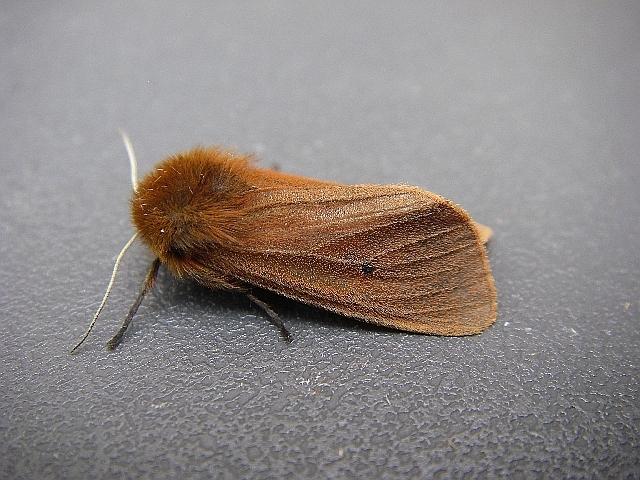
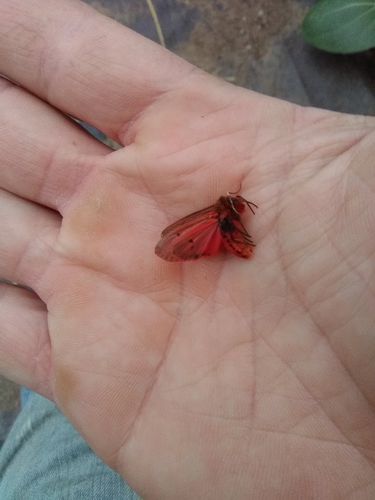
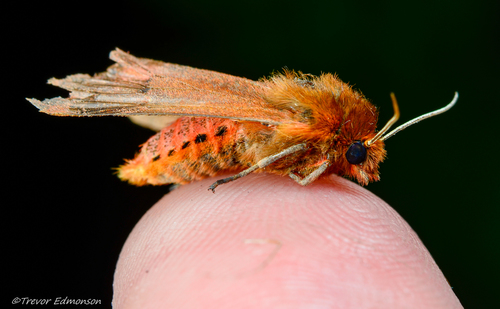
The ruby tiger moth has a wingspan of about 35 to 45 mm and dark reddish-brown forewings with a distinctive black comma-shaped spot edged in carmine. Its hindwings are bright carmine, partly transparent near the front, and bear black spots near the edge and wing tip. It lives in moist open forests, meadows and low-elevation agricultural areas across most of Europe, North Africa, parts of Asia and northern North America, and the adults fly from May to August (two generations in the south of England).
Source: Wikipedia
How to recognize it
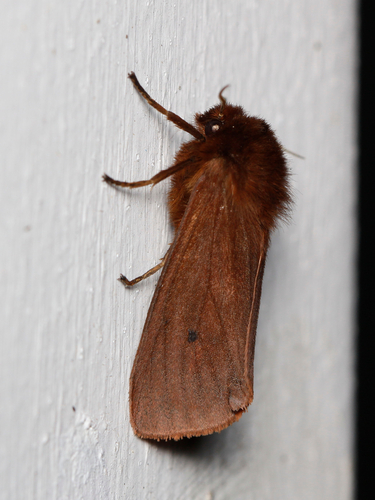
Forewings are dark reddish brown with a black comma-shaped spot at the cell apex, edged in carmine.
Source: Wikipedia
Size
Wingspan ranges from 35 to 45 mm.
Source: Wikipedia
Where it lives
Found in moist open forests, meadows, low-elevation mixed hardwood forests and agricultural fields. In winter, larvae may emerge onto field paths and roads on warm days.
Source: Wikipedia
What it eats
Caterpillars are polyphagous, feeding on many plants such as blackberry, blackthorn, meadowsweet, plantain, ragwort, various willows, knotweed, dock, cinquefoil, raspberry, clover, fireweed, heather, bilberry, bog bilberry, Andromeda, dandelion and others.
Source: Wikipedia
Life cycle
Adults are on the wing from May to August, with two broods in southern England and one brood in northern areas.
Source: Wikipedia
When you see it
Flight period spans May through August, varying by location.
Source: Wikipedia
Where it comes from
Occurs throughout the Palearctic region, including most of Europe, North Africa, Russia, Central Asia, Tibet, and northern North America.
Source: Wikipedia
Lookalikes
The northern form P. fuliginosa borealis has strong black markings and red limited to the abdomen sides and hindwing anal area. The form ab. subnigra has very dark forewings but is only slightly darker than the typical form and less transparent than borealis.
Source: Wikipedia
Where it is found in the US
Recorded in 32 of 51 states and DC. Most records: Michigan, Massachusetts, Vermont, New York, Pennsylvania, Connecticut, Minnesota, Wisconsin.
Darker = more records. Counts are museum and citizen-science records, not population size.
Source: GBIF
Status: native in North America; native in Canada; native in United States. Source: iNaturalist
Months it is reported in the US
Source: GBIF
More photos
Questions people ask
Can they damage my garden?
Yes, the larvae feed on many common garden plants and can cause noticeable feeding damage.
Source: Wikipedia
When will I see the adult moths?
Adults fly from May to August, with two generations in the south of England and one in the north.
Source: Wikipedia
Where are ruby tiger moths found?
They occur across most of Europe, North Africa, parts of Asia and northern North America, in moist open forests and meadow habitats.
Source: Wikipedia
Same family (Erebidae)
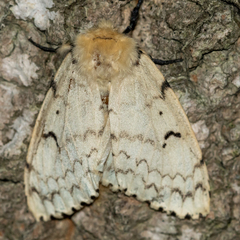 Spongy MothLymantria disparDamages trees, gardens or crops
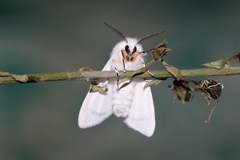 Fall Webworm MothHyphantria cuneaDamages trees, gardens or crops
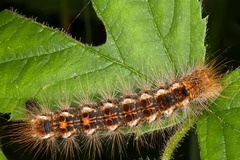 Brown-tail MothEuproctis chrysorrhoeaCan irritate skin
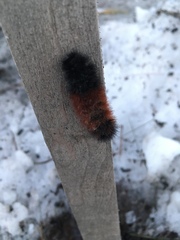 Isabella Tiger MothPyrrharctia isabella
 Virginian Tiger MothSpilosoma virginicaCan irritate skin
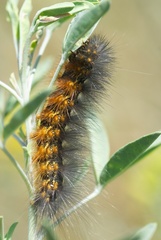 Salt Marsh MothEstigmene acrea
Sources
- Wikipedia: https://en.wikipedia.org/wiki/Phragmatobia_fuliginosa
Look it up elsewhere: GBIF · iNaturalist · BugGuide · ITIS · Wikipedia
Text written 2026-10-22 from the sources above and checked sentence by sentence against them. Data fetched 2026-10-22.