 Bug FAQ
Rosy Footman
Miltochrista miniata · Order: Lepidoptera · Family: Erebidae
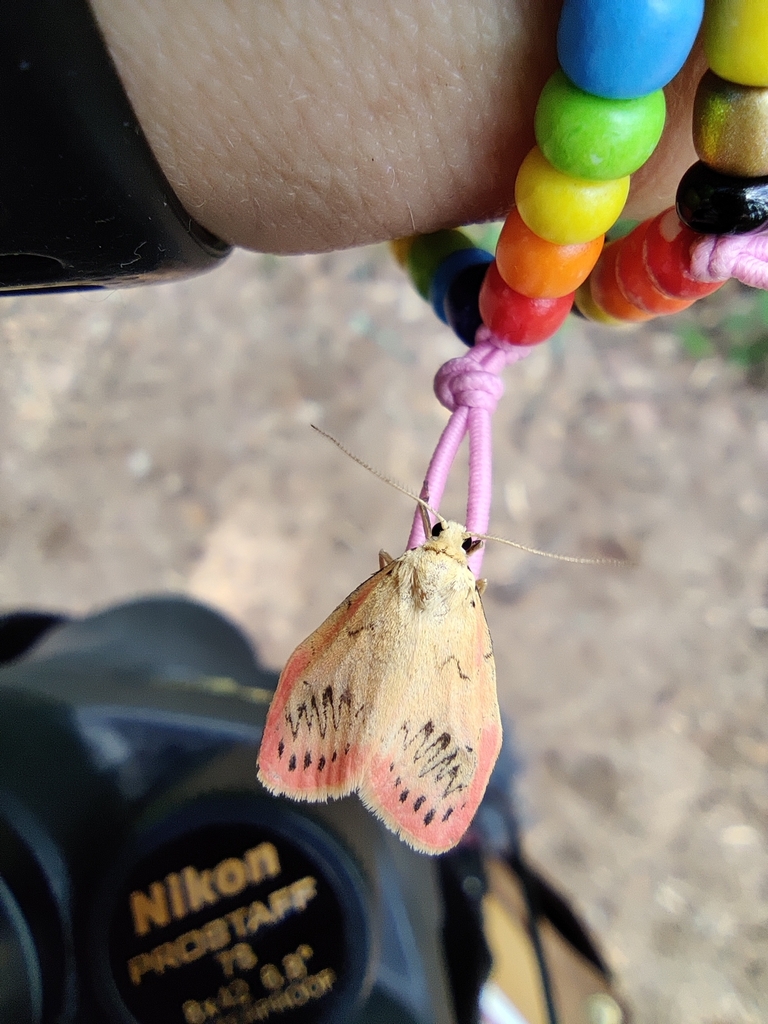
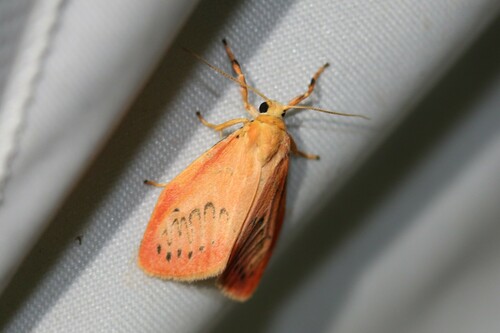
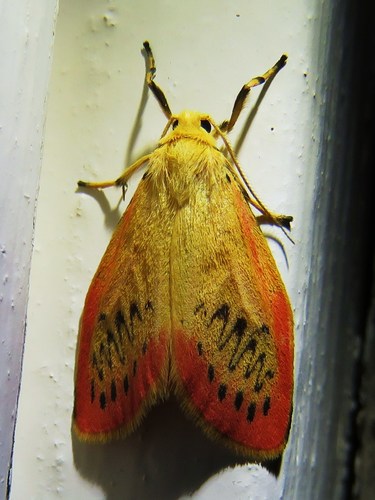
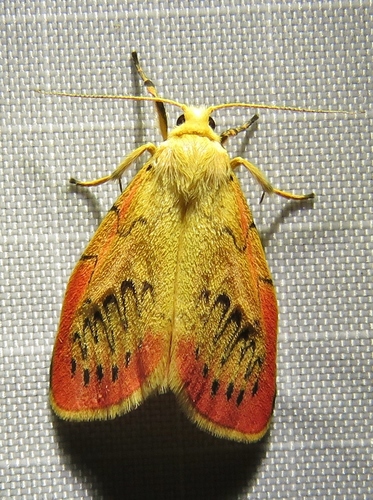
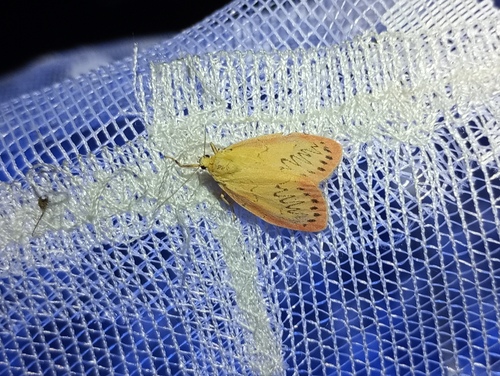
The Rosy Footman moth has a wingspan of about 23 to 27 mm and shows a tannish-peach ground colour with a rose-red forewing margin and distinctive black markings. It lives in broadleaf and mixed forests, moors, roadside ditches and on plants such as umbellifers and scabious, and its larvae feed on lichens on walls and fences. Adults fly from June to September, laying yellow oval eggs; the caterpillars hibernate until June, then pupate in a hairy cocoon with a black-brown pupa.
Source: Wikipedia
How to recognize it
In males the leading edge of the forewing curves upward beyond the cell apex.
Source: Wikipedia
Size
Wingspan ranges from 23 to 27 mm.
Source: Wikipedia
Where it lives
Larvae live on lichens on walls and fences, hibernating until June.
Source: Wikipedia
What it eats
Caterpillars eat lichens; the phenolic compounds they ingest protect them from predators.
Source: Wikipedia
Life cycle
Eggs are oval and yellow. Pupae are black-brown with yellow abdominal incisions, enclosed in a densely hairy cocoon.
Source: Wikipedia
When you see it
Adults are on the wing from June through September, varying with location.
Source: Wikipedia
Where it comes from
Occurs throughout temperate Palearctic regions including Europe, parts of Asia, and Japan, sometimes replaced by Miltochrista rosaria in the east.
Source: Wikipedia
Lookalikes
In the east, Miltochrista rosaria may replace it; that form has a more yellow ground colour, while ab. crogea shows pale yellow wings edged with bright yellow.
Source: Wikipedia
More photos
Questions people ask
When can I see adult Rosy Footman moths?
Adults fly from June to September, depending on where you are.
Source: Wikipedia
What do the caterpillars eat?
The larvae feed on lichens, and the chemicals they take up help deter predators.
Source: Wikipedia
Where does this moth live?
It is found in broadleaf and mixed forests, moors, roadside ditches, and on plants like umbellifers and scabious across temperate Europe and Asia.
Source: Wikipedia
Same family (Erebidae)
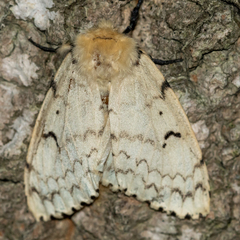 Spongy MothLymantria disparDamages trees, gardens or crops
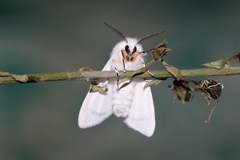 Fall Webworm MothHyphantria cuneaDamages trees, gardens or crops
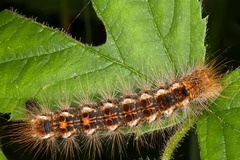 Brown-tail MothEuproctis chrysorrhoeaCan irritate skin
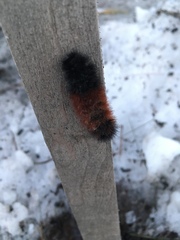 Isabella Tiger MothPyrrharctia isabella
 Virginian Tiger MothSpilosoma virginicaCan irritate skin
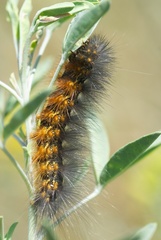 Salt Marsh MothEstigmene acrea
Sources
- Wikipedia: https://en.wikipedia.org/wiki/Miltochrista_miniata
Look it up elsewhere: GBIF · iNaturalist · BugGuide · Wikipedia
Text written 2026-10-22 from the sources above and checked sentence by sentence against them. Data fetched 2026-10-22.