 Bug FAQ
Polka-Dot Wasp Moth
Syntomeida epilais · Order: Lepidoptera · Family: Erebidae
Also called: Oleander Moth
Source: Wikipedia

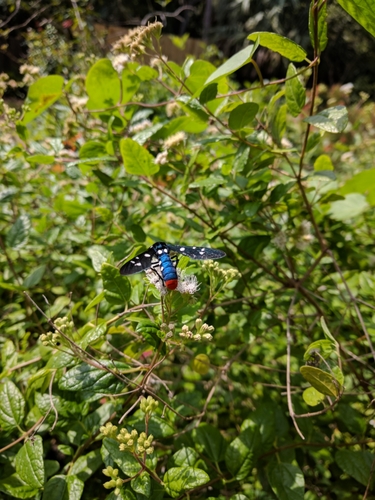
Adults are dark metallic blue with white spots and a bright red tip on the abdomen. Caterpillars are orange with long black hairs that do not harm people. The larvae eat oleander and desert rose, often in large groups, and can heavily damage these plants.
Source: Wikipedia
How to recognize it
Caterpillars are orange or dark orange and covered with long black hairs that look dangerous but are harmless.
Source: Wikipedia
Is it a pest in the house?
The larval stage, known as the oleander caterpillar, has a gluttonous appetite. Caterpillars are gregarious and can cause damage ranging from minor to severe.
Source: Wikipedia
Where it lives
They are native to Neotropical regions. Caterpillars are found wherever oleander grows, except in California.
Source: Wikipedia
What it eats
Larvae feed on oleander plants. They also feed on desert rose plants.
Source: Wikipedia
Life cycle
Females lay groups of 12 to 75 eggs on the undersides of oleander leaves. The eggs are pale cream to light yellow, spherical, and less than 1 mm in diameter.
Source: Wikipedia
When you see it
Adults are day-flying moths.
Source: Wikipedia
Where it comes from
The species is thought to be native to the Caribbean.
Source: Wikipedia
Lookalikes
Their coloration mimics a dangerous wasp, but they are harmless moths.
Source: Wikipedia
Where it is found in the US
Recorded in 8 of 51 states and DC. Most records: Florida, Georgia, South Carolina, Texas, Kansas, Alabama, Michigan, New York.
Darker = more records. Counts are museum and citizen-science records, not population size.
Source: GBIF
Status: native in North America. Source: iNaturalist
Months it is reported in the US
Source: GBIF
More photos


Questions people ask
Do they damage garden plants?
Yes, the larvae feed on oleander and desert rose and can cause minor to severe damage to these plants.
Source: Wikipedia
Same family (Erebidae)
 Spongy MothLymantria disparDamages trees, gardens or crops
 Fall Webworm MothHyphantria cuneaDamages trees, gardens or crops
 Brown-tail MothEuproctis chrysorrhoeaCan irritate skin
 Isabella Tiger MothPyrrharctia isabella
 Virginian Tiger MothSpilosoma virginicaCan irritate skin
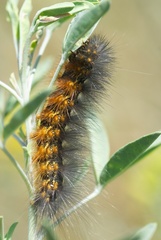 Salt Marsh MothEstigmene acrea
Sources
- Wikipedia: https://en.wikipedia.org/wiki/Syntomeida_epilais
Look it up elsewhere: GBIF · iNaturalist · BugGuide · ITIS · Wikipedia
Text written 2026-10-23 from the sources above and checked sentence by sentence against them. Data fetched 2026-10-23.