 Bug FAQ
Pale Tussock Moth
Calliteara pudibunda · Order: Lepidoptera · Family: Erebidae
Also called: Pale Tussock
Source: Wikipedia

Adults have a wingspan of 4 to 6 cm and show different wing colours in males and females. The caterpillars feed on a range of trees including oak, beech, willow, birch, Prunus and Crataegus.
Source: Wikipedia
How to recognize it
Females have grey-white forewings dusted with dark markings and white-edged wavy lines; hindwings are white with a faint dark band. Males have olive-grey forewings with a dark median area and faint wavy lines; hindwings are grey-yellow with a more distinct transverse band.
Source: Wikipedia
Size
The wingspan ranges from 40 to 60 mm.
Source: Wikipedia
Where it lives
It is a pest of European beech forests.
Source: Wikipedia
What it eats
Historically it also fed on hop plants, earning the name “hop dog”.
Source: Wikipedia
Life cycle
Adults are on the wing from April to June. Eggs are light yellow-brown with a dark spot; larvae are usually lemon-yellow but can vary in colour.
Source: Wikipedia
When you see it
The moth is active in the spring, flying from April through June.
Source: Wikipedia
Where it comes from
It occurs across Europe and parts of Asia, including Anatolia, the Caucasus, Siberia and East Asia.
Source: Wikipedia
Lookalikes
The male form juglandis has a grey-white head and thorax and a whitish base on the forewing, unlike the typical dark brown. Aberration concolor shows uniformly dark grey forewings with little or no transverse lines.
Source: Wikipedia
Where it is found in the US
Recorded in 1 of 51 states and DC. Most records: Massachusetts.
Darker = more records. Counts are museum and citizen-science records, not population size.
Source: GBIF
Questions people ask
Are they a problem for gardens or crops?
Yes, the caterpillars feed on many tree species and were once a pest of hop plants.
Source: Wikipedia
Same family (Erebidae)
 Spongy MothLymantria disparDamages trees, gardens or crops
 Fall Webworm MothHyphantria cuneaDamages trees, gardens or crops
 Brown-tail MothEuproctis chrysorrhoeaCan irritate skin
 Isabella Tiger MothPyrrharctia isabella
 Virginian Tiger MothSpilosoma virginicaCan irritate skin
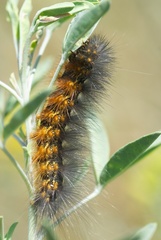 Salt Marsh MothEstigmene acrea
Sources
- Wikipedia: https://en.wikipedia.org/wiki/Calliteara_pudibunda
Look it up elsewhere: GBIF · iNaturalist · BugGuide · Wikipedia
Text written 2026-10-22 from the sources above and checked sentence by sentence against them. Data fetched 2026-10-22.