 Bug FAQ
New Zealand Blue Blowfly
Calliphora quadrimaculata · Order: Diptera · Family: Calliphoridae
Source: Wikipedia
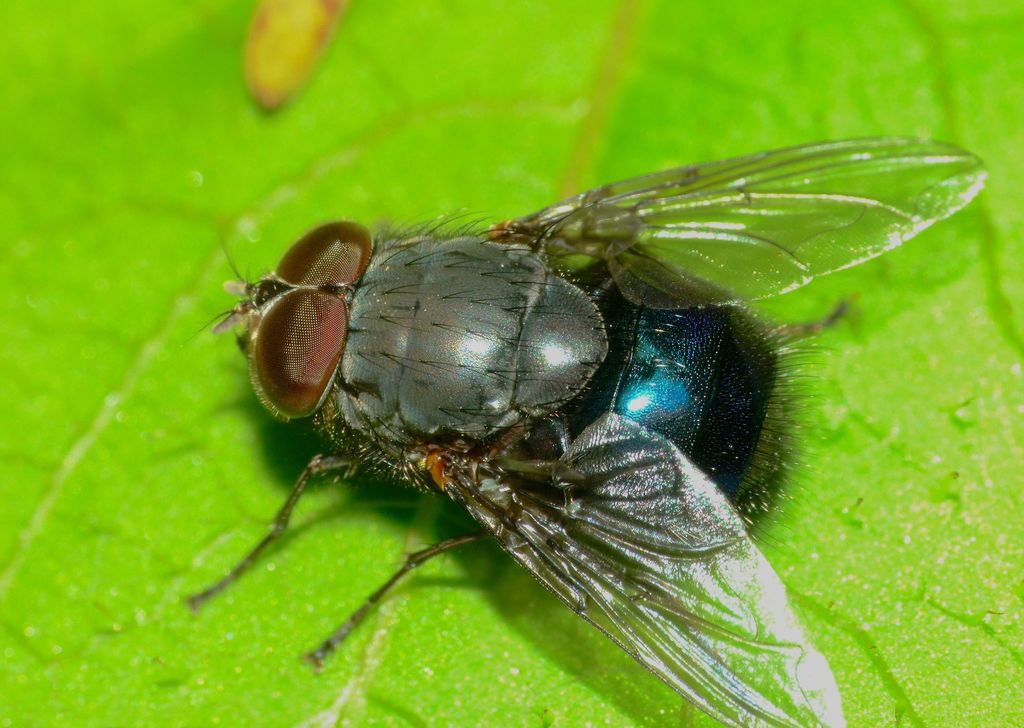
Adults are New Zealand’s largest native blowflies, measuring about 9.5 to 15 mm long. They are found across the main islands and outlying islands of New Zealand and feed on decaying animal and plant matter, sometimes visiting alpine hebe flowers for nectar. The species can act as a vector for human bacterial diseases such as dysentery.
Source: Wikipedia
How to recognize it
The abdomen is black with a violet or blue-green metallic sheen and no dusting. Wing bases are darkened with a brown tint and the wing veins are brown.
Source: Wikipedia
Size
Adults range from 9.5 to 15 mm in body length, making them the largest native blowfly in New Zealand.
Source: Wikipedia
Does it bite or sting?
They can transmit bacterial infections such as dysentery from animals to humans. While not a primary cause of myiasis, they may act as a secondary source.
Source: Wikipedia
Where it lives
It occurs throughout the North and South Islands and on the Chatham, Auckland, Stewart and Campbell Islands. Populations on Auckland and Campbell Islands show a blue-green metallic abdomen instead of the typical violet sheen.
Source: Wikipedia
What it eats
They mainly consume decaying animal carcasses and rotting plant material. In alpine areas they also visit hebe flowers for nectar, acting as pollinators.
Source: Wikipedia
Life cycle
The species has a relatively short life cycle, completing from egg to egg in about 20 to 25 days.
Source: Wikipedia
When you see it
Mating peaks in the summer months, especially February, because development requires warm temperatures.
Source: Wikipedia
Questions people ask
Can the New Zealand blue blowfly spread disease to people?
Yes, it can carry and transmit bacterial infections like dysentery to humans.
Source: Wikipedia
Do they bite or cause myiasis?
They are not the main cause of myiasis, but they can be a secondary source of the condition.
Source: Wikipedia
Same family (Calliphoridae)
 Common European Greenbottle FlyLucilia sericataNuisance, not dangerous
 Blue BlowflyCalliphora vicinaCan spread germs or disease
 Black Blow FlyPhormia reginaNuisance, not dangerous
 Oriental Latrine FlyChrysomya megacephalaCan spread germs or disease
 Australian Sheep Blow FlyLucilia cuprinaNuisance, not dangerous
 Locust BlowflyStomorhina lunata
Sources
- Wikipedia: https://en.wikipedia.org/wiki/Calliphora_quadrimaculata
Look it up elsewhere: GBIF · iNaturalist · BugGuide · Wikipedia
Text written 2026-10-23 from the sources above and checked sentence by sentence against them. Data fetched 2026-10-23.