 Bug FAQ
New World Screwworm Fly
Cochliomyia hominivorax · Order: Diptera · Family: Calliphoridae
Also called: New World screw-worm fly, New world screwworm
Source: Wikipedia
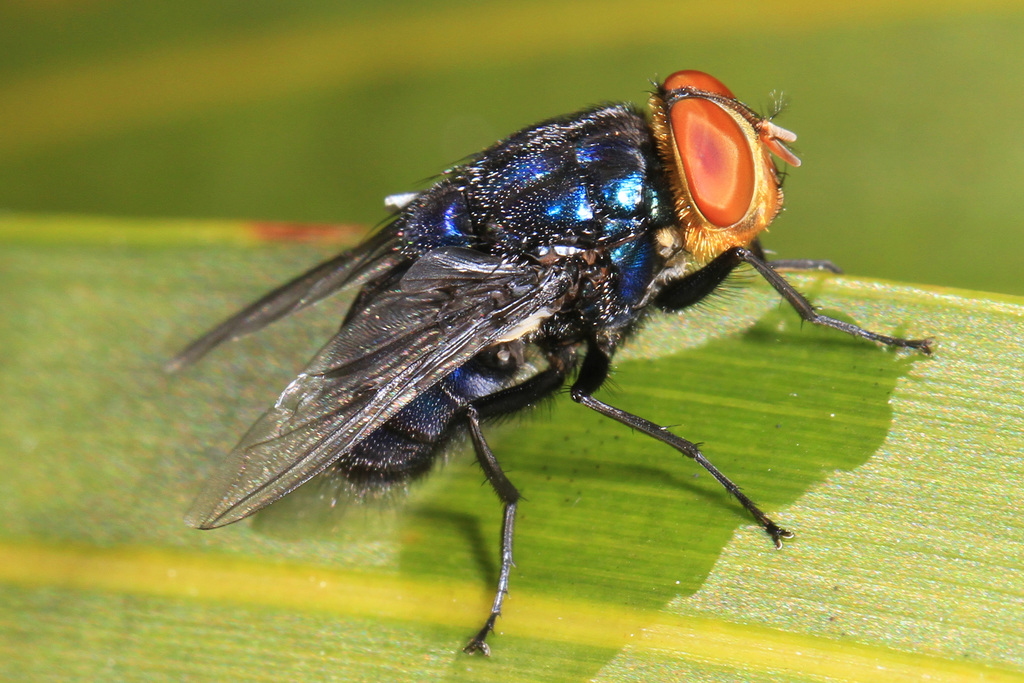
Is it a pest in the house?
Cold-blooded animals or carrion cannot be infested.
Source: Wikipedia
Can it bite, sting or make you sick?
It prefers to lay eggs near wounds, newborn navels, or insect bites.
Source: Wikipedia
What it eats
The larvae hatch and burrow into surrounding tissue as they feed.
Source: Wikipedia
Life cycle
Females lay 250 to 500 eggs on exposed flesh of warm-blooded animals. After three to seven days the larvae drop to the ground to pupate, and about a week later the adults emerge.
Source: Wikipedia
When you see it
Populations collapse in winter in the extreme southern and former northern areas but stay stable in the tropics.
Source: Wikipedia
Lookalikes
The Old World screwworm (Chrysomya bezziana) is a different genus but also parasitic.
Source: Wikipedia
Where it is found in the US
Recorded in 10 of 51 states and DC. Most records: Texas, District of Columbia, New Mexico, Indiana, Iowa, Missouri, South Carolina, Florida.
Darker = more records. Counts are museum and citizen-science records, not population size.
Source: GBIF
Months it is reported in the US
Source: GBIF
More photos
Questions people ask
How does the New World screwworm fly damage its host?
Its larvae burrow into living tissue, causing severe damage that can lead to death.
Source: Wikipedia
Where is the New World screwworm fly found?
It occurs throughout tropical New World regions and is present in the United States as of 2026.
Source: Wikipedia
Can the New World screwworm fly be controlled?
Yes, releasing sterile males has eradicated it from many areas, and inspection of imported animals helps prevent its return.
Source: Wikipedia
What animals can be infested by the New World screwworm fly?
It infests wild and domestic warm-blooded animals, and occasionally birds and humans, but not cold-blooded animals or carrion.
Source: Wikipedia
Same family (Calliphoridae)
 Common European Greenbottle FlyLucilia sericataNuisance, not dangerous
 Blue BlowflyCalliphora vicinaCan spread germs or disease
 Black Blow FlyPhormia reginaNuisance, not dangerous
 Oriental Latrine FlyChrysomya megacephalaCan spread germs or disease
 Australian Sheep Blow FlyLucilia cuprinaNuisance, not dangerous
 Locust BlowflyStomorhina lunata
Sources
- Wikipedia: https://en.wikipedia.org/wiki/Cochliomyia_hominivorax
Look it up elsewhere: GBIF · iNaturalist · BugGuide · ITIS · Wikipedia
Text written 2026-10-27 from the sources above and checked sentence by sentence against them. Data fetched 2026-10-27.