 Bug FAQ
Muslin Moth
Diaphora mendica · Order: Lepidoptera · Family: Erebidae

The species lives across the Palearctic region east to Lake Baikal and flies from April to July depending on location.
Source: Wikipedia
How to recognize it
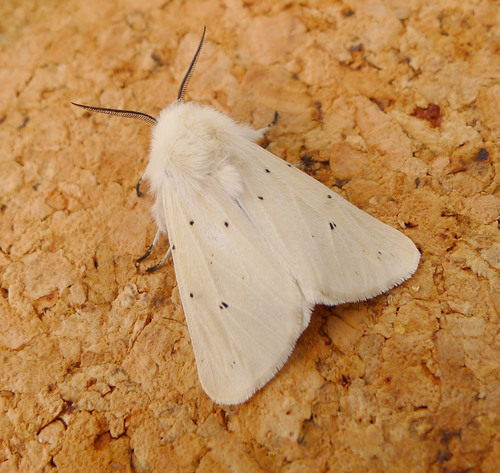
Males are sooty brown-grey, often with a black dot at the wing cell apex; females are thinly scaled, milky white with very sparse wing dots.
Source: Wikipedia
Size
Wingspan ranges from 28 to 38 mm. Male forewings are 14 to 17 mm; female forewings are 17 to 19 mm.
Source: Wikipedia
Where it lives
Found throughout the Palearctic realm east to Lake Baikal.
Source: Wikipedia
What it eats
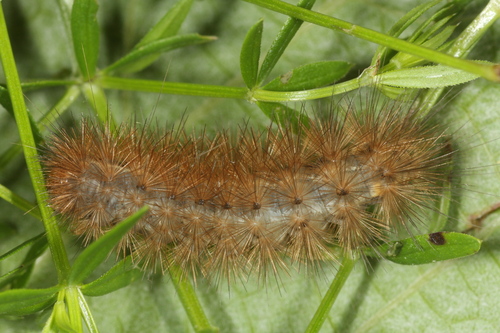
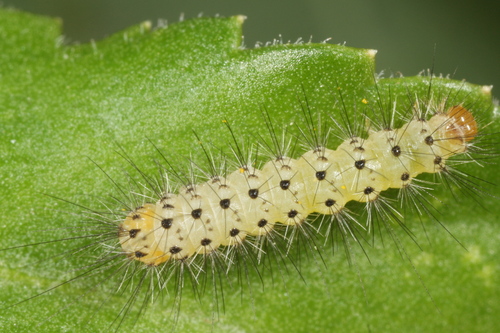
Larvae eat birch, willow, Rumex, Lamium and Plantago.
Source: Wikipedia
When you see it
Adults are on the wing from April through July, varying by location.
Source: Wikipedia
Where it comes from
Its native range is the Palearctic region extending to Lake Baikal.
Source: Wikipedia
Lookalikes
Females look similar to Spilosoma lubricipeda, but that species has longer, smaller wings and a yellow-black back.
Source: Wikipedia
Where it is found in the US
Recorded in 1 of 51 states and DC. Most records: Pennsylvania.
Darker = more records. Counts are museum and citizen-science records, not population size.
Source: GBIF
More photos
Questions people ask
When can I expect to see Muslin moths?
Adults fly from April to July, depending on where you are.
Source: Wikipedia
How can I tell a male Muslin moth from a female?
Males are brown-grey with a possible black dot on the wing cell; females are milky white with very few wing spots.
Source: Wikipedia
What size are Muslin moths?
Their wingspan is 28 to 38 mm; males have forewings 14 to 17 mm long and females 17 to 19 mm.
Source: Wikipedia
Same family (Erebidae)
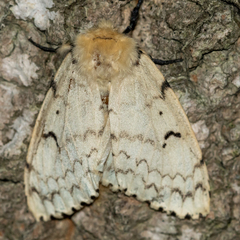 Spongy MothLymantria disparDamages trees, gardens or crops
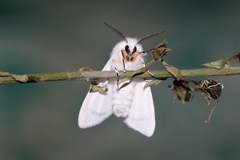 Fall Webworm MothHyphantria cuneaDamages trees, gardens or crops
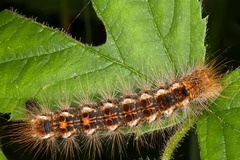 Brown-tail MothEuproctis chrysorrhoeaCan irritate skin
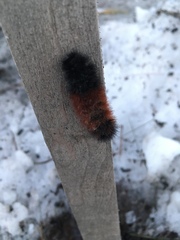 Isabella Tiger MothPyrrharctia isabella
 Virginian Tiger MothSpilosoma virginicaCan irritate skin
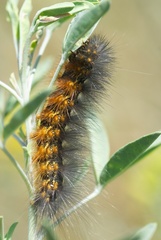 Salt Marsh MothEstigmene acrea
Sources
- Wikipedia: https://en.wikipedia.org/wiki/Diaphora_mendica
Look it up elsewhere: GBIF · iNaturalist · BugGuide · Wikipedia
Text written 2026-10-22 from the sources above and checked sentence by sentence against them. Data fetched 2026-10-22.