 Bug FAQ
Marsh Greenbottle Fly
Lucilia silvarum · Order: Diptera · Family: Calliphoridae
Also called: Marsh Greenbottle
Source: Wikipedia
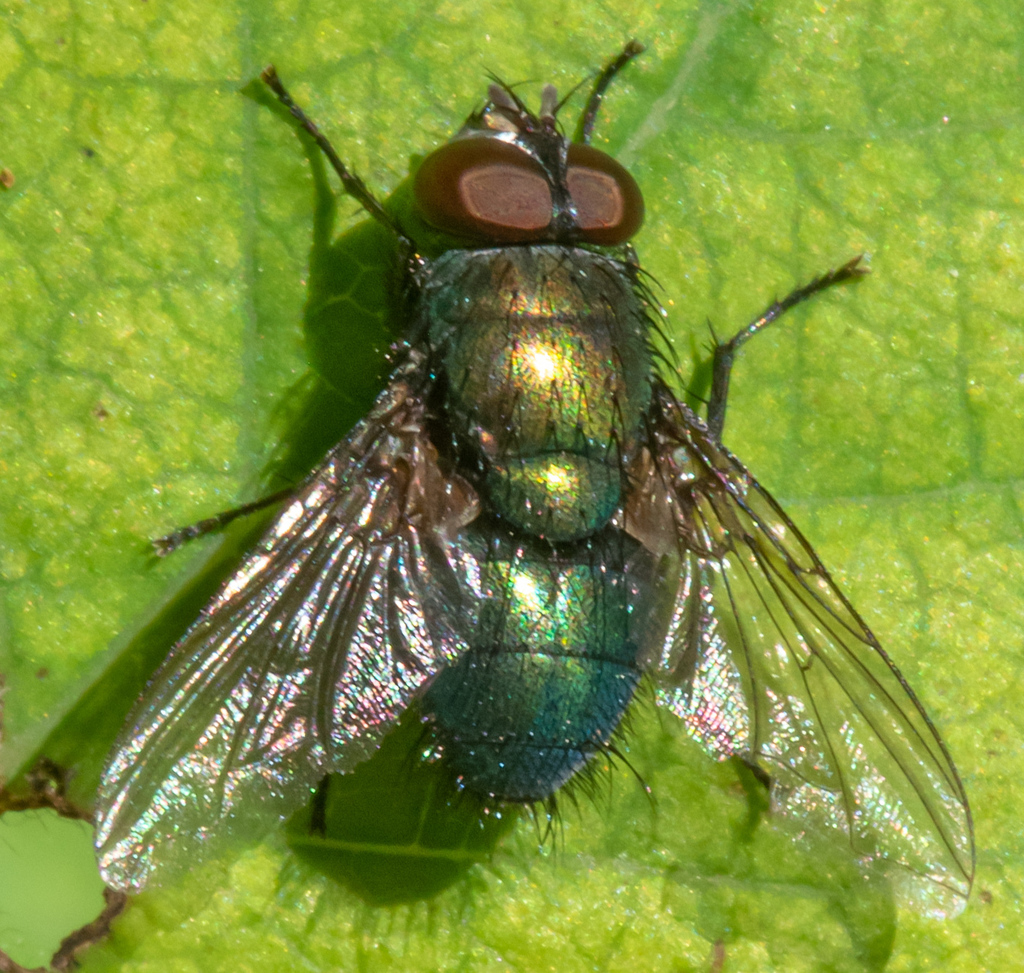
Marsh greenbottle flies are metallic green blowflies that are attracted to carrion and other foul sites. Adults are 4.5 to 10 mm long and feed on nectar, while the larvae grow from about 2 mm at hatching to roughly 17 mm before pupating. The species is common in warm weather (24 to 29 °C) and is often the first blowfly found on corpses in North America.
Source: Wikipedia
How to recognize it
Adults have one pair of wings, a metallic sheen, and feathery aristae on the antennae.
Source: Wikipedia
Size
Adult flies measure between 4.5 and 10 mm in length. Newly hatched larvae are about 2 mm long and can reach up to 17 mm as they develop.
Source: Wikipedia
Is it a pest in the house?
Its larvae can cause myiasis, infesting necrotic tissue in humans and animals.
Source: Wikipedia
Where it lives
They are commonly found on carrion and in places with high levels of filth. The species prefers warm temperatures, typically 75 to 85 °F (24 to 29 °C).
Source: Wikipedia
What it eats
Adult flies feed on nectar and other sweet liquids. Larvae scavenge on carrion, dung, and can infest necrotic tissue of animals and humans.
Source: Wikipedia
Life cycle
Mating is followed by the female laying eggs on carrion. Larval development proceeds through three stages: the first appears about 2 days after hatching, the second after roughly 2.5 days, and the third after 4 to 5 days.
Source: Wikipedia
When you see it
The fly is active in warm weather, thriving at temperatures between 24 °C and 29 °C. In North America it is usually the first blowfly species to colonize a corpse.
Source: Wikipedia
Where it comes from
It occurs in the United States and Canada. Other countries where it is found include China, Denmark, Finland, Norway, North Africa, and Russia.
Source: Wikipedia
Lookalikes
It is hard to separate from other green blowflies without close examination. All true flies have a single pair of wings and metallic coloration, which this species shares with many relatives.
Source: Wikipedia
Where it is found in the US
Recorded in 27 of 51 states and DC. Most records: Illinois, Wisconsin, Ohio, Vermont, California, Massachusetts, Minnesota, New York.
Darker = more records. Counts are museum and citizen-science records, not population size.
Source: GBIF
Status: native in North America; native in Canada. Source: iNaturalist
Months it is reported in the US
Source: GBIF
More photos

Questions people ask
How does myiasis occur?
The larvae infest necrotic tissue of humans or animals, leading to a painful myiasis infection.
Source: Wikipedia
When are these flies most common?
They are most active in warm weather, between 24 °C and 29 °C, and are often the first blowflies on corpses in North America.
Source: Wikipedia
What do adult marsh greenbottle flies eat?
Adults feed on nectar and other sweet liquids.
Source: Wikipedia
Where can I find this species?
It is found in the United States, Canada, and several other countries across Europe, Asia, and Africa.
Source: Wikipedia
Same family (Calliphoridae)
 Common European Greenbottle FlyLucilia sericataNuisance, not dangerous
 Blue BlowflyCalliphora vicinaCan spread germs or disease
 Black Blow FlyPhormia reginaNuisance, not dangerous
 Oriental Latrine FlyChrysomya megacephalaCan spread germs or disease
 Australian Sheep Blow FlyLucilia cuprinaNuisance, not dangerous
 Locust BlowflyStomorhina lunata
Sources
- Wikipedia: https://en.wikipedia.org/wiki/Lucilia_silvarum
Look it up elsewhere: GBIF · iNaturalist · BugGuide · Wikipedia
Text written 2026-10-27 from the sources above and checked sentence by sentence against them. Data fetched 2026-10-27.