 Bug FAQ
Lucilia mexicana
Lucilia mexicana · Order: Diptera · Family: Calliphoridae
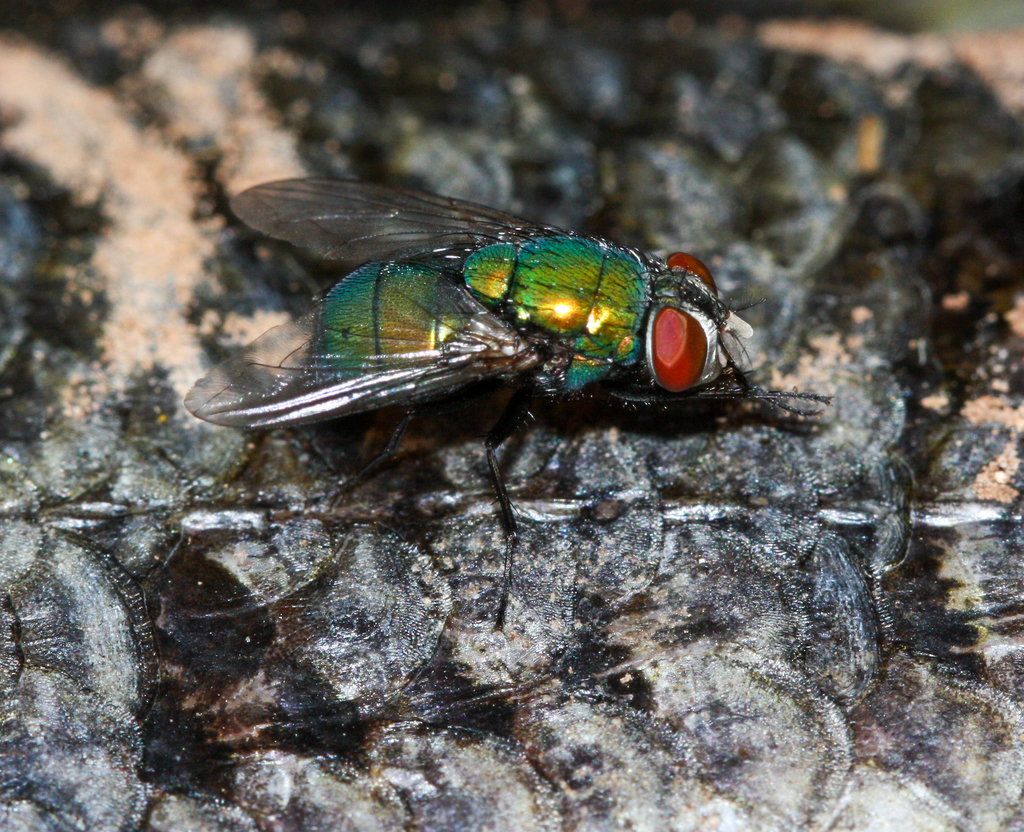
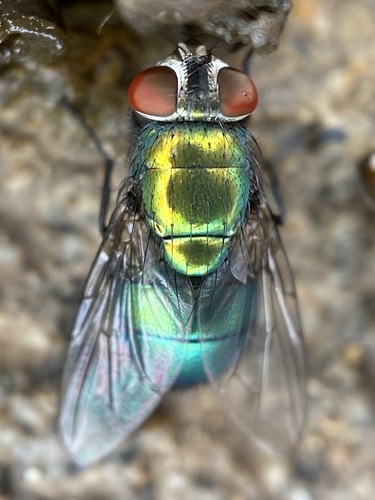
Adult Lucilia mexicana are metallic blue-green with purple tinges and have black setae on the propleuron and dark brown wing bases. They are 6 to 9 mm long, lay eggs on carrion, and develop through three larval instars after about a week of egg incubation. The species lives in wooded and urban areas of the southwestern United States, Mexico and further into South America, where it is attracted to feces, garbage and fresh carrion.
Source: Wikipedia
How to recognize it
The thorax is metallic blue-green with purple hints, and the propleuron bears black hairs and dark brown wing base sclerites.
Source: Wikipedia
Size
Adults measure about 6 to 9 mm in length.
Source: Wikipedia
Is it a pest in the house?
In forensic entomology, L. mexicana is noted for its attraction to fresh carrion and waste in both natural and urban settings.
Source: Wikipedia
What it eats
Females lay their eggs on carrion, providing food for the developing larvae.
Source: Wikipedia
Life cycle
The larval stage consists of three distinct instars. Eggs hatch into the first instar after 7 to 14 hours of incubation.
Source: Wikipedia
When you see it
Because it colonizes fresh carcasses, it is useful for estimating post-mortem intervals in forensic cases.
Source: Wikipedia
Where it comes from
Its native range stretches from the southwestern United States through Mexico into Brazil.
Source: Wikipedia
Lookalikes
Morphological differences exist, though molecular barcode analysis may be needed for definitive identification.
Source: Wikipedia
Where it is found in the US
Recorded in 7 of 51 states and DC. Most records: California, Arizona, Texas, New Mexico, Kansas, Nevada, Pennsylvania.
Darker = more records. Counts are museum and citizen-science records, not population size.
Source: GBIF
Months it is reported in the US
Source: GBIF
More photos
Questions people ask
How can I tell Lucilia mexicana apart from similar flies?
Look for two or more full rows of post-ocular setae on the head; L. coeruleiviridis lacks these rows.
Source: Wikipedia
Where is Lucilia mexicana found?
It occurs from the southwestern United States through Mexico and into Brazil, inhabiting both woods and urban areas.
Source: Wikipedia
What is the life cycle of Lucilia mexicana?
The species lays eggs on carrion; eggs hatch in 7 to 14 hours, and the larvae pass through three instars before pupating.
Source: Wikipedia
Same family (Calliphoridae)
 Common European Greenbottle FlyLucilia sericataNuisance, not dangerous
 Blue BlowflyCalliphora vicinaCan spread germs or disease
 Black Blow FlyPhormia reginaNuisance, not dangerous
 Oriental Latrine FlyChrysomya megacephalaCan spread germs or disease
 Australian Sheep Blow FlyLucilia cuprinaNuisance, not dangerous
 Locust BlowflyStomorhina lunata
Sources
- Wikipedia: https://en.wikipedia.org/wiki/Lucilia_mexicana
Look it up elsewhere: GBIF · iNaturalist · BugGuide · ITIS · Wikipedia
Text written 2026-10-29 from the sources above and checked sentence by sentence against them. Data fetched 2026-10-29.