 Bug FAQ
Jigsaw
Dysgonia torrida · Order: Lepidoptera · Family: Erebidae
Source: Wikipedia

The Jigsaw moth has a wingspan of about 45 to 50 mm. It occurs from tropical and subtropical Africa across the Mediterranean into southern Europe and extends east through the Middle East to India and Myanmar. The larvae feed on maize, castor bean and Acalypha, making it a pest of those crops.
Source: Wikipedia
How to recognize it
The forewing shows an erect antemedial line with a broad, white, slightly diffused band beyond it. A postmedial line angles between veins 3 and 4 and becomes sinuous toward the inner margin. The apical streak is broken into two separate spots. Hindwings have a white medial band and a greyish outer margin at the centre.
Source: Wikipedia
Size
Wingspan ranges from 45 to 50 mm.
Source: Wikipedia
What it eats
Larvae feed on maize (Zea mays), castor bean (Ricinus communis) and Acalypha wilkesiana.
Source: Wikipedia
Life cycle
There are several generations each year.
Source: Wikipedia
When you see it
In Europe adults are on the wing in May-June and again in September.
Source: Wikipedia
Where it comes from
Found from tropical and subtropical Africa through Spain, southern Italy, Greece, the Middle East and into India, Sri Lanka and Myanmar.
Source: Wikipedia
More photos


Questions people ask
What plants do the caterpillars eat?
The larvae feed on maize, castor bean and Acalypha, which can damage those crops.
Source: Wikipedia
When can I see adult Jigsaw moths in Europe?
Adults are active in May-June and again in September.
Source: Wikipedia
Same family (Erebidae)
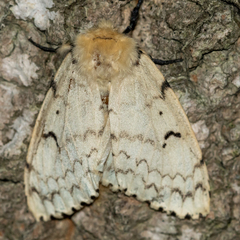 Spongy MothLymantria disparDamages trees, gardens or crops
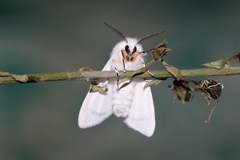 Fall Webworm MothHyphantria cuneaDamages trees, gardens or crops
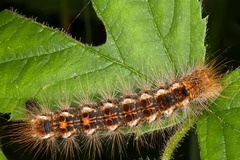 Brown-tail MothEuproctis chrysorrhoeaCan irritate skin
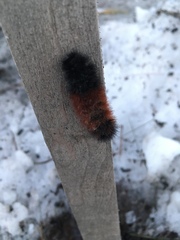 Isabella Tiger MothPyrrharctia isabella
 Virginian Tiger MothSpilosoma virginicaCan irritate skin
 Salt Marsh MothEstigmene acrea
Sources
- Wikipedia: https://en.wikipedia.org/wiki/Dysgonia_torrida
Look it up elsewhere: GBIF · iNaturalist · BugGuide · Wikipedia
Text written 2026-10-23 from the sources above and checked sentence by sentence against them. Data fetched 2026-10-23.