 Bug FAQ
Horned Treehopper
Centrotus cornutus · Order: Hemiptera · Family: Membracidae
Also called: Treehopper, Horned Tree Hopper, Tree Hopper

Adult horned treehoppers are 7 to 10 mm long, dark-brown and have a distinctive arched pronotum with two horn-like side extensions. They live in woodlands, beech forests and hedgerows across most of Europe and the Near East, and can be seen from early May to early August. Both larvae and adults feed on plant juices to larvae on thistles and nettles, adults on poplars, oaks and brambles.
Source: Wikipedia
How to recognize it
The body is dark-brown, the eyes are round and reddish, and the front wings are pale brown, translucent and veined. The pronotum is hairy, arches upward and extends far beyond the wings with two sharp, ear-shaped horns.
Source: Wikipedia
Size
Males are 7 to 10 mm long; females are slightly larger.
Source: Wikipedia
What it eats
They suck plant juices with piercing-sucking mouthparts. Larvae feed mainly on thistles (Cirsium, Carduus) and nettles (Urtica); adults prefer poplars, oaks and brambles.
Source: Wikipedia
Life cycle
They overwinter as larvae in leaf litter and complete their development over two years.
Source: Wikipedia
When you see it
Adults are active from early May through early August.
Source: Wikipedia
Where it comes from
Found throughout most of Europe, the eastern Palearctic realm and the Near East; one of only two treehopper species in the UK.
Source: Wikipedia
Lookalikes
It resembles Gargara genistae, the other UK treehopper, which lacks the horn-like pronotum extensions and is associated with broom.
Source: Wikipedia
Status: introduced in North America. Source: iNaturalist
Questions people ask
How can I tell a horned treehopper apart from other bugs?
Look for the dark-brown body, reddish round eyes, translucent veined wings and the long, arched pronotum with two horn-like side projections.
Source: Wikipedia
When will I see horned treehoppers?
Adults are present from early May to early August.
Source: Wikipedia
What plants do they feed on?
Larvae feed on thistles and nettles, while adults feed on poplars, oaks and brambles.
Source: Wikipedia
Where are horned treehoppers found?
They occur in most of Europe, the eastern Palearctic, the Near East and live in woodlands, beech forests and hedgerows.
Source: Wikipedia
Same family (Membracidae)
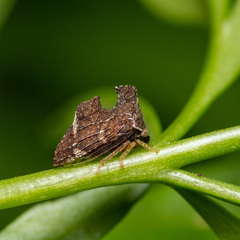 Keeled TreehopperEntylia carinata
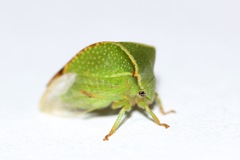 Buffalo TreehopperStictocephala bisoniaDamages trees, gardens or crops
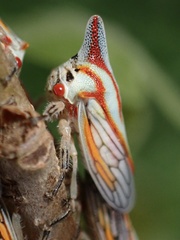 Oak TreehopperPlatycotis vittata
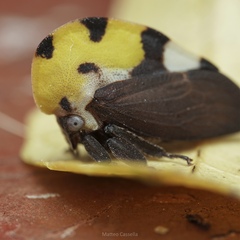 Mexican TreehopperMembracis mexicanaDamages trees, gardens or crops
 Three-cornered Alfalfa HopperSpissistilus festinusDamages trees, gardens or crops
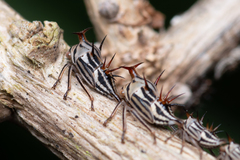 Lantana treehopperAconophora compressaDamages trees, gardens or crops
Sources
- Wikipedia: https://en.wikipedia.org/wiki/Centrotus_cornutus
Look it up elsewhere: GBIF · iNaturalist · BugGuide · Wikipedia
Text written 2026-10-22 from the sources above and checked sentence by sentence against them. Data fetched 2026-10-22.