 Bug FAQ
Hübner's Wasp Moth
Amata huebneri · Order: Lepidoptera · Family: Erebidae
Also called: Tiger Wasp Moth
Source: Wikipedia
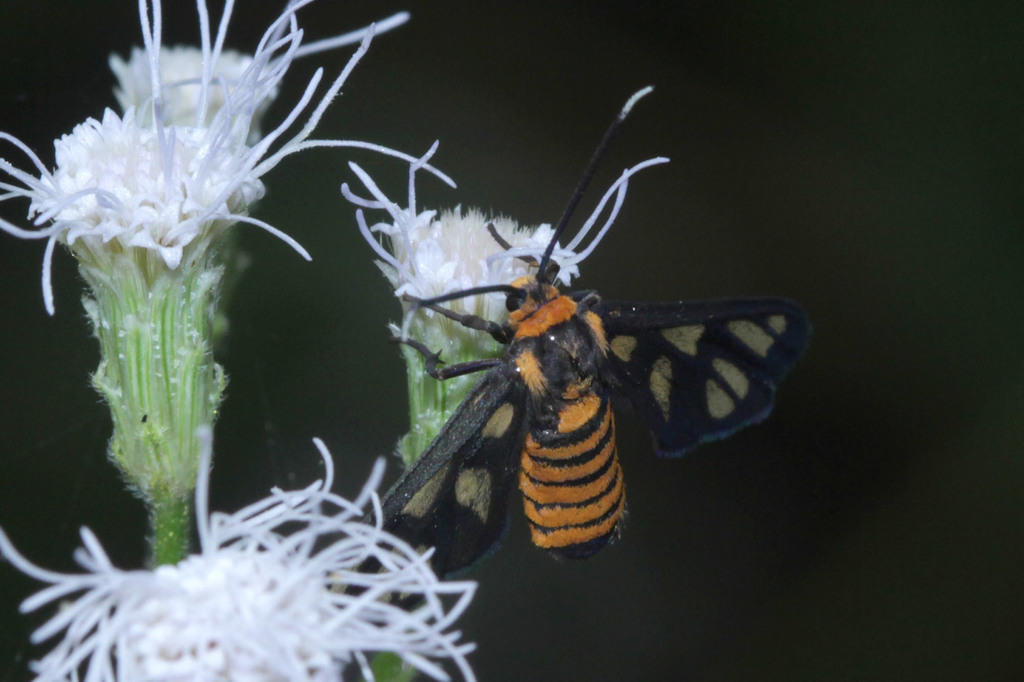
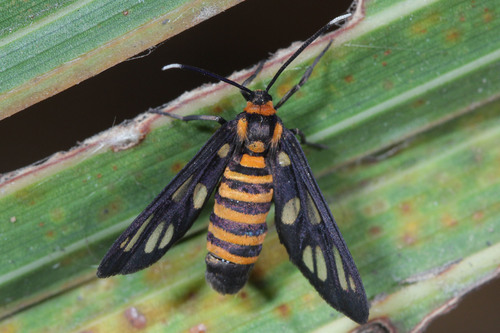
Adult Hübner's wasp moth has black bodies with yellow bands and clear wing windows, mimicking a wasp. The caterpillars eat crops like rice and sweet potato, making the species a potential garden and field pest.
Source: Wikipedia
How to recognize it
Adults are black with yellow abdominal bands and have transparent patches in their wings. They closely resemble wasps in appearance.
Source: Wikipedia
Where it lives
It lives in tropical regions from the Indo-Australian area down to northern Australia.
Source: Wikipedia
What it eats
Larvae have been recorded feeding on rice, sweet potato, Mikania micrantha and Oxalis barrelieri.
Source: Wikipedia
Where it comes from
Its natural range extends across the Indo-Australian tropics to northern Australia.
Source: Wikipedia
Lookalikes
The moth is a wasp mimic, which can cause it to be mistaken for a stinging insect.
Source: Wikipedia
More photos
Questions people ask
What plants do the larvae eat?
The caterpillars feed on rice, sweet potato, Mikania micrantha and Oxalis barrelieri.
Source: Wikipedia
Where is Hübner's wasp moth found?
It occurs in the Indo-Australian tropics through to northern Australia.
Source: Wikipedia
Why does this moth look like a wasp?
Its coloration and wing pattern mimic a wasp, which is a defensive strategy.
Source: Wikipedia
Same family (Erebidae)
 Spongy MothLymantria disparDamages trees, gardens or crops
 Fall Webworm MothHyphantria cuneaDamages trees, gardens or crops
 Brown-tail MothEuproctis chrysorrhoeaCan irritate skin
 Isabella Tiger MothPyrrharctia isabella
 Virginian Tiger MothSpilosoma virginicaCan irritate skin
 Salt Marsh MothEstigmene acrea
Sources
- Wikipedia: https://en.wikipedia.org/wiki/Amata_huebneri
Look it up elsewhere: GBIF · iNaturalist · BugGuide · Wikipedia
Text written 2026-10-22 from the sources above and checked sentence by sentence against them. Data fetched 2026-10-22.