 Bug FAQ
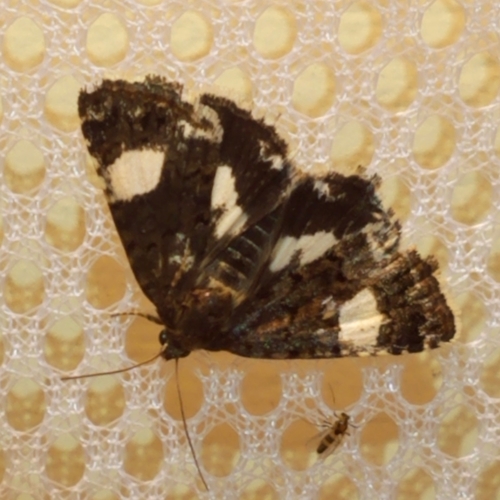
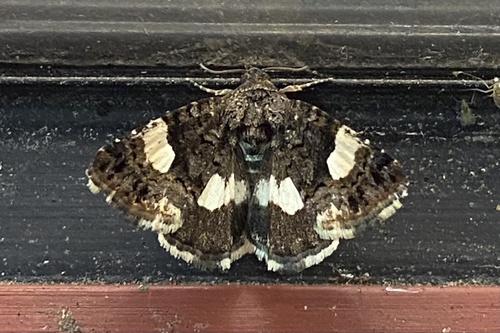
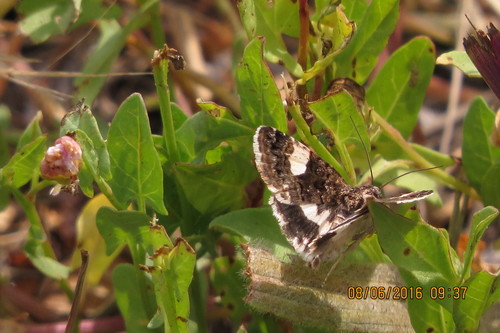
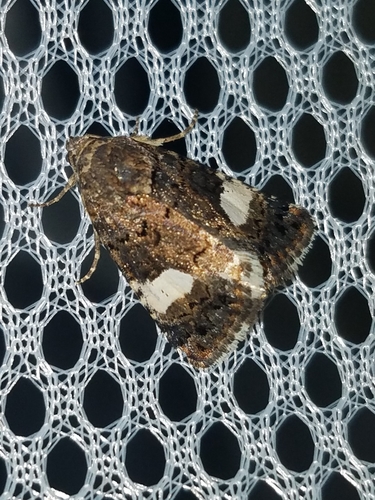
Four-spotted Moth
Tyta luctuosa · Order: Lepidoptera · Family: Erebidae
Also called: Field Bindweed Moth, The Four-spotted

The four-spotted moth is a tiny, dark brown insect with a white spot on each wing and measures about 11 mm long. It lives across much of the Palearctic region, from Europe to China and North Africa. Adults appear twice a year, late spring and summer, with a possible third generation in warm areas, and they feed on leaves, flowers and new buds of bindweed.
Source: Wikipedia
Size
The adult moth is about eleven millimetres long.
Source: Wikipedia
How to get rid of it
The moth is released as a biological control agent against field bindweed, its main food plant, and was first introduced to the United States in the 1980s for this purpose.
Source: Wikipedia
Where it lives
It is native to much of the Palearctic, covering most of Europe, the Caucasus, Kazakhstan, Siberia, China and North Africa.
Source: Wikipedia
What it eats
The moth eats leaves and flowers, especially new buds, of its main food plant, field bindweed.
Source: Wikipedia
When you see it
Adults appear in late spring and again in summer.
Source: Wikipedia
Where it comes from
Its native range includes the same Palearctic area described above.
Source: Wikipedia
Where it is found in the US
Recorded in 8 of 51 states and DC. Most records: Colorado, Utah, Oregon, Washington, Idaho, Wyoming, Montana, Nebraska.
Darker = more records. Counts are museum and citizen-science records, not population size.
Source: GBIF
Status: introduced in North America; introduced in United States; introduced in Canada. Source: iNaturalist
Months it is reported in the US
Source: GBIF
More photos
Questions people ask
Is this moth a problem for my garden?
It feeds on field bindweed, so it actually helps control that weed rather than harming garden plants.
Source: Wikipedia
Same family (Erebidae)
 Spongy MothLymantria disparDamages trees, gardens or crops
 Fall Webworm MothHyphantria cuneaDamages trees, gardens or crops
 Brown-tail MothEuproctis chrysorrhoeaCan irritate skin
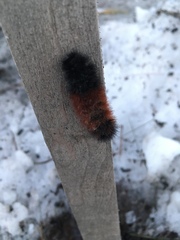 Isabella Tiger MothPyrrharctia isabella
 Virginian Tiger MothSpilosoma virginicaCan irritate skin
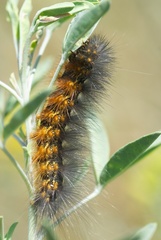 Salt Marsh MothEstigmene acrea
Sources
- Wikipedia: https://en.wikipedia.org/wiki/Tyta
Look it up elsewhere: GBIF · iNaturalist · BugGuide · ITIS · Wikipedia
Text written 2026-10-22 from the sources above and checked sentence by sentence against them. Data fetched 2026-10-22.