 Bug FAQ
Four-spotted Footman
Lithosia quadra · Order: Lepidoptera · Family: Erebidae
Source: Wikipedia
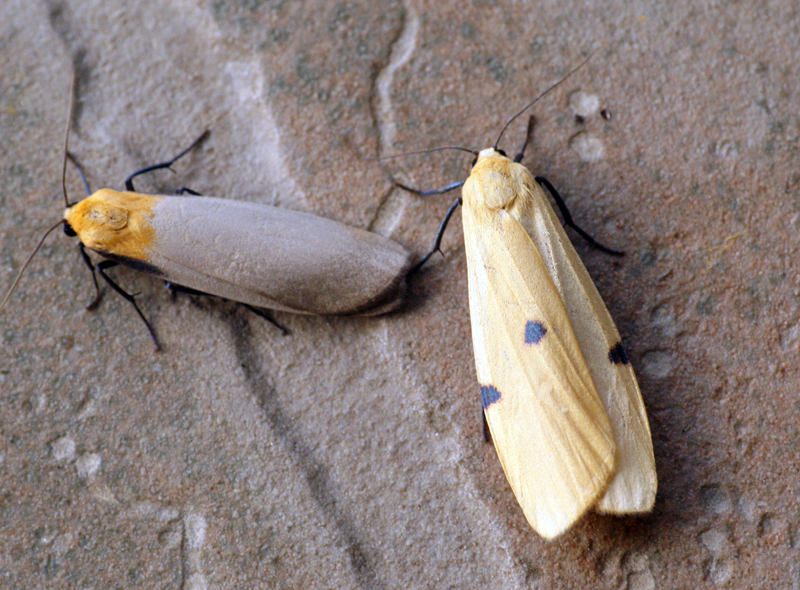
The four-spotted footman moth has a wingspan of about 35 to 55 mm, with males smaller than females. Males show gray wings with a yellow joint and a blue-black stripe on the forewing edge, while females have yellow wings marked with two blue-black dots. It lives across southern and central Europe into the Palearctic, reaching Japan, and is also found in southern Britain and Scandinavia.
Source: Wikipedia
Size
The wingspan ranges from 35 to 55 mm. Males are smaller than females.
Source: Wikipedia
Where it lives
It is also present in southern Great Britain and Scandinavia.
Source: Wikipedia
What it eats
Larvae feed on lichens and algae that grow on trees, walls, and stones, especially oak. When food becomes scarce due to over-abundance, larvae may start eating tree leaves and needles, causing damage.
Source: Wikipedia
Life cycle
Adults fly from June to September, varying with location. In the southern part of the range a second brood can appear occasionally.
Source: Wikipedia
When you see it
Flight period is June to September, depending on where they live. A second generation may occur in southern areas.
Source: Wikipedia
Where it comes from
It is native to southern Britain and Scandinavia as well.
Source: Wikipedia
Lookalikes
Japanese specimens sometimes have darker males, but this is not a consistent difference. European specimens show considerable variation in female size and male colouration.
Source: Wikipedia
More photos


Questions people ask
Do the larvae damage trees?
Yes, when they become too numerous they can eat leaves and needles, harming trees and garden plants.
Source: Wikipedia
Same family (Erebidae)
 Spongy MothLymantria disparDamages trees, gardens or crops
 Fall Webworm MothHyphantria cuneaDamages trees, gardens or crops
 Brown-tail MothEuproctis chrysorrhoeaCan irritate skin
 Isabella Tiger MothPyrrharctia isabella
 Virginian Tiger MothSpilosoma virginicaCan irritate skin
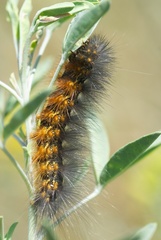 Salt Marsh MothEstigmene acrea
Sources
- Wikipedia: https://en.wikipedia.org/wiki/Lithosia_quadra
Look it up elsewhere: GBIF · iNaturalist · BugGuide · Wikipedia
Text written 2026-10-22 from the sources above and checked sentence by sentence against them. Data fetched 2026-10-22.