 Bug FAQ
Footman moth
Nepita conferta · Order: Lepidoptera · Family: Erebidae
Source: Wikipedia
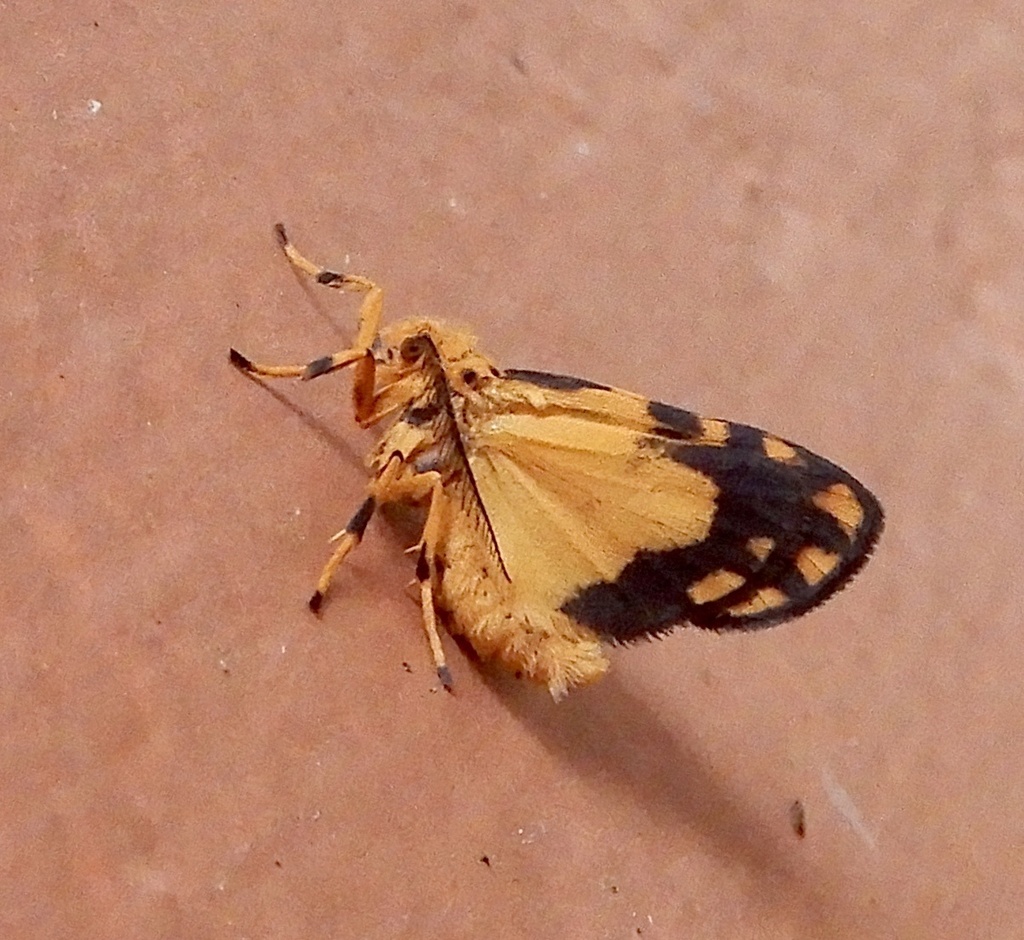
Adults have orange heads, thorax with black spots, and black-orange abdomens; wings are orange with black markings and a black-capped margin. They live in wet, moist areas and often appear on damp walls inside homes during the rainy season. The caterpillars are minor pests of brinjal and can be a nuisance in houses.
Source: Wikipedia
How to recognize it
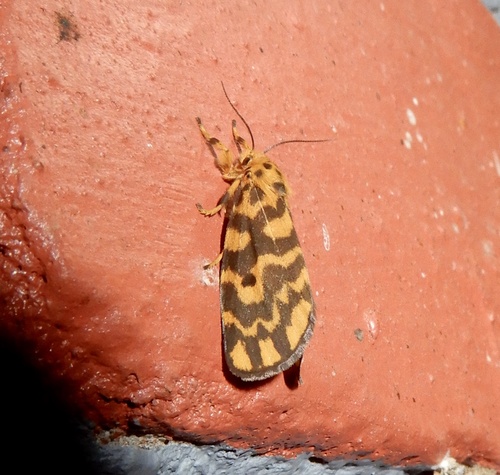
Head and thorax are orange with black spots on the thorax; abdomen is black with orange below and at the tip. Forewings are orange with black marks at the base, curved waved bands that join at the median vein, a black spot on the discocellulars, and a waved post-medial band curving around the cell end. A series of submarginal spots and streaks often form a band; the wing margin and cilia are black. Hindwings have an orange base and a broad black marginal band.
Source: Wikipedia
Is it a pest in the house?
Highly adaptable to homes; larvae often colonise damp interior walls in rainy weather.
Source: Wikipedia
Where it lives
Found in wet, moist habitats and can thrive in domestic settings, especially on damp walls during rainy periods.
Source: Wikipedia
What it eats
Larvae feed on brinjal, where they are considered a minor pest.
Source: Wikipedia
Life cycle
Caterpillars are sometimes parasitized by Glyptapanteles wasps.
Source: Wikipedia
When you see it
Caterpillars appear in large numbers on moist walls during the rainy season.
Source: Wikipedia
Where it comes from
Native to India and Sri Lanka.
Source: Wikipedia
Lookalikes
Historical taxonomic confusion led to many former binomials for this species.
Source: Wikipedia
More photos
Questions people ask
Is the footman moth a crop pest?
Yes, its larvae can damage brinjal (eggplant) plants.
Source: Wikipedia
Where does the footman moth live?
It prefers wet, moist areas and often shows up on damp walls inside homes during the rainy season.
Source: Wikipedia
What do adult footman moths look like?
Adults have orange heads and thorax with black spots, orange-black abdomens, and orange wings marked with black bands and a black margin.
Source: Wikipedia
Are footman moth larvae harmful to houses?
They can become a nuisance by gathering in large numbers on moist interior walls.
Source: Wikipedia
Same family (Erebidae)
 Spongy MothLymantria disparDamages trees, gardens or crops
 Fall Webworm MothHyphantria cuneaDamages trees, gardens or crops
 Brown-tail MothEuproctis chrysorrhoeaCan irritate skin
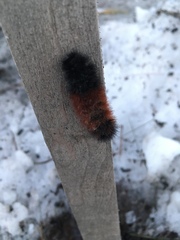 Isabella Tiger MothPyrrharctia isabella
 Virginian Tiger MothSpilosoma virginicaCan irritate skin
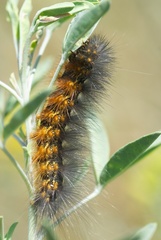 Salt Marsh MothEstigmene acrea
Sources
- Wikipedia: https://en.wikipedia.org/wiki/Nepita
Look it up elsewhere: GBIF · iNaturalist · BugGuide · ITIS · Wikipedia
Text written 2026-10-23 from the sources above and checked sentence by sentence against them. Data fetched 2026-10-22.