 Bug FAQ
Douglas-fir tussock moth
Orgyia pseudotsugata · Order: Lepidoptera · Family: Erebidae
Source: Wikipedia

Caterpillars grow to 20 to 26 mm, feed on the needles of Douglas fir and related firs, and can cause defoliation during outbreaks that last several years.
Source: Wikipedia
How to recognize it
Adult males are grayish brown with mottled light and dark patterns.
Source: Wikipedia
Size
Males have a wingspread of 25 to 34 mm. Caterpillars measure 20 to 26 mm long.
Source: Wikipedia
How to get rid of it
Monitoring with pheromone traps helps detect outbreaks early. Silvicultural practices or aerial sprays of carbaryl are used to manage infestations.
Source: Wikipedia
Life cycle
Larvae spin cocoons and pupate in July or August, with adults emerging later in the season.
Source: Wikipedia
Where it is found in the US
Recorded in 13 of 51 states and DC. Most records: Colorado, New Mexico, California, Washington, Montana, Idaho, Arizona, Oregon.
Darker = more records. Counts are museum and citizen-science records, not population size.
Source: GBIF
Status: native in North America; native in United States; native in Canada. Source: iNaturalist
Months it is reported in the US
Source: GBIF
More photos


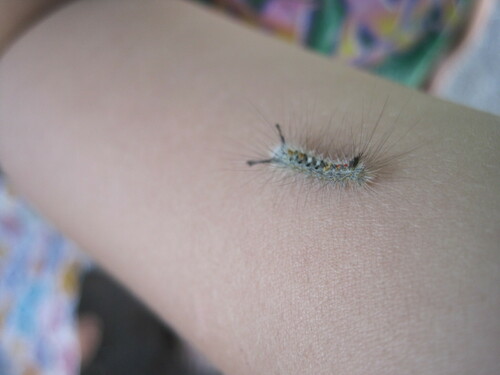
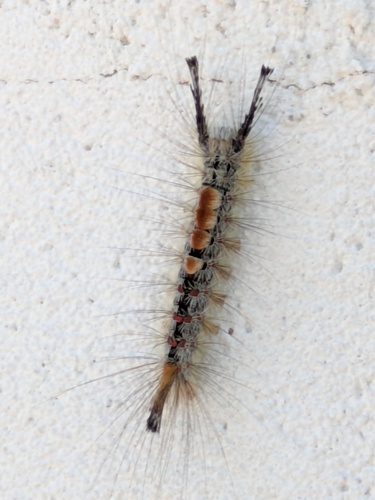
Questions people ask
How can I control a Douglas-fir tussock moth outbreak?
Entomologists use pheromone traps to spot outbreaks early, and managers may apply silvicultural methods or aerial carbaryl sprays to reduce the larvae.
Source: Wikipedia
When are the moths active?
Adults fly from late summer into November, while eggs hatch in May-June and larvae feed through the summer.
Source: Wikipedia
Same family (Erebidae)
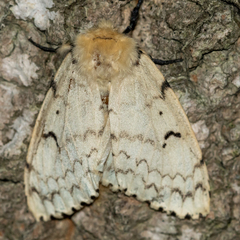 Spongy MothLymantria disparDamages trees, gardens or crops
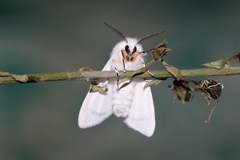 Fall Webworm MothHyphantria cuneaDamages trees, gardens or crops
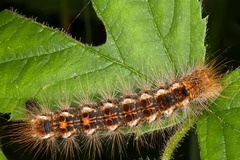 Brown-tail MothEuproctis chrysorrhoeaCan irritate skin
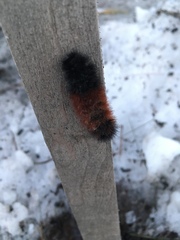 Isabella Tiger MothPyrrharctia isabella
 Virginian Tiger MothSpilosoma virginicaCan irritate skin
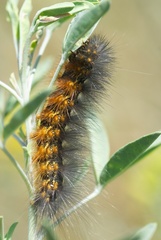 Salt Marsh MothEstigmene acrea
Sources
- Wikipedia: https://en.wikipedia.org/wiki/Orgyia_pseudotsugata
Look it up elsewhere: GBIF · iNaturalist · BugGuide · ITIS · Wikipedia
Text written 2026-10-23 from the sources above and checked sentence by sentence against them. Data fetched 2026-10-23.