 Bug FAQ
Crimson-speckled Flunkey
Utetheisa pulchella · Order: Lepidoptera · Family: Erebidae
Also called: Common Speckled, Crimson Speckled, Crimson Speckled Footman, Crimsonspeckle Footman
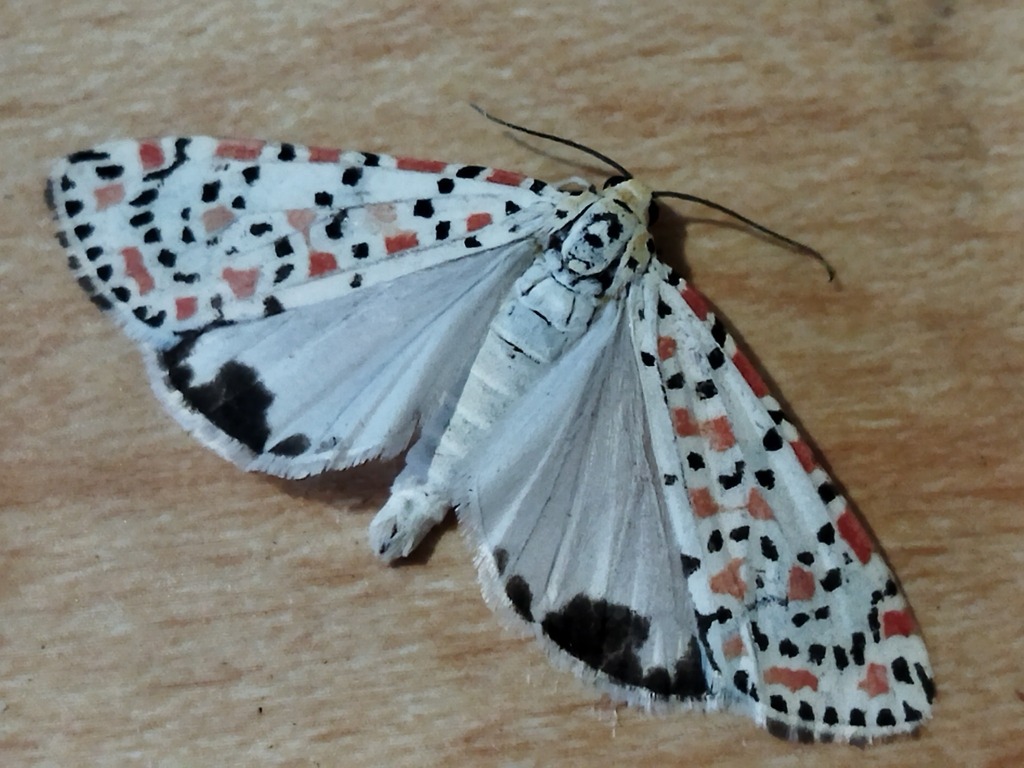
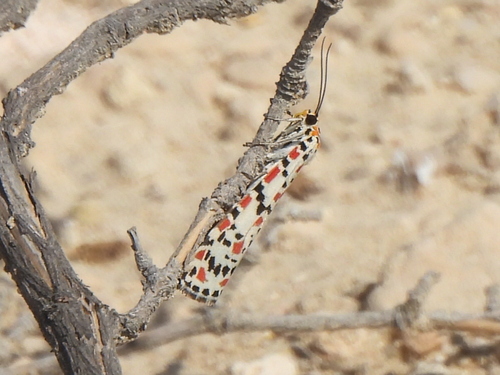
The Crimson-speckled Flunkey has a wingspan of about 29 to 42 mm and narrow front wings that are white or cream with many tiny black spots and larger red spots, sometimes forming bands. It lives in dry open areas such as meadows and parks across most of Europe, the Afrotropical realm, North Africa, the Near East, Central Asia and parts of the Indomalayan region. The caterpillars feed on a variety of herbaceous plants, including forget-me-not, echium, borago, solanum, plantain and anchusa, and in Africa they also eat trichodesma, lithospermum, heliotropium and cotton.
Source: Wikipedia
How to recognize it
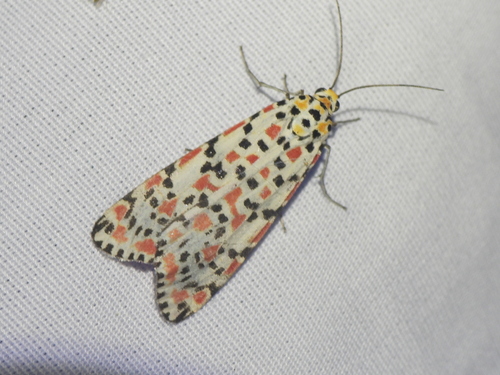
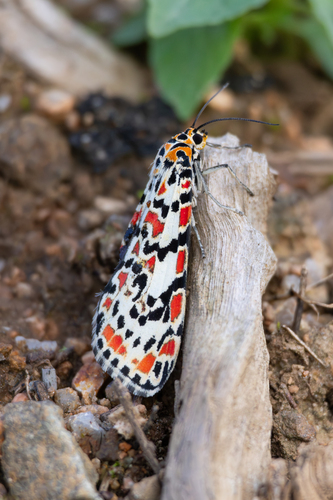
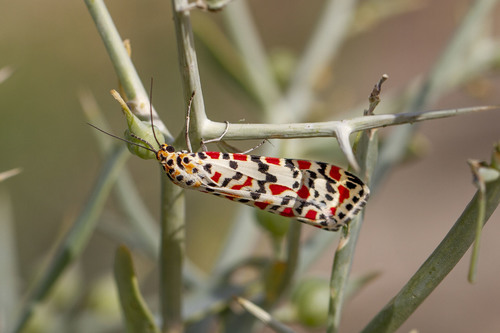
Front wings are narrow, white or cream with many small black spots and larger red spots that may merge into bands.
Source: Wikipedia
Size
Wingspan ranges from 29 to 42 mm.
Source: Wikipedia
What it eats
Larvae eat many herbaceous plants such as forget-me-not, echium, borago, solanum, plantain, anchusa, trichodesma, lithospermum, heliotropium and cotton.
Source: Wikipedia
Life cycle
In southern Europe it overwinters as a caterpillar; pupation occurs on the ground near host plants on leaf litter or bark.
Source: Wikipedia
Where it comes from
Occurs throughout most of Europe as a migrant, the entire Afrotropical realm, North Africa, the Near East, Central Asia and the western Indomalayan realm.
Source: Wikipedia
Where it is found in the US
Recorded in 2 of 51 states and DC. Most records: Colorado, Connecticut.
Darker = more records. Counts are museum and citizen-science records, not population size.
Source: GBIF
More photos
Questions people ask
What do the red spots on the wings look like?
The red spots are usually distinct but can sometimes join together to form transverse bands across the forewings.
Source: Wikipedia
When can I expect to see adult moths?
Adults are typically on the wing from March through early November in temperate regions, while in tropical areas they can be seen year-round.
Source: Wikipedia
What plants do the caterpillars eat?
Caterpillars feed on a range of herbaceous plants including forget-me-not, echium, borago, solanum, plantain, anchusa, and in Africa also on trichodesma, lithospermum, heliotropium and cotton.
Source: Wikipedia
Where does this moth live?
It inhabits dry open habitats such as meadows, shrublands, grasslands and parks across Europe, Africa, the Near East, Central Asia and parts of Southeast Asia.
Source: Wikipedia
Same family (Erebidae)
 Spongy MothLymantria disparDamages trees, gardens or crops
 Fall Webworm MothHyphantria cuneaDamages trees, gardens or crops
 Brown-tail MothEuproctis chrysorrhoeaCan irritate skin
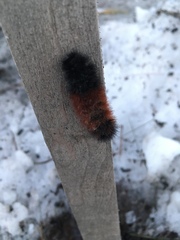 Isabella Tiger MothPyrrharctia isabella
 Virginian Tiger MothSpilosoma virginicaCan irritate skin
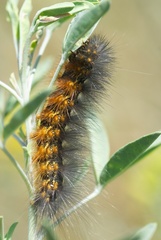 Salt Marsh MothEstigmene acrea
Sources
- Wikipedia: https://en.wikipedia.org/wiki/Utetheisa_pulchella
Look it up elsewhere: GBIF · iNaturalist · BugGuide · Wikipedia
Text written 2026-10-22 from the sources above and checked sentence by sentence against them. Data fetched 2026-10-22.