 Bug FAQ
Common Footman
Eilema lurideola · Order: Lepidoptera · Family: Erebidae
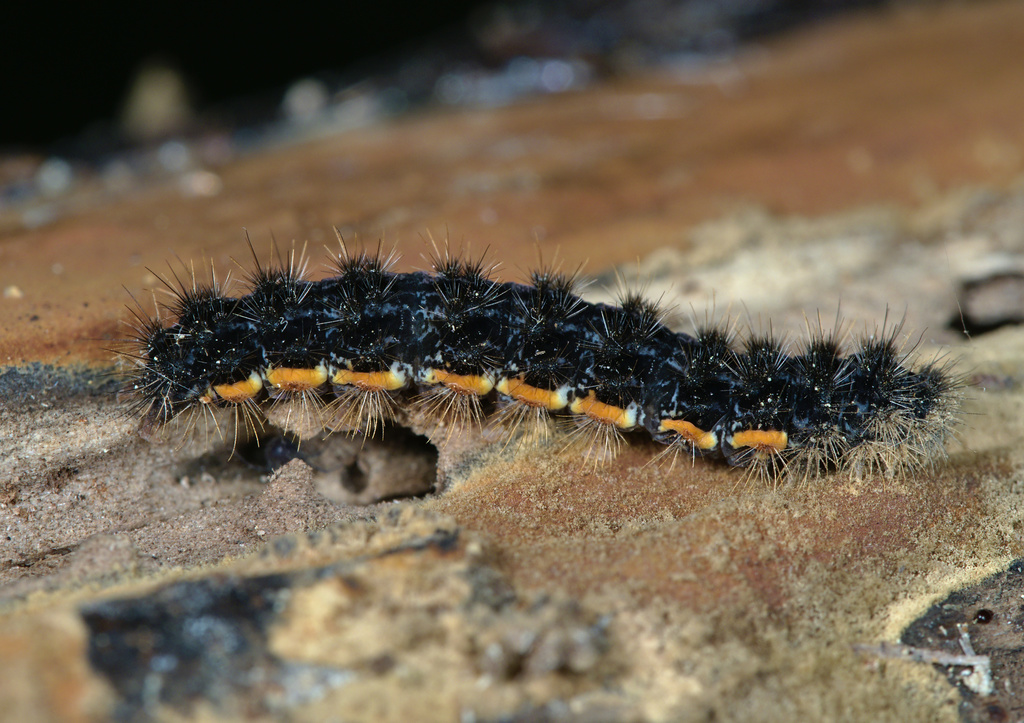
The Common Footman has a wingspan of about 31 to 38 mm and grey forewings with a yellow-buff streak along the leading edge, while the hindwings are uniformly cream coloured.
Source: Wikipedia
Size
Wingspan ranges from 31 to 38 mm.
Source: Wikipedia
What it eats
Larvae feed mainly on various lichens such as Parmelia, and have also been recorded eating buckthorn and oak. The caterpillars are dark lilac-grey with black dorsal line, black head, and bear black and yellow hairs.
Source: Wikipedia
Life cycle
The species overwinters as a hibernating larva, which resumes development in late spring. Pupae are reddish-brown and glossy.
Source: Wikipedia
When you see it
Adults fly at night during July and August, are attracted to light and nectar-rich flowers, and this timing refers to the British Isles.
Source: Wikipedia
Where it comes from
Its range covers Europe and extends eastward across the Palearctic to Lake Baikal.
Source: Wikipedia
Same family (Erebidae)
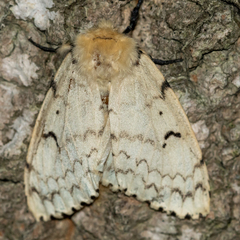 Spongy MothLymantria disparDamages trees, gardens or crops
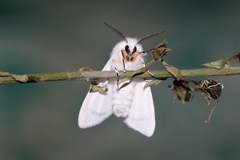 Fall Webworm MothHyphantria cuneaDamages trees, gardens or crops
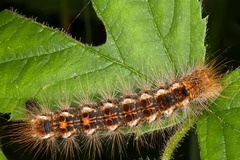 Brown-tail MothEuproctis chrysorrhoeaCan irritate skin
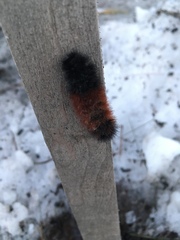 Isabella Tiger MothPyrrharctia isabella
 Virginian Tiger MothSpilosoma virginicaCan irritate skin
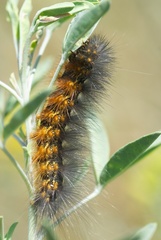 Salt Marsh MothEstigmene acrea
Sources
- Wikipedia: https://en.wikipedia.org/wiki/Common_footman
Look it up elsewhere: GBIF · iNaturalist · BugGuide · Wikipedia
Text written 2026-10-22 from the sources above and checked sentence by sentence against them. Data fetched 2026-10-22.