 Bug FAQ
Buttoned Snout
Hypena rostralis · Order: Lepidoptera · Family: Erebidae
Source: Wikipedia
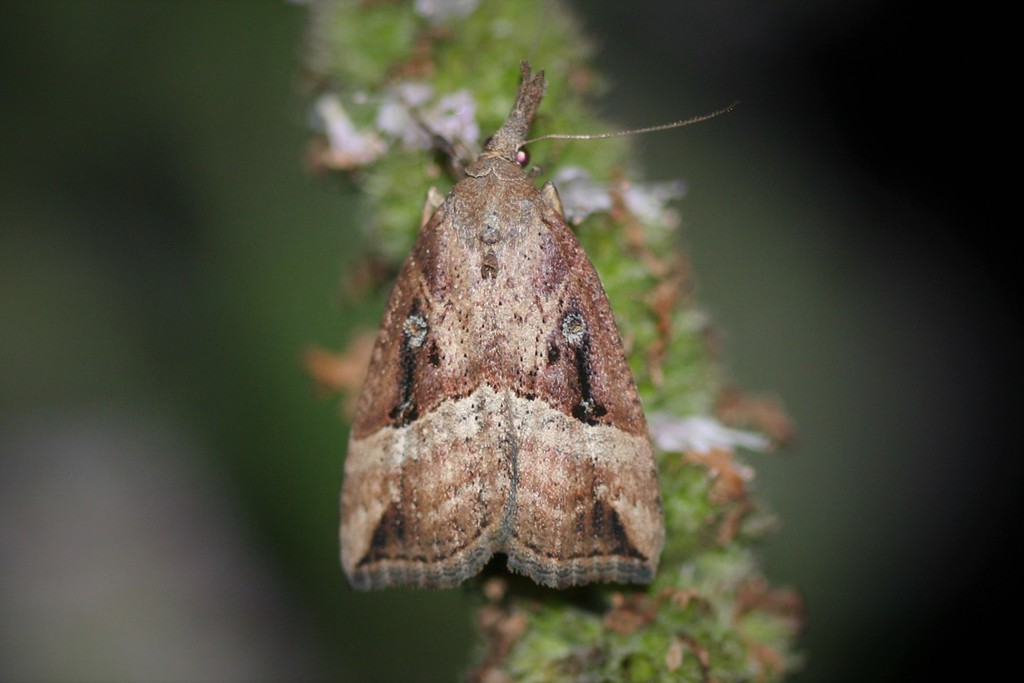
The buttoned snout moth has a wingspan of about 27 to 32 mm and grey-brown forewings with distinct black markings. It lives at forest edges, clearings, gardens and cultivated land up to 1600 m and is found across Europe into Siberia.
Source: Wikipedia
How to recognize it
Forewings are grey-brown, speckled with black, with black lines edged in ochre, a dentate inner line and a nearly straight outer line; the orbicular stigma is a raised tuft of black or black-white scales linked to a faint reniform spot.
Source: Wikipedia
Size
Wingspan ranges from 27 to 32 mm.
Source: Wikipedia
Where it lives
Found at forest edges, clearings, shore areas, gardens, parks and cultivated land, up to 1600 m altitude.
Source: Wikipedia
What it eats
Larvae feed on hop plants.
Source: Wikipedia
Life cycle
The species produces two generations of adults each year.
Source: Wikipedia
Where it comes from
Occurs throughout Europe, into Scandinavia, across the Palearctic to Asia Minor, the Caucasus and Siberia.
Source: Wikipedia
Lookalikes
Several forms exist, such as the uniformly grey-brown ab. unicolor, the dark grey palpalis, and the paler costal streak form vittatus; some may appear ochreous in colour.
Source: Wikipedia
More photos


Questions people ask
Does the buttoned snout moth damage crops?
Yes, its caterpillars feed on hop, which can harm this cultivated plant.
Source: Wikipedia
When can I see adult buttoned snout moths?
Adults appear in two periods each year: from August to October and from March to June.
Source: Wikipedia
Where is this moth likely to be found?
It lives in forest edges, clearings, gardens and cultivated areas up to 1600 m, across Europe into Siberia.
Source: Wikipedia
Same family (Erebidae)
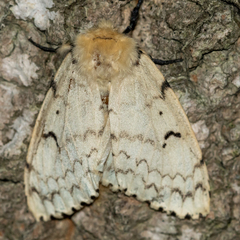 Spongy MothLymantria disparDamages trees, gardens or crops
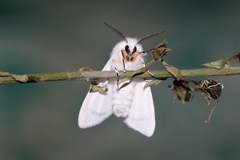 Fall Webworm MothHyphantria cuneaDamages trees, gardens or crops
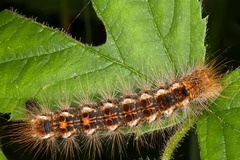 Brown-tail MothEuproctis chrysorrhoeaCan irritate skin
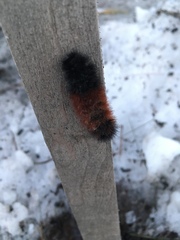 Isabella Tiger MothPyrrharctia isabella
 Virginian Tiger MothSpilosoma virginicaCan irritate skin
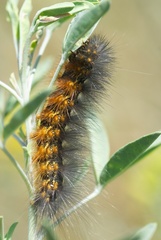 Salt Marsh MothEstigmene acrea
Sources
- Wikipedia: https://en.wikipedia.org/wiki/Hypena_rostralis
Look it up elsewhere: GBIF · iNaturalist · BugGuide · Wikipedia
Text written 2026-10-22 from the sources above and checked sentence by sentence against them. Data fetched 2026-10-22.