 Bug FAQ
Burnet Companion
Euclidia glyphica · Order: Lepidoptera · Family: Erebidae
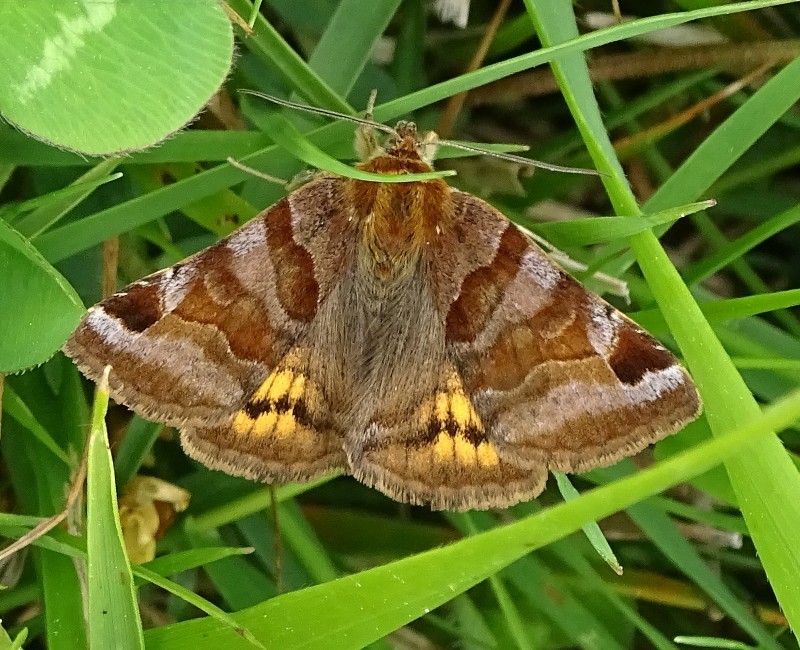
The Burnet Companion moth has pale grey or brown forewings with distinct dark olive-brown shading and orange hindwings with dark veins. Its caterpillars feed on a variety of legumes and violets, and they are yellowish-brown or reddish-brown with a darker dorsal line.
Source: Wikipedia
How to recognize it
Forewings are pale grey or uniform pale brown with dark olive-brown shadings, a pale oblique inner line followed by a brown band, and a whitish outer line with a brown band; hindwings are orange with dark veins, a fuscous base and inner margin, and a blackish submarginal band.
Source: Wikipedia
Life cycle
Caterpillars are yellowish-brown or reddish-brown with a darker dorsal line; the head is yellowish-brown with two dark streaks.
Source: Wikipedia
Where it comes from
Its native range matches its habitat: most of the Palearctic, from Ireland to Mongolia and Siberia, extending south to the Mediterranean and North Africa.
Source: Wikipedia
Lookalikes
British forms include the uniformly dark brown ab. suffusa, the whitish-ochreous subterminal ab. marginata, the band-less underside ab. obsoleta, and the much darker ab. tristicula.
Source: Wikipedia
More photos

Same family (Erebidae)
 Spongy MothLymantria disparDamages trees, gardens or crops
 Fall Webworm MothHyphantria cuneaDamages trees, gardens or crops
 Brown-tail MothEuproctis chrysorrhoeaCan irritate skin
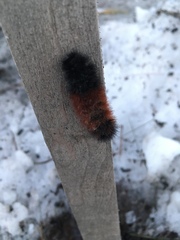 Isabella Tiger MothPyrrharctia isabella
 Virginian Tiger MothSpilosoma virginicaCan irritate skin
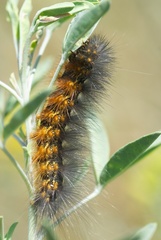 Salt Marsh MothEstigmene acrea
Sources
- Wikipedia: https://en.wikipedia.org/wiki/Burnet_companion
Look it up elsewhere: GBIF · iNaturalist · BugGuide · Wikipedia
Text written 2026-10-22 from the sources above and checked sentence by sentence against them. Data fetched 2026-10-22.