 Bug FAQ
Brown-striped Semilooper
Mocis undata · Order: Lepidoptera · Family: Erebidae
Source: Wikipedia

Caterpillars eat a wide range of legumes and other crops such as soy, beans, cotton, rubber, and solanaceous plants, so they can become garden and field pests.
Source: Wikipedia
How to recognize it
Body is pale red-brown; forewing shows a short sub-basal red-brown line and a sinuous medial line angled on the median vein; hindwing is ochreous-fuscous with a narrow medial band and a diffused sub-marginal band (-).
Source: Wikipedia
Where it comes from
Native to the Afrotropical and Oriental regions, recorded from India and Sri Lanka.
Source: Wikipedia
More photos


Questions people ask
What plants do the larvae eat?
The caterpillars feed on a wide range of legumes and other crops, including beans, soy, cotton, rubber, and solanaceous plants.
Source: Wikipedia
Where is the brown-striped semilooper found?
It occurs in the Afrotropical and Oriental regions, especially in India and Sri Lanka.
Source: Wikipedia
Same family (Erebidae)
 Spongy MothLymantria disparDamages trees, gardens or crops
 Fall Webworm MothHyphantria cuneaDamages trees, gardens or crops
 Brown-tail MothEuproctis chrysorrhoeaCan irritate skin
 Isabella Tiger MothPyrrharctia isabella
 Virginian Tiger MothSpilosoma virginicaCan irritate skin
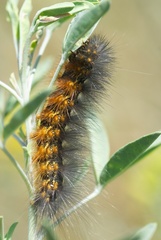 Salt Marsh MothEstigmene acrea
Sources
- Wikipedia: https://en.wikipedia.org/wiki/Mocis_undata
Look it up elsewhere: GBIF · iNaturalist · BugGuide · Wikipedia
Text written 2026-10-23 from the sources above and checked sentence by sentence against them. Data fetched 2026-10-22.