 Bug FAQ
Blue-green Bottle Fly
Lucilia caeruleiviridis · Order: Diptera · Family: Calliphoridae

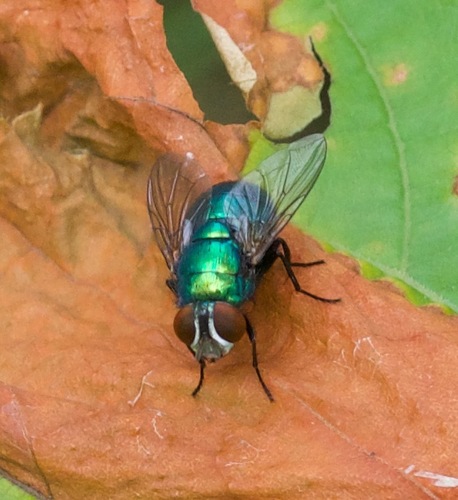
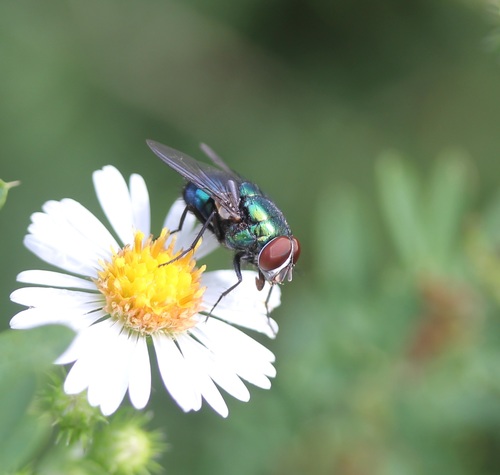
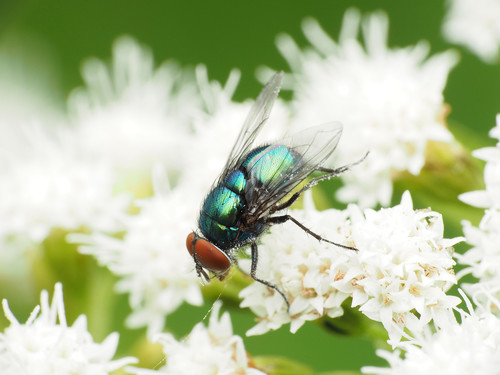
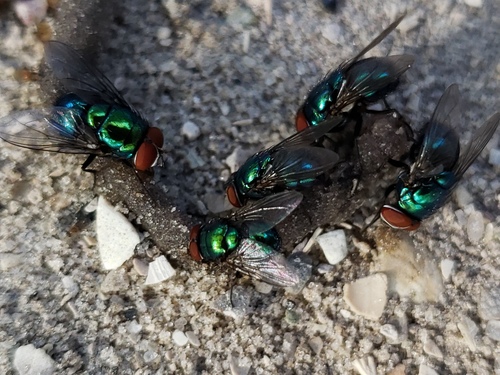
The adult blue-green bottle fly has a metallic blue-green body and a white face with large red eyes. It lives across the Nearctic region, from Greenland through most of North America, and is especially common in the southern United States where warm weather (75-85 °F) is typical.
Source: Wikipedia
How to recognize it
Adults are metallic blue-green and have a white facial area with large red compound eyes.
Source: Wikipedia
What it eats
Females are strongly attracted to flesh and can act as mechanical vectors.
Source: Wikipedia
Life cycle
Development proceeds through four distinct stages.
Source: Wikipedia
When you see it
It prefers warm weather, with an optimal temperature range of 75-85 °F (23-29 °C).
Source: Wikipedia
Where it is found in the US
Recorded in 36 of 51 states and DC. Most records: Pennsylvania, Florida, Maryland, Virginia, Illinois, Massachusetts, New York, North Carolina.
Darker = more records. Counts are museum and citizen-science records, not population size.
Source: GBIF
Status: native in North America; native in Canada. Source: iNaturalist
Months it is reported in the US
Source: GBIF
More photos
Questions people ask
What does the blue-green bottle fly look like?
Adults have a metallic blue-green body and a white face with large red eyes.
Source: Wikipedia
Where is this fly found?
It is distributed across the Nearctic region, including Greenland and most of North America, and is especially common in the southern United States.
Source: Wikipedia
What do the females feed on?
Females are heavily attracted to flesh and can carry material mechanically.
Source: Wikipedia
How many life stages does it have?
Its life cycle includes four stages of development.
Source: Wikipedia
Same family (Calliphoridae)
 Common European Greenbottle FlyLucilia sericataNuisance, not dangerous
 Blue BlowflyCalliphora vicinaCan spread germs or disease
 Black Blow FlyPhormia reginaNuisance, not dangerous
 Oriental Latrine FlyChrysomya megacephalaCan spread germs or disease
 Australian Sheep Blow FlyLucilia cuprinaNuisance, not dangerous
 Locust BlowflyStomorhina lunata
Sources
- Wikipedia: https://en.wikipedia.org/wiki/Lucilia_coeruleiviridis
Look it up elsewhere: GBIF · iNaturalist · BugGuide · ITIS · Wikipedia
Text written 2026-10-25 from the sources above and checked sentence by sentence against them. Data fetched 2026-10-25.