 Bug FAQ
Blackbottle
Protophormia terraenovae · Order: Diptera · Family: Calliphoridae
Also called: Holarctic Blowfly, Northern Blow Fly
Source: Wikipedia
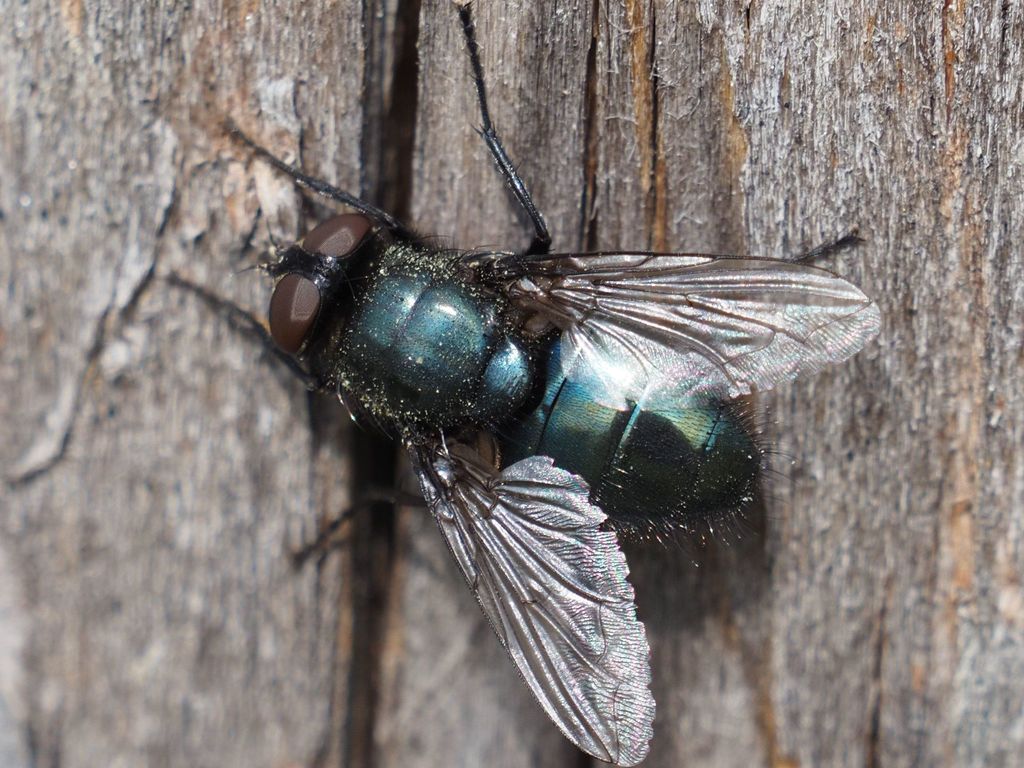
Adult Blackbottle flies are 7 to 12 mm long and have black heads, legs, and a black basicosta with brown wing veins. They breed on refuse and animal carcasses and are found across the northern hemisphere from Mexico to Canada.
Source: Wikipedia
How to recognize it
Key marks are a black to brown front thoracic spiracle, black basicosta, brown wing veins, dark calypters with black setae, and a head and legs that are black.
Source: Wikipedia
Size
Adults measure between 7 and 12 mm in length.
Source: Wikipedia
Is it a pest in the house?
They are a problem in slaughterhouses and poultry houses, where they cause nuisance and can spread disease by contaminating meat and food.
Source: Wikipedia
Where it lives
Populations are maintained by refuse and dead animal carcasses.
Source: Wikipedia
What it eats
First-instar larvae feed on liquids from wounds or body openings, while later instars consume the body tissue itself.
Source: Wikipedia
Life cycle
The fly goes through three larval instars, then a pupal stage, and finally becomes an adult. Development time between stages varies with temperature.
Source: Wikipedia
When you see it
In warm regions like Texas and Florida it appears mainly in winter, while in higher latitudes and elevations it is a spring or summer species.
Source: Wikipedia
Where it comes from
The species has a Holarctic distribution, occurring throughout the northern hemisphere from Mexico to Canada.
Source: Wikipedia
Lookalikes
The third-instar larva can be distinguished from the similar species Phormia regina by its characteristic markings.
Source: Wikipedia
Where it is found in the US
Recorded in 23 of 51 states and DC. Most records: Alaska, Wyoming, Massachusetts, Colorado, Utah, Idaho, Maryland, New York.
Darker = more records. Counts are museum and citizen-science records, not population size.
Source: GBIF
Status: native in North America; native in Canada. Source: iNaturalist
Months it is reported in the US
Source: GBIF
More photos


Same family (Calliphoridae)
 Common European Greenbottle FlyLucilia sericataNuisance, not dangerous
 Blue BlowflyCalliphora vicinaCan spread germs or disease
 Black Blow FlyPhormia reginaNuisance, not dangerous
 Oriental Latrine FlyChrysomya megacephalaCan spread germs or disease
 Australian Sheep Blow FlyLucilia cuprinaNuisance, not dangerous
 Locust BlowflyStomorhina lunata
Sources
- Wikipedia: https://en.wikipedia.org/wiki/Protophormia_terraenovae
Look it up elsewhere: GBIF · iNaturalist · BugGuide · ITIS · Wikipedia
Text written 2026-10-23 from the sources above and checked sentence by sentence against them. Data fetched 2026-10-22.