 Bug FAQ
Black Arches
Lymantria monacha · Order: Lepidoptera · Family: Erebidae
Source: Wikipedia
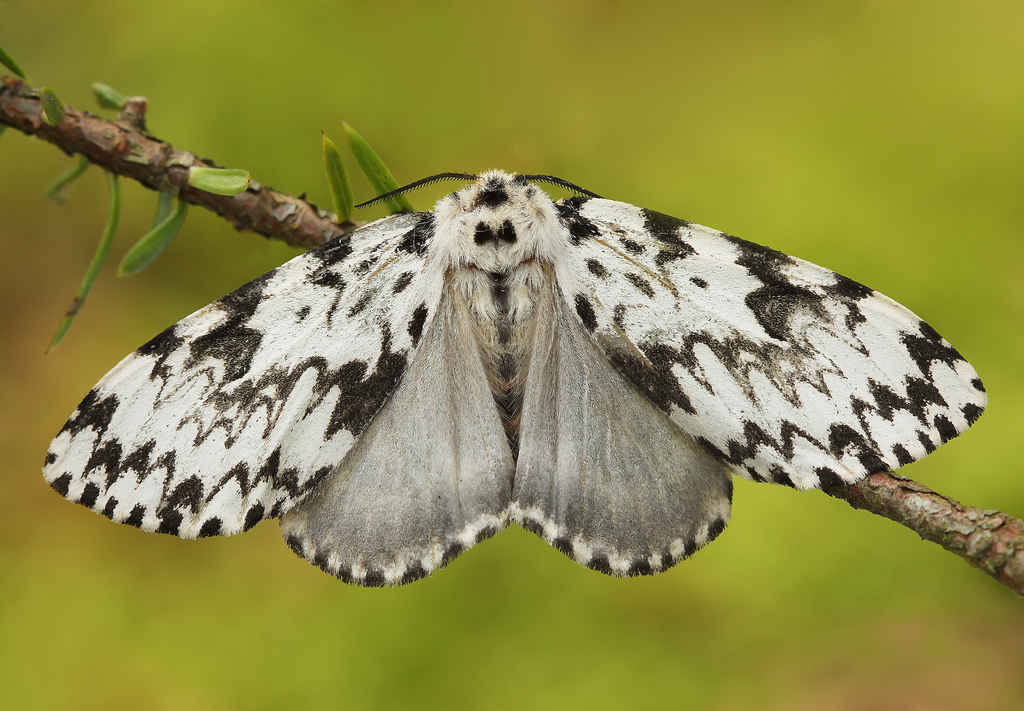
Adult black arches moths have a wingspan of about 4 to 5 cm and are recognisable by white forewings crossed by black wavy arches and light-brown hindwings with white fringed edges marked with black spots. The larvae feed mainly on spruce and pine, eating buds in spring and later the needles, and they can cause serious damage to forest trees.
Source: Wikipedia
How to recognize it
Adults show white forewings with connected black wavy arches, and light brown hindwings with white fringes that have black spots.
Source: Wikipedia
Size
The moth’s wingspan ranges from 40 to 50 mm.
Source: Wikipedia
Where it lives
It is regarded as a forest pest.
Source: Wikipedia
What it eats
In spring they eat the first buds, then later consume the needles.
Source: Wikipedia
Life cycle
Young larvae hibernate in groups and reach full size by June.
Source: Wikipedia
Where it comes from
It occurs across most of Europe, including Great Britain, and extends through temperate parts of the Palearctic to Japan and India.
Source: Wikipedia
More photos


Questions people ask
Do black arches moths damage trees?
Yes, their larvae chew buds and needles of spruce and pine, which can defoliate and weaken forest trees.
Source: Wikipedia
Same family (Erebidae)
 Spongy MothLymantria disparDamages trees, gardens or crops
 Fall Webworm MothHyphantria cuneaDamages trees, gardens or crops
 Brown-tail MothEuproctis chrysorrhoeaCan irritate skin
 Isabella Tiger MothPyrrharctia isabella
 Virginian Tiger MothSpilosoma virginicaCan irritate skin
 Salt Marsh MothEstigmene acrea
Sources
- Wikipedia: https://en.wikipedia.org/wiki/Black_arches
Look it up elsewhere: GBIF · iNaturalist · BugGuide · Wikipedia
Text written 2026-10-22 from the sources above and checked sentence by sentence against them. Data fetched 2026-10-22.