 Bug FAQ
Banyan tussock moth
Perina nuda · Order: Lepidoptera · Family: Erebidae
Also called: Clearwing Tussock Moth
Source: Wikipedia


The caterpillar has a grey head, black back and white hairs, while the pupa is bristly with orange setae on a dark-grey and cream body. The larvae feed on banyan species and on fruit trees such as mango and jackfruit, making it a minor pest of those plants.
Source: Wikipedia
How to recognize it
Caterpillars show a greyish head and flanks, a broad black back, and white setae. Pupae are bristly, piebald dark grey and cream, with orange setae.
Source: Wikipedia
What it eats
Caterpillars feed on several banyan species (Ficus benjamina, F. benghalensis, F. racemosa, F. pumila, F. religiosa) and on crop plants such as jackfruit (Artocarpus) and mango (Mangifera).
Source: Wikipedia
More photos


Questions people ask
What plants does the banyan tussock moth damage?
Its larvae feed on banyan trees and on fruit crops such as mango and jackfruit, causing minor damage.
Source: Wikipedia
Same family (Erebidae)
 Spongy MothLymantria disparDamages trees, gardens or crops
 Fall Webworm MothHyphantria cuneaDamages trees, gardens or crops
 Brown-tail MothEuproctis chrysorrhoeaCan irritate skin
 Isabella Tiger MothPyrrharctia isabella
 Virginian Tiger MothSpilosoma virginicaCan irritate skin
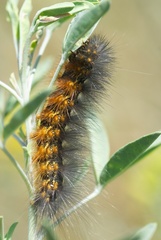 Salt Marsh MothEstigmene acrea
Sources
- Wikipedia: https://en.wikipedia.org/wiki/Perina_nuda
Look it up elsewhere: GBIF · iNaturalist · BugGuide · Wikipedia
Text written 2026-10-23 from the sources above and checked sentence by sentence against them. Data fetched 2026-10-22.