 Bug FAQ
Yellow-bellied Rush-cutter
Eutomostethus luteiventris · Order: Hymenoptera · Family: Tenthredinidae
Also called: Tenthredid wasp
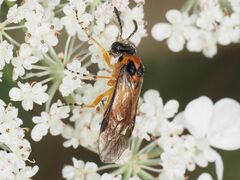
The yellow-bellied rush-cutter is a small fly about half a centimetre long, with a black head and thorax, orange abdomen and partly black fore-femurs. It lives in wet meadows and hedge rows across most of Europe and the Nearctic region, but not in the Balkan or Iberian Peninsulas. Adults feed on the nectar of wild chervil and are seen in May and July, while the larvae eat only certain rush species in July and August.
Source: Wikipedia
How to recognize it
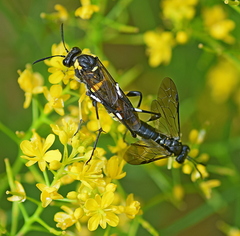
The head, antennae and thorax shine black; the abdomen is orange with black base plates and tip segments; legs are mostly orange with the front femur tips black; wings are somewhat darkened.
Source: Wikipedia
Size
Adults measure between 5 and 7 mm in length.
Source: Wikipedia
Where it lives
It prefers wet meadows and hedge rows.
Source: Wikipedia
What it eats
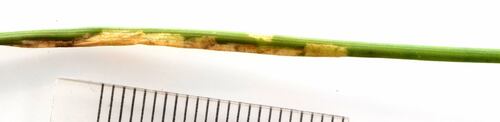
Adults sip nectar from Anthriscus sylvestris (wild chervil). Larvae are monophagous, feeding only on rushes such as Juncus articulatus, J. conglomeratus and J. effusus.
Source: Wikipedia
Life cycle
Adults are present in May and again in July. Larvae appear in July and persist through August.
Source: Wikipedia
When you see it
The adult flight period is May and July; larvae are found in July and August.
Source: Wikipedia
Where it comes from
The species occurs throughout most of Europe and the Nearctic realm, except the Balkan and Iberian Peninsulas.
Source: Wikipedia
Where it is found in the US
Recorded in 12 of 51 states and DC. Most records: Michigan, Maine, Connecticut, Ohio, Massachusetts, New York, Washington, Kansas.
Darker = more records. Counts are museum and citizen-science records, not population size.
Source: GBIF
Status: introduced in Canada. Source: iNaturalist
Months it is reported in the US
Source: GBIF
More photos
Questions people ask
When can I see adult yellow-bellied rush-cutters?
Adults are on the wing in May and again in July.
Source: Wikipedia
What do the larvae eat?
The larvae feed exclusively on rush species like Juncus articulatus, J. conglomeratus and J. effusus.
Source: Wikipedia
Where does this fly live?
It inhabits wet meadows and hedge rows across most of Europe and the Nearctic region, but not the Balkan or Iberian Peninsulas.
Source: Wikipedia
Same family (Tenthredinidae)


Sources
- Wikipedia: https://en.wikipedia.org/wiki/Eutomostethus_luteiventris
Look it up elsewhere: GBIF · iNaturalist · BugGuide · Wikipedia
Text written 2026-10-29 from the sources above and checked sentence by sentence against them. Data fetched 2026-10-29.