 Bug FAQ
Alder Sawfly
Eriocampa ovata · Order: Hymenoptera · Family: Tenthredinidae
Also called: Alder wooly sawfly, Woolly Alder Sawfly
Source: Wikipedia

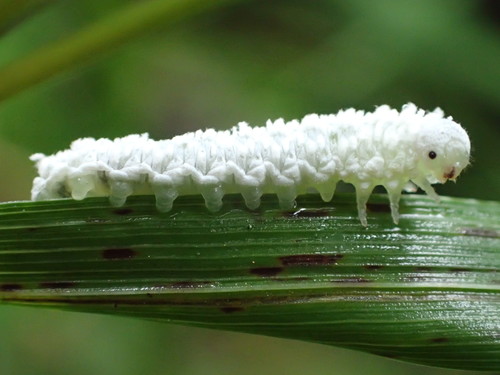
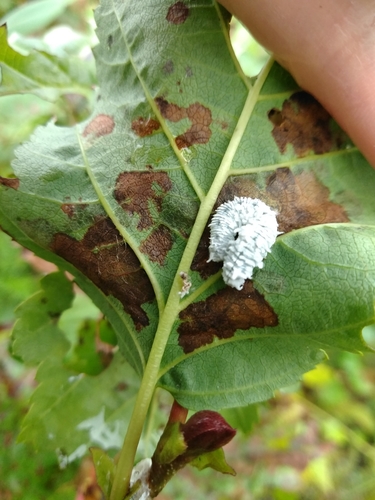
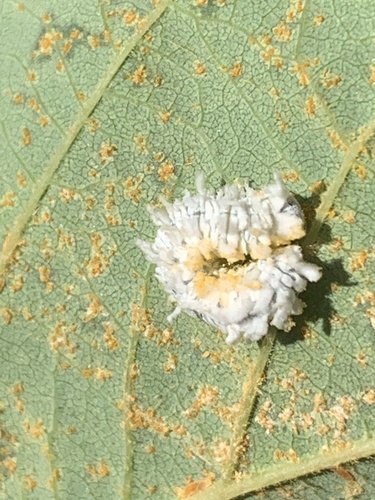
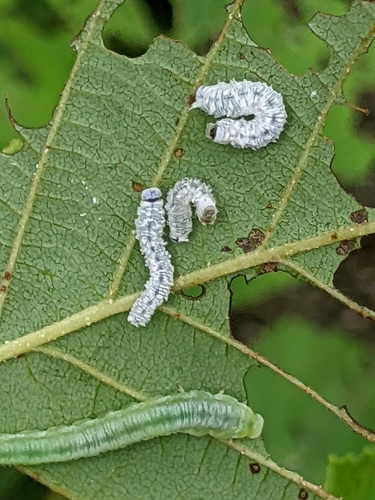
Adult females are about 7 mm long, black with red thorax segments and some whitish parts on the antennae and legs. Larvae grow to 5 to 7.5 mm, live on common and grey alder, and may strip leaves, sometimes causing noticeable defoliation.
Source: Wikipedia
How to recognize it
Females are mainly black, the first two thorax segments are red, and the underside of antenna tips, inner fore-tibia and base of hind femur are whitish.
Source: Wikipedia
Size
Adult females are about 7 mm (0.3 in) long. Larvae reach 5 to 7.5 mm (0.2 to 0.3 in) in length.
Source: Wikipedia
What it eats
Larvae feed on the leaves of common and grey alder. Feeding can lead to defoliation of the host trees.
Source: Wikipedia
Life cycle
Females insert their ovipositor into the upper leaf surface near the midrib to lay eggs. Fully developed larvae drop to the ground, spin a cocoon in leaf litter, pupate and overwinter there.
Source: Wikipedia
When you see it
Eggs are laid on young foliage near the tree base, usually leaving the upper crown untouched. There are two generations per year in Quebec and one in England.
Source: Wikipedia
Where it comes from
Native to Europe and accidentally introduced to North America.
Source: Wikipedia
Where it is found in the US
Recorded in 14 of 51 states and DC. Most records: Alaska, Washington, Maine, New York, Minnesota, New Hampshire, Vermont, Massachusetts.
Darker = more records. Counts are museum and citizen-science records, not population size.
Source: GBIF
Status: introduced in Canada. Source: iNaturalist
Months it is reported in the US
Source: GBIF
More photos
Questions people ask
Which trees are affected by the alder sawfly?
The larvae feed on common alder and grey alder leaves, and can also be found on elm and hazel.
Source: Wikipedia
Do the larvae cause damage to trees?
Yes, they can strip the leaves and cause defoliation of the host alders.
Source: Wikipedia
Same family (Tenthredinidae)
 Willow Apple Gall SawflyEuura californica
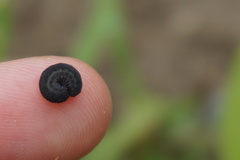 Turnip SawflyAthalia rosaeNuisance, not dangerous
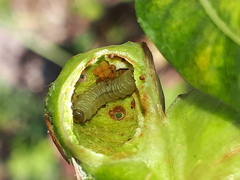 Willow Redgall SawflyEuura proxima
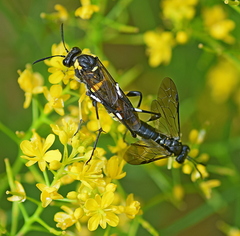 Yellow-spotted MacrophyaMacrophya montanaDamages trees, gardens or crops
 Saddleback Grass-cutterEutomostethus ephippiumDamages trees, gardens or crops
 Cherry Slug SawflyCaliroa cerasi
Sources
- Wikipedia: https://en.wikipedia.org/wiki/Eriocampa_ovata
Look it up elsewhere: GBIF · iNaturalist · BugGuide · Wikipedia
Text written 2026-10-23 from the sources above and checked sentence by sentence against them. Data fetched 2026-10-22.