 Bug FAQ
Cherry Slug Sawfly
Caliroa cerasi · Order: Hymenoptera · Family: Tenthredinidae
Also called: Pear Sawfly, pear slug sawfly
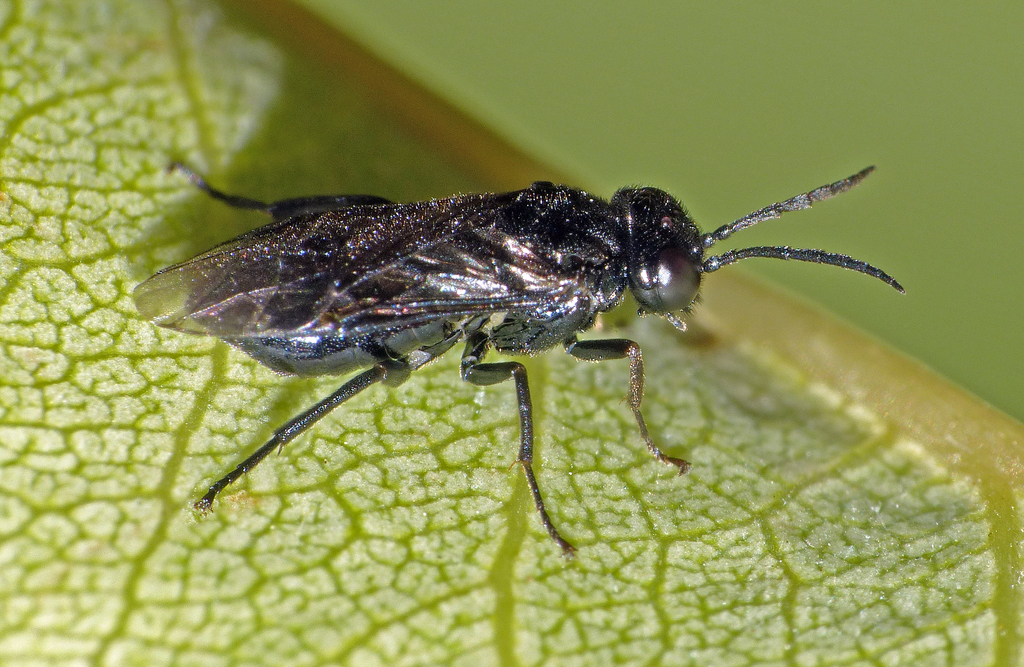
The larvae feed on the foliage of cherry, pear, plum and hawthorn, leaving only the leaf veins. They molt several times, drop to the ground to pupate, and the adults lay eggs on host leaves to continue the cycle.
Source: Wikipedia
How to recognize it
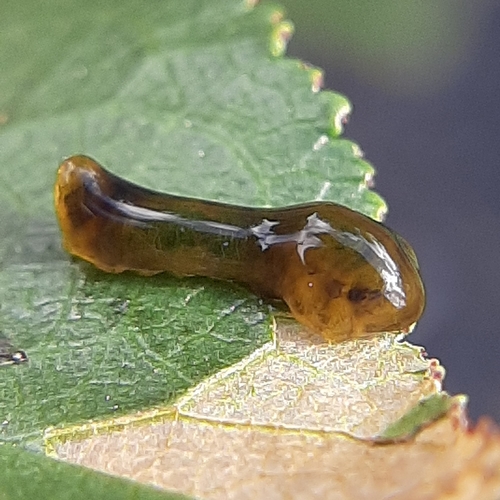
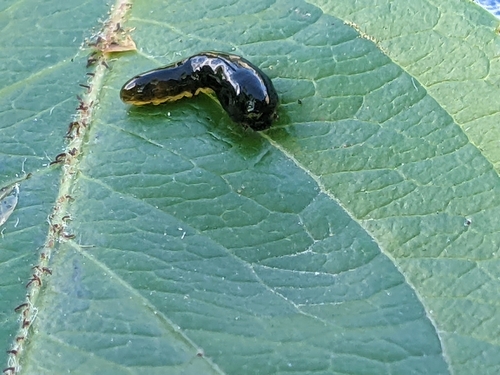
Larvae coat themselves in a green slime that makes them unpalatable to predators.
Source: Wikipedia
Is it a pest in the house?
They are a notable pest of cherry, pear, plum and hawthorn trees.
Source: Wikipedia
How to get rid of it
In New Zealand, the parasitoid wasp Lathrolestes luteolator has been released twice to help control this pest. There is disagreement about whether females climb or fly to lay eggs, which matters for glue-based control methods.
Source: Wikipedia
Where it lives
They are an important pest of cherry, pear, plum and hawthorn trees.
Source: Wikipedia
What it eats
The larvae eat the leaves of cherry, pear, plum and hawthorn, leaving a skeleton of veins.
Source: Wikipedia
Life cycle
Larvae molt five to eight times, then drop to the ground to pupate; adults emerge, climb from the soil, mate and lay eggs on host leaves.
Source: Wikipedia
Lookalikes
The larvae are commonly called pear slug or cherry slug.
Source: Wikipedia
Where it is found in the US
Recorded in 28 of 51 states and DC. Most records: California, Washington, Illinois, Michigan, Oregon, Florida, Maine, Vermont.
Darker = more records. Counts are museum and citizen-science records, not population size.
Source: GBIF
Status: introduced in Canada; introduced in United States. Source: iNaturalist
Months it is reported in the US
Source: GBIF
More photos

Questions people ask
What trees does the cherry slug sawfly damage?
It feeds on cherry, pear, plum and hawthorn leaves, stripping them down to the veins.
Source: Wikipedia
How can I control a cherry slug sawfly infestation?
In some regions biological control with the wasp Lathrolestes luteolator has been used, and understanding whether females climb or fly to lay eggs helps when using sticky traps or glues.
Source: Wikipedia
Same family (Tenthredinidae)
 Willow Apple Gall SawflyEuura californica
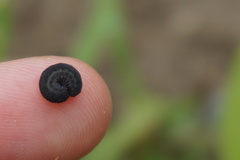 Turnip SawflyAthalia rosaeNuisance, not dangerous
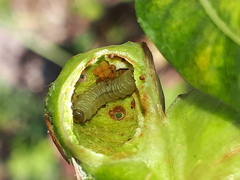 Willow Redgall SawflyEuura proxima
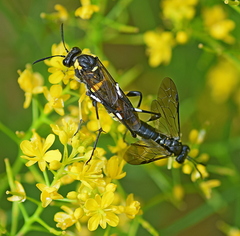 Yellow-spotted MacrophyaMacrophya montanaDamages trees, gardens or crops
 Saddleback Grass-cutterEutomostethus ephippiumDamages trees, gardens or crops
 Alder SawflyEriocampa ovataDamages trees, gardens or crops
Sources
- Wikipedia: https://en.wikipedia.org/wiki/Pear_slug
Look it up elsewhere: GBIF · iNaturalist · BugGuide · ITIS · Wikipedia
Text written 2026-10-23 from the sources above and checked sentence by sentence against them. Data fetched 2026-10-22.