 Bug FAQ
Toothed Tiger Ichneumon
Amblyteles armatorius · Order: Hymenoptera · Family: Ichneumonidae
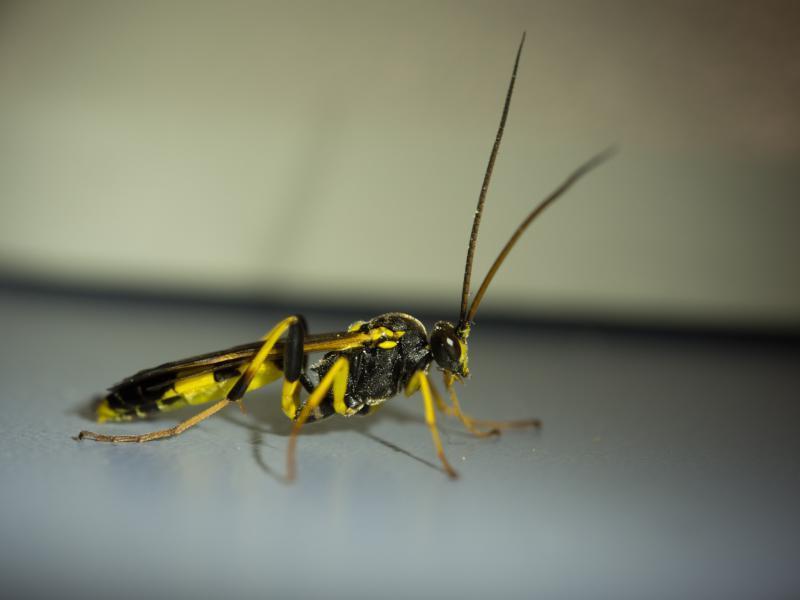
The toothed tiger ichneumon is a large wasp about 12 to 16 mm long, with antennae roughly 9 mm in length. Its head and thorax are black with a yellow scutellum, while the abdomen is yellow with broad black bands; legs are mainly yellow except the hind legs, which are black and yellow. It lives in hedgerows, meadows and at the edges of spruce forests across most of Europe, the Near East and parts of the Oriental realm.
Source: Wikipedia
How to recognize it
The wasp’s head and thorax are black, the scutellum is yellow, and the abdomen is yellow with wide black bands; its legs are yellow except for the hind legs, which are black and yellow.
Source: Wikipedia
Size
Adults measure 12 to 16 mm in body length, not counting antennae that add about 9 mm.
Source: Wikipedia
Does it bite or sting?
This wasp does not have a sting; its bright markings are a form of protective mimicry.
Source: Wikipedia
Where it lives
They are typically found in hedgerows, meadow areas and at the borders of spruce forests.
Source: Wikipedia
What it eats
Adults visit flowers, especially those of the Apiaceae family, to drink nectar and collect pollen. Females lay eggs inside moth caterpillars; the emerging larvae feed on hosts such as Noctuidae, Notodontidae and several other moth families.
Source: Wikipedia
Life cycle
The adult wasps survive the winter months. Females deposit eggs inside moth caterpillars, and the larvae develop by feeding on the host.
Source: Wikipedia
When you see it
Adults are most commonly seen during the summer when they visit flowers.
Source: Wikipedia
Where it comes from
The species is Palearctic, occurring throughout most of Europe, the Near East and into the Oriental region.
Source: Wikipedia
Same family (Ichneumonidae)




Sources
- Wikipedia: https://en.wikipedia.org/wiki/Amblyteles_armatorius
Look it up elsewhere: GBIF · iNaturalist · BugGuide · Wikipedia
Text written 2026-10-22 from the sources above and checked sentence by sentence against them. Data fetched 2026-10-22.