 Bug FAQ
Black Giant Ichneumonid Wasp
Megarhyssa atrata · Order: Hymenoptera · Family: Ichneumonidae
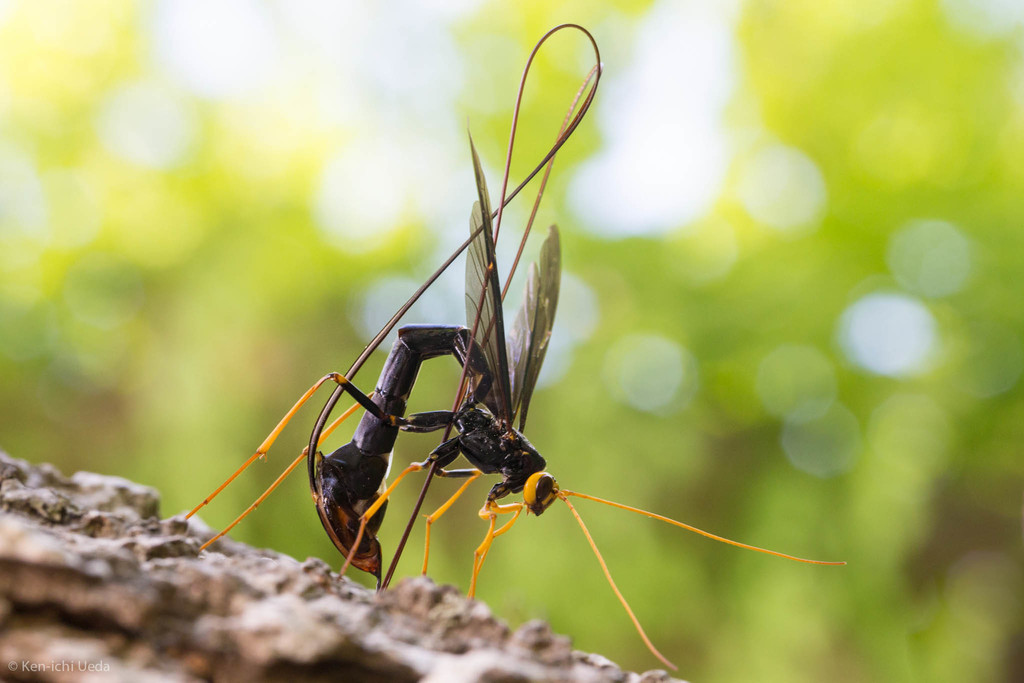
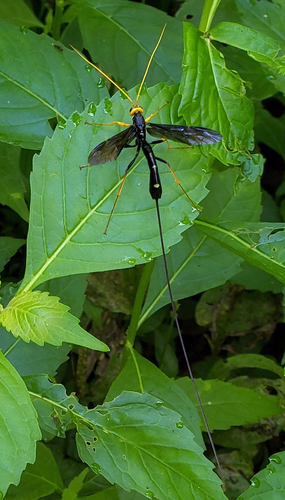
The black giant ichneumonid wasp is a large ichneumon wasp found in parts of North America from Quebec down to Florida. Females drill into dead deciduous wood to lay eggs, and their larvae parasitize woodwasp larvae inside the wood. Adults are active from May through July.
Source: Wikipedia
How to recognize it
Megarhyssa atrata is the scientific name for the black giant ichneumonid wasp.
Source: Wikipedia
Where it lives
It lives in North America, ranging from Quebec and Michigan to the Carolinas and Florida.
Source: Wikipedia
What it eats
The larvae feed on the larvae of the woodwasp Tremex columba found in dead deciduous trees.
Source: Wikipedia
Life cycle
Female wasps bore into wood with their long ovipositor, releasing a substance that softens the wood for egg laying.
Source: Wikipedia
When you see it
Adults are on the wing from May to July.
Source: Wikipedia
Where it comes from
Its native range covers the same North American region from Quebec to Florida.
Source: Wikipedia
Where it is found in the US
Recorded in 44 of 51 states and DC. Most records: Michigan, Minnesota, Illinois, New York, Wisconsin, Massachusetts, Pennsylvania, Ohio.
Darker = more records. Counts are museum and citizen-science records, not population size.
Source: GBIF
Status: native in North America; native in United States. Source: iNaturalist
Months it is reported in the US
Source: GBIF
More photos
Questions people ask
When can I see adult black giant ichneumonid wasps?
Adults are active from May through July.
Source: Wikipedia
Where is this wasp found in the United States?
It occurs from Michigan and Ohio down through the Carolinas to Florida.
Source: Wikipedia
Same family (Ichneumonidae)



Sources
- Wikipedia: https://en.wikipedia.org/wiki/Megarhyssa_atrata
Look it up elsewhere: GBIF · iNaturalist · BugGuide · Wikipedia
Text written 2026-10-23 from the sources above and checked sentence by sentence against them. Data fetched 2026-10-22.