 Bug FAQ
Glabridorsum stokesii
Glabridorsum stokesii · Order: Hymenoptera · Family: Ichneumonidae
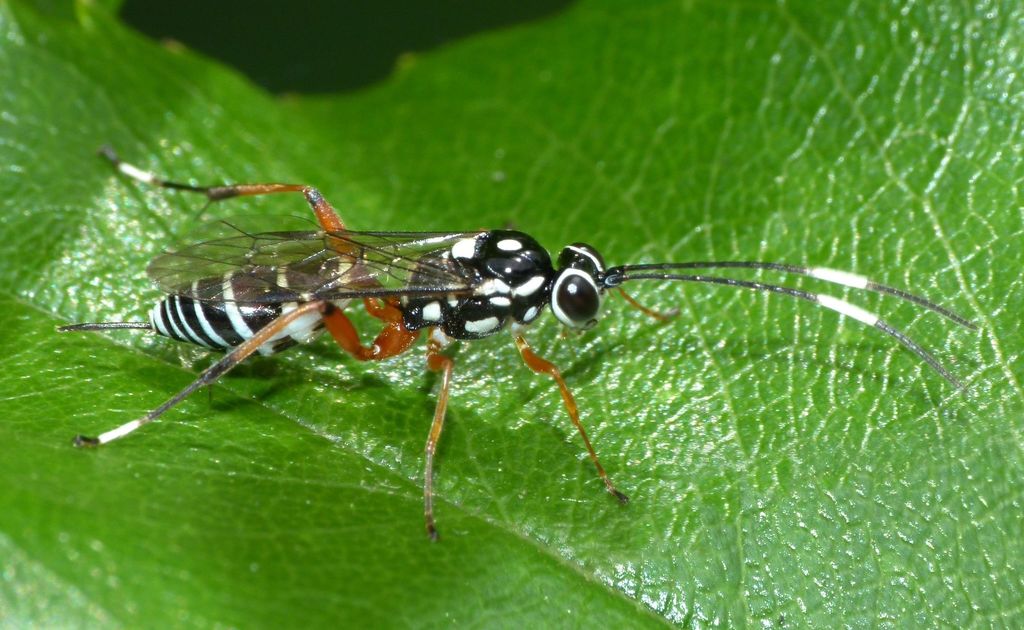
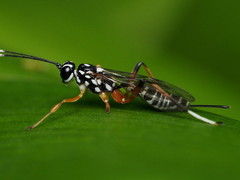
Adult females are about seven millimetres long (roughly a quarter of an inch). In New Zealand it can be told apart by a solid white ring around the eyes and white segments on antennae joints eight to fourteen. It is a generalist parasite that attacks codling moth and oriental fruit moth larvae.
Source: Wikipedia
How to recognize it
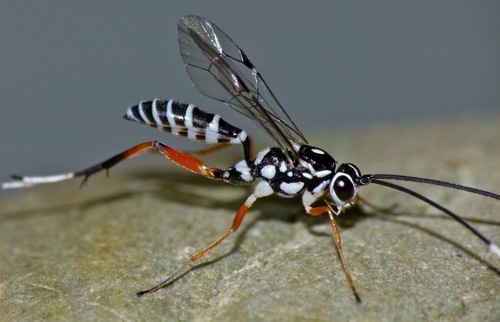
A continuous white band circles the eyes, unlike the broken band of a similar species. Antenna segments eight through fourteen are white.
Source: Wikipedia
Size
Females measure about seven millimetres in length.
Source: Wikipedia
Where it lives
It lives as a parasite on codling moth and Grapholita molesta (oriental fruit moth).
Source: Wikipedia
What it eats
It parasitises larvae of codling moth and oriental fruit moth.
Source: Wikipedia
Life cycle
The holotype female was collected in Glen Innes, NSW in January and laid eggs inside weevil larvae.
Source: Wikipedia
Where it comes from
The species originates from southeastern Australia.
Source: Wikipedia
Lookalikes
In New Zealand it differs from Xanthocryptus novozealandicus by having a complete white eye band, whereas the latter’s band is broken.
Source: Wikipedia
More photos
Questions people ask
How can I identify Glabridorsum stokesii?
Look for a solid white ring around the eyes and white antenna segments eight to fourteen.
Source: Wikipedia
What does Glabridorsum stokesii feed on?
It parasitises the larvae of codling moth and oriental fruit moth.
Source: Wikipedia
Where is Glabridorsum stokesii originally from?
It is native to southeastern Australia.
Source: Wikipedia
Same family (Ichneumonidae)



Sources
- Wikipedia: https://en.wikipedia.org/wiki/Glabridorsum_stokesii
Look it up elsewhere: GBIF · iNaturalist · BugGuide · Wikipedia
Text written 2026-10-23 from the sources above and checked sentence by sentence against them. Data fetched 2026-10-23.