 Bug FAQ
Tityus stigmurus
Tityus stigmurus · Order: Scorpiones · Family: Buthidae
Source: Wikipedia
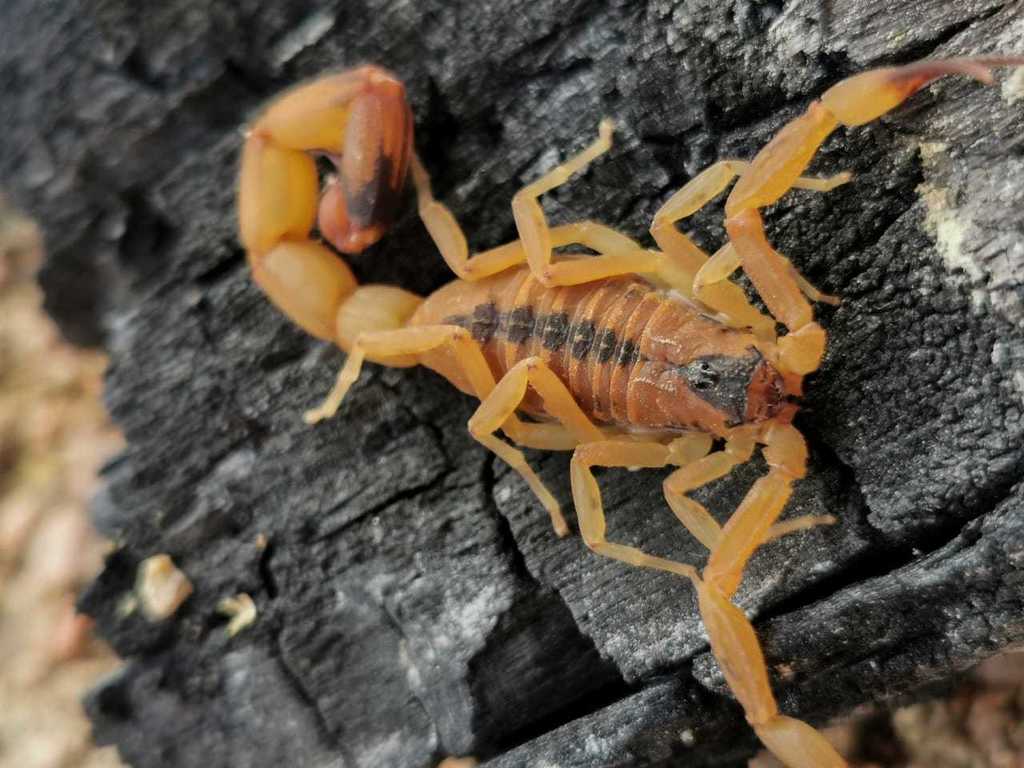
Tityus stigmurus is a 4.5 to 6 cm scorpion with a dark stripe on its middle body and yellow-orange front claws. It lives mainly in Brazil’s northeastern Caatinga region but has also been reported in several other Brazilian states. In captivity it eats cockroaches and crickets, reaches adulthood in about a year, and can reproduce without males. The scorpion’s venom contains neurotoxins Tst1 and Tst26, so it should not be handled.
Source: Wikipedia
How to recognize it
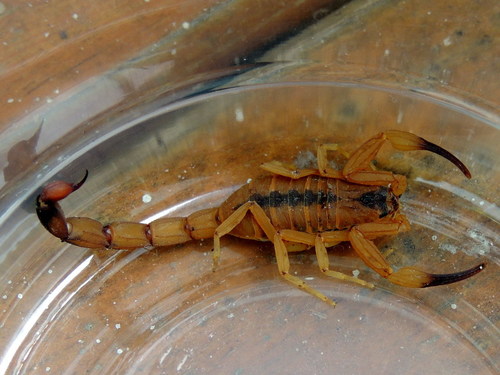
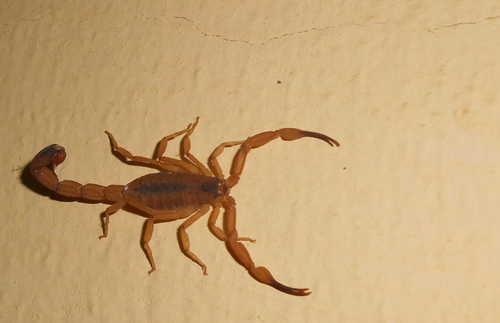
It has a dark stripe across the mesosoma and yellowish or orange pedipalps.
Source: Wikipedia
Size
Adults measure about 4.5 to 6 cm (1.8 to 2.4 in) long.
Source: Wikipedia
Does it bite or sting?
The scorpion is venomous and can sting if disturbed.
Source: Wikipedia
Where it lives
The species is most common in the Caatinga region of northeastern Brazil. It has also been found in several other Brazilian states.
Source: Wikipedia
What it eats
In captivity it is fed cockroaches such as Shelfordella lateralis and crickets.
Source: Wikipedia
Life cycle
It matures to an adult in about one year, making it a fast-growing species. The scorpion can reproduce without a male (facultative parthenogenesis).
Source: Wikipedia
Where it comes from
Tityus stigmurus is native to Brazil.
Source: Wikipedia
More photos
Questions people ask
Can Tityus stigmurus bite or sting people?
Yes, it can sting and its venom includes neurotoxins, so it should not be handled.
Source: Wikipedia
Where is this scorpion found?
It lives mainly in Brazil’s northeastern Caatinga region and also in other Brazilian states.
Source: Wikipedia
What does it eat in captivity?
It is fed cockroaches (like Shelfordella lateralis) and crickets.
Source: Wikipedia
Same family (Buthidae)


Sources
- Wikipedia: https://en.wikipedia.org/wiki/Tityus_stigmurus
Look it up elsewhere: GBIF · iNaturalist · BugGuide · Wikipedia
Text written 2026-10-23 from the sources above and checked sentence by sentence against them. Data fetched 2026-10-23.