 Bug FAQ
Brazilian Yellow Scorpion
Tityus serrulatus · Order: Scorpiones · Family: Buthidae
Source: Wikipedia
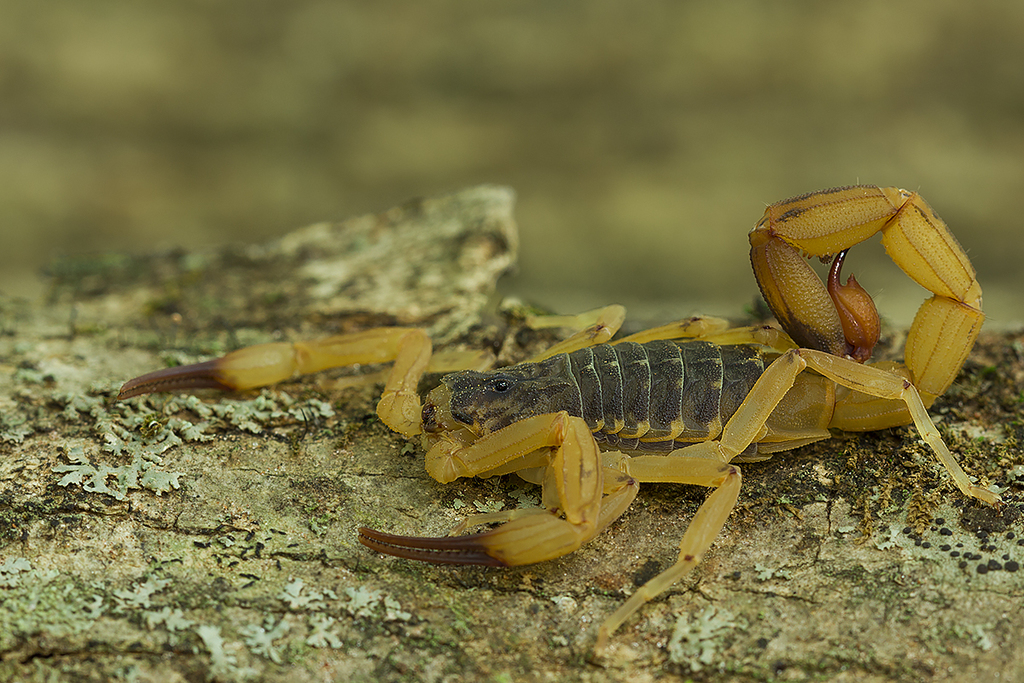
Adults are 5 to 7 cm long and have pale-yellow legs and pedipalps with a darker yellow-brown trunk and tail tip. They live in urban sewers, trash heaps and homes across Brazil, especially where deforestation and city growth increase their numbers. Most stings happen in warm, rainy months in the south and southeast, while the north, northeast and centre-west see stings year-round.
Source: Wikipedia
How to recognize it
The scorpion’s legs and pedipalps are pale-yellow, while the body and tail tip are a darker yellow-brown. Its tail is bulbous, curved forward over the back, segmented with ridges and serrations.
Source: Wikipedia
Size
Adults measure about 5 to 7 cm (2 to 3 in) in length.
Source: Wikipedia
Is it a pest in the house?
Because it eats household insects, it is increasingly common in homes as urbanization expands.
Source: Wikipedia
Does it bite or sting?
Scorpions cause the highest number of human envenomations among venomous animals in Brazil.
Source: Wikipedia
Where it lives
It feeds on insects like cockroaches and thrives in sewers, trash heaps and other urban debris.
Source: Wikipedia
What it eats
Its diet consists mainly of insects such as cockroaches, and it can survive months without food due to a low metabolic rate.
Source: Wikipedia
Life cycle
The Brazilian yellow scorpion reproduces mainly by parthenogenesis.
Source: Wikipedia
When you see it
Stings are most frequent during warm, rainy months in the south and southeast, but occur year-round in other regions.
Source: Wikipedia
Where it comes from
The species is endemic to Brazil and found throughout the country.
Source: Wikipedia
Where it is found in the US
Recorded in 1 of 51 states and DC. Most records: Texas.
Darker = more records. Counts are museum and citizen-science records, not population size.
Source: GBIF
More photos
Questions people ask
When are stings from this scorpion most common?
Stings peak in the warm, rainy months in Brazil’s south and southeast, while the north, northeast and centre-west see little seasonal change.
Source: Wikipedia
What does the Brazilian yellow scorpion look like?
It is 5 to 7 cm long, with pale-yellow legs and pedipalps, a darker yellow-brown body, and a bulbous, forward-curved tail with ridges.
Source: Wikipedia
Same family (Buthidae)
 Striped Bark ScorpionCentruroides vittatusCan sting
 Arizona Bark ScorpionCentruroides sculpturatusVenomous
 Slender Brown ScorpionCentruroides gracilisVenomous
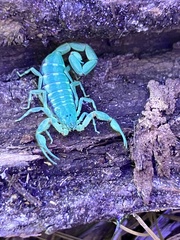 Hentz Striped ScorpionCentruroides hentziCan sting
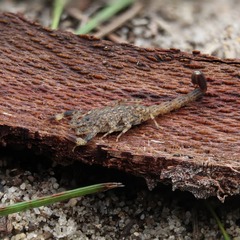 Little Marbled ScorpionLychas marmoreus
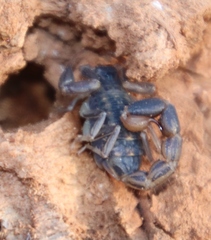 Striped Lesser-Thicktail ScorpionUroplectes lineatusCan sting
Sources
- Wikipedia: https://en.wikipedia.org/wiki/Tityus_serrulatus
Look it up elsewhere: GBIF · iNaturalist · BugGuide · Wikipedia
Text written 2026-10-23 from the sources above and checked sentence by sentence against them. Data fetched 2026-10-23.